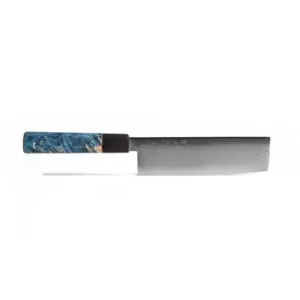
A good Japanese knife is not where a sensible kitchen starts. The knife you already own will cut better tomorrow with a stone, last longer on the right board and stay sharp in the right place. So this guide is in the order we would buy things ourselves: the stone, the board, somewhere to keep it, and then the knife.
We have left prices out on purpose. They change with your currency, and every product page shows today’s price where you are.
1. Before the knife: a stone
Pull-through and electric sharpeners take too much steel from a hard blade and set the wrong angle. A water stone takes only what it needs, and twenty minutes is enough to learn the basics.
If your knives are very dull: King #800
The King #800 is a single medium-grit stone. It brings back an edge that has been neglected for months, before you move on to a finer stone.
Your first stone: King KW-65 1000/6000
One block, two grits. The 1000 restores the edge and the 6000 polishes it. The King KW-65 is the stone most home kitchens need, and the one we recommend first. Our guide to choosing a whetstone grit explains the numbers.
A step up: King HT-65 PRO 1000/6000
The HT-65 PRO is exclusive to Oishya: two separate stones, the HT-65 #1000 and the S-1 #6000, for cooks who sharpen often.
For a mirror finish: King Gold G-1 #8000
If you already own a 1000/6000, the King Gold G-1 takes the edge to a polish. It comes with a Nagura stone for preparing the surface.
2. Something kind to cut on
Glass, marble, stone and hard bamboo are harder than the blade and dull it quickly. Wood gives a little under the edge, so it stays sharp for longer between stones. More on this in our guide to cutting board woods.
Light and easy: Aomori Hiba
The Aomori Hiba board comes from a maker in Japan. Hiba is pale, light enough to carry to the sink, soft under the blade and naturally resistant to bacteria.
Heavy and steady: walnut
Our American Walnut Premium board is made by hand in Poland in three sizes, 3.5 to 4 cm thick. It stays where you put it. The European Walnut board is the same idea in a darker wood.
3. Somewhere safe to keep it
A drawer is where edges chip. A magnetic rack or stand keeps each blade apart, dry and in sight. Both are made by hand in Poland, in oak or walnut. If you are not sure which suits your kitchen, read drawer, stand or magnetic rack.
On the wall: a magnetic rack
The wall rack comes in 50 or 70 cm, with steel, brass or copper ends. The 50 cm holds up to six knives, the 70 cm eight or nine. For ideas on where to put it, see ten places to hang a magnetic rack.
On the counter: a magnetic stand
The magnetic stand holds up to six knives, with no slots for the edge to rub against. It is the answer if you cannot drill, or you rent.
4. Your first Japanese knife
This is where most of the budget goes, and it is worth it. Every Oishya knife is forged in Sakai or Seki, has a stabilised maple burl handle made and fitted in Poland, and comes with lifetime sharpening and 100-day returns.
Where most people start: KATA
KATA is VG10 steel in three layers, hammered, at HRC 60 to 62. The KATA Santoku is compact, easy to control and the most forgiving shape to learn on. If you already have a chef’s knife, the KATA Petty is the small knife for everything a large one makes awkward.
Hammered Damascus from Sakai: KYU
KYU folds an AUS10 core into 46 layers of hammered Damascus at HRC 62. The KYU Santoku is an all-rounder for meat, fish and vegetables, and the KYU Nakiri is the one for vegetable-forward cooks. The KYU Petty pairs with either.
Damascus from Seki: RYU
RYU is VG10 in 33 layers of Damascus at HRC 62. The RYU Santoku is an all-rounder, the RYU Nakiri shows the pattern best on its wide, flat blade, and the RYU Petty completes the pair.
Not sure which shape or line? Our knife quiz suggests one from a few questions about how you cook.
5. The knife people forget: bread
A serrated edge does something a straight one cannot. The PAN bread knife is 23.5 cm of carbon-rich 1K6 steel at HRC 59 to 60, made in Seki, and it saves your chef’s knife from crusts.
Our order of priority
- A stone. The King KW-65 improves every knife you already own.
- A wooden board. Hiba if you want light, walnut if you want steady.
- Somewhere to keep it. A rack on the wall or a stand on the counter.
- Your first Japanese knife. The KATA Santoku is where most people start.
- A second knife. A Petty for small jobs, or a Nakiri if you cook mostly vegetables.
Handcrafted Japanese Knives by Oishya
Forged by master craftsmen in Seki and Sakai, Japan. Free worldwide shipping over £270 • 100-day money-back guarantee • Lifetime warranty