
Home / Japanese knives / RYU
Seki Kyuba · Knife line
RYU
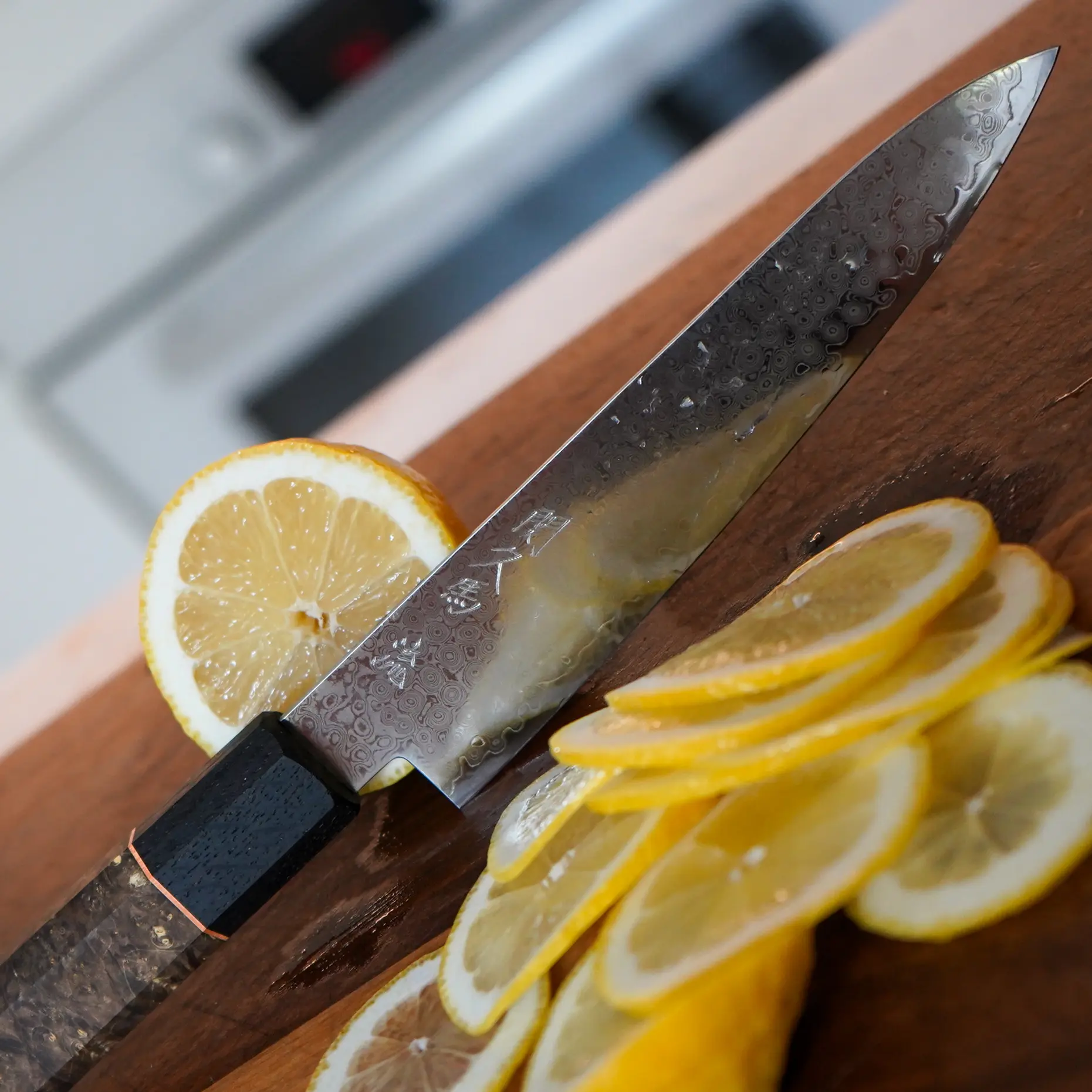
A VG10 core in a 33-layer Damascus blade, with our stabilised maple burl handle. Forged in Seki, with five knives and two matched sets. The line for someone who wants the full Damascus pattern without the step up to powder steel: the steel of KATA, dressed in 33 layers.
Five knives, two sets
Choose your RYU.
Same steel and the same handle across the line. The difference is the shape, and what it does best.
…
Side by side
The two sets
Each set pairs a main knife with the Nakiri and the Petty. Choose the one whose main knife suits how you cook.
The blade · Forged in Seki, Japan
Thirty-three layers around a VG10 core.
A VG10 cutting core wrapped in 33 folded layers of steel. The wave on the blade is the trace of the folding, and no two blades carry quite the same pattern.
In a matched set, the three blades come from the same hands and the same standard. Each blade carries the line name, engraved by hand.
The handle
Made in Poland, for a Japanese blade.
Every Oishya knife shares the same handle. The body is stabilised maple burl, waterproof and premium-cut, so every handle carries its own grain. The ferrule (kakumaki) is bog oak around 2,500 years old, joined to the burl by a hand-fitted copper ring.
The profile is octagonal and symmetrical, so it sits firmly in either a left or a right hand.

The hands that make it
Seki. Nearly eight hundred years of blade-making.
Seki, in Gifu, has forged blades since the thirteenth century, first swords, then kitchen knives. The workshop we work with there forges five of our six lines.
Meet our craftsmenSpecifications
What’s inside every RYU knife.
Blade
| Cutting core | VG10 stainless |
|---|---|
| Construction | 33-layer Damascus |
| Hardness | HRC 60–61 |
| Bevel | Double, for either hand |
| Forged in | Seki, Japan |
Handle
| Body | Stabilised maple burl, waterproof |
|---|---|
| Ferrule (kakumaki) | Bog oak, around 2,500 years old |
| Ring | Hand-fitted copper |
| Profile | Octagonal, for left or right hand |
| Made and mounted in | Poland |
| Colours | Mediterranean Blue, Natural Brown, Olive Green |
Care. Hand wash and dry straight away. Use a wooden cutting board. Sharpen on a 1000/6000 whetstone three or four times a year. The full method is in Knife School.
The six lines
How RYU compares.
Every line shares the same handle. What changes is the steel, the layers and the finish.
| Line | Steel | Layers | Hardness | Finish | Price | |
|---|---|---|---|---|---|---|
 Sakai Kyuba KYU | AUS10 | 46 | HRC 62 | Hammered Damascus | View KYU | |
 Seki Kyuba KATA | VG10 | 3 | HRC 62 | Hammered | View KATA | |
 Seki Kyuba RYUThis line | VG10 | 33 | HRC 60–61 | Damascus | ||
 Seki Kyuba NIJI | 12Cr18MoV | 37, with brass and copper | HRC 60–61 | Shot-blasted rainbow Damascus | View NIJI | |
 Seki Kyuba SHIN | SG2 (R2) | 31 | HRC 62–63 | Damascus | View SHIN | |
 Seki Kyuba PAN | 1K6 | Single steel | HRC 56–57 | Serrated bread knife | View PAN |
Questions
About RYU.
How is RYU different from KATA?
Both have a VG10 core. KATA is three-layer with a hammered face, at HRC 62. RYU, at HRC 60–61, wraps the same core in 33 folded layers that show as a Damascus wave, and it also comes as a Gyuto 21cm and a Bunka 21cm.
Is the Damascus pattern just decoration?
Mostly, and we would rather say so. The 33 layers protect the core and carry the pattern, but the VG10 core does the cutting. Choose RYU because you like how it looks. The cutting steel is the same as on KATA.
Which RYU knife should I start with?
For one knife that does most things, the Gyuto 21cm or the Santoku 18cm. The Bunka 21cm adds a pointed tip for detail work. The Nakiri 17.5cm is for vegetable-heavy cooking, and the Petty 15cm for small, precise jobs.
Is RYU a good gift?
It is the line people choose most often as a gift. Every knife comes in a wooden box with a certificate of authenticity and a five-yen coin. Tick "this is a gift" at checkout and no prices go in the parcel.
How do I keep a RYU knife sharp?
Hand wash and dry it straight away, keep it to wooden boards, and sharpen on a 1000/6000 whetstone three or four times a year. VG10 is one of the easiest steels to bring back. Lifetime sharpening is included too: send it to us, and you cover the shipping both ways.
Still deciding?
Answer a few questions and we’ll suggest a knife and a line.