
Home / Japanese knives / Compare lines
Compare our six lines
Six lines. One handle, one box, one guarantee.
Every Oishya knife has the same handle, ships in the same wooden box and carries the same lifetime guarantee. What changes from line to line is the steel, the number of layers, the finish and the shapes on offer. This page puts those differences side by side.
Start here
What are you looking for?
Pick what matters most and we’ll point out the lines that fit.
 Seki KyubaKATA
A VG10 core in a three-layer blade with a hammered face. The everyday line, and where most people start.
 Sakai KyubaKYU
Our Sakai line: 46 hammered Damascus layers around an AUS10 core, forged by a master blacksmith whose family has done this work since 1927.
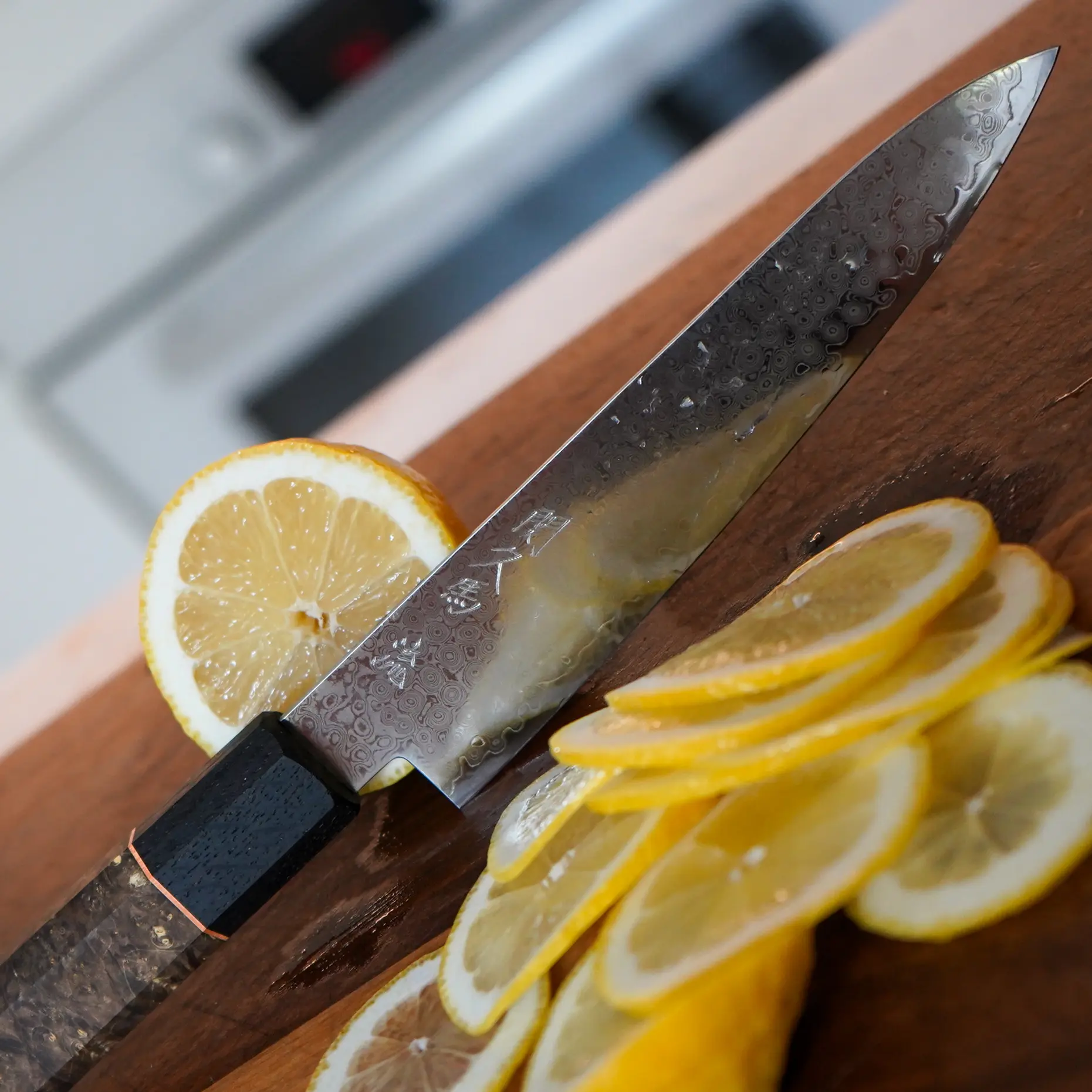
 Seki KyubaRYU
A VG10 core in 33 layers of Damascus. Five shapes and two matched sets, often chosen as a gift.
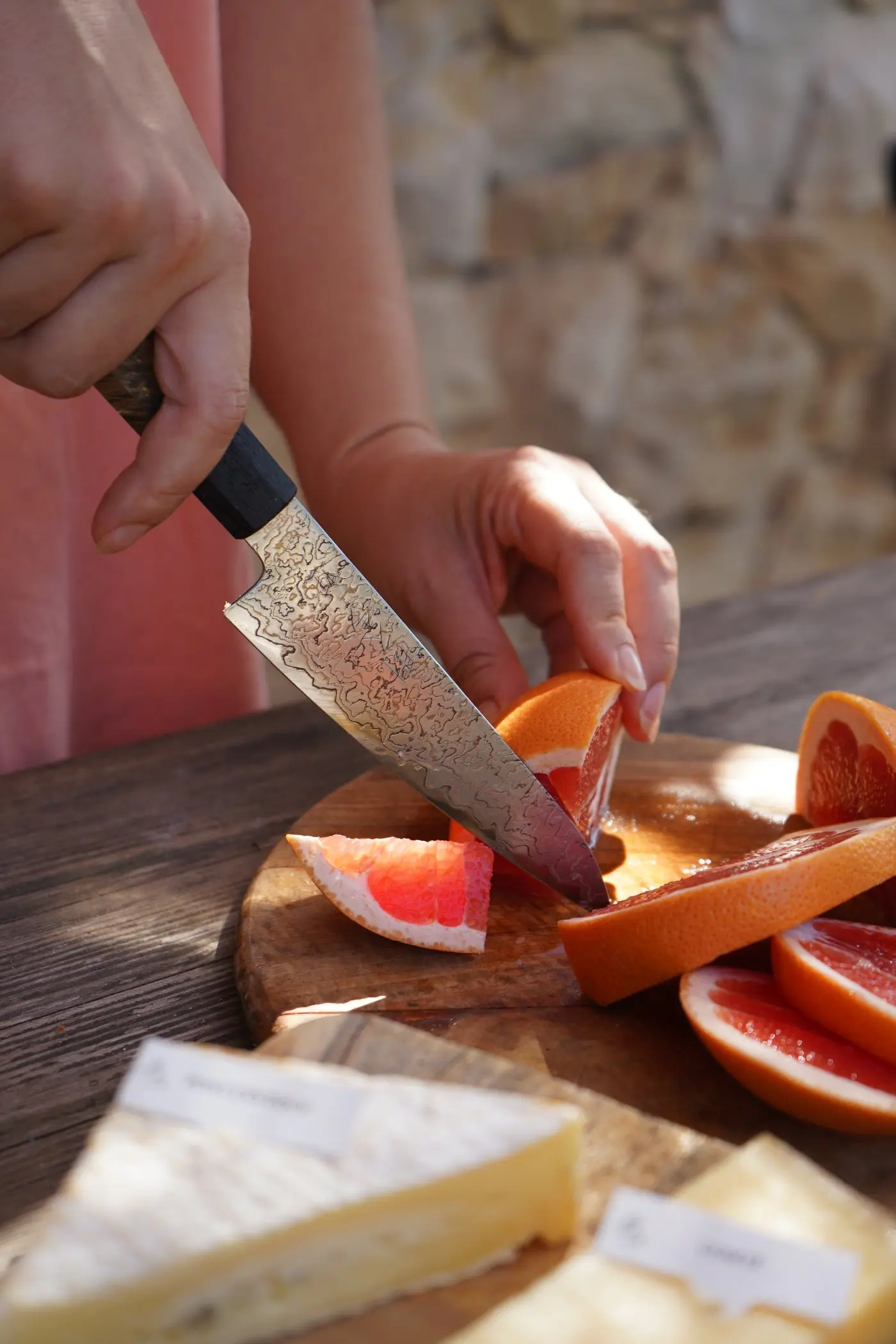
 Seki KyubaNIJI
Rainbow in Japanese. A 12Cr18MoV core in 37 layers of stainless steel, brass and copper, so no two blades look the same.
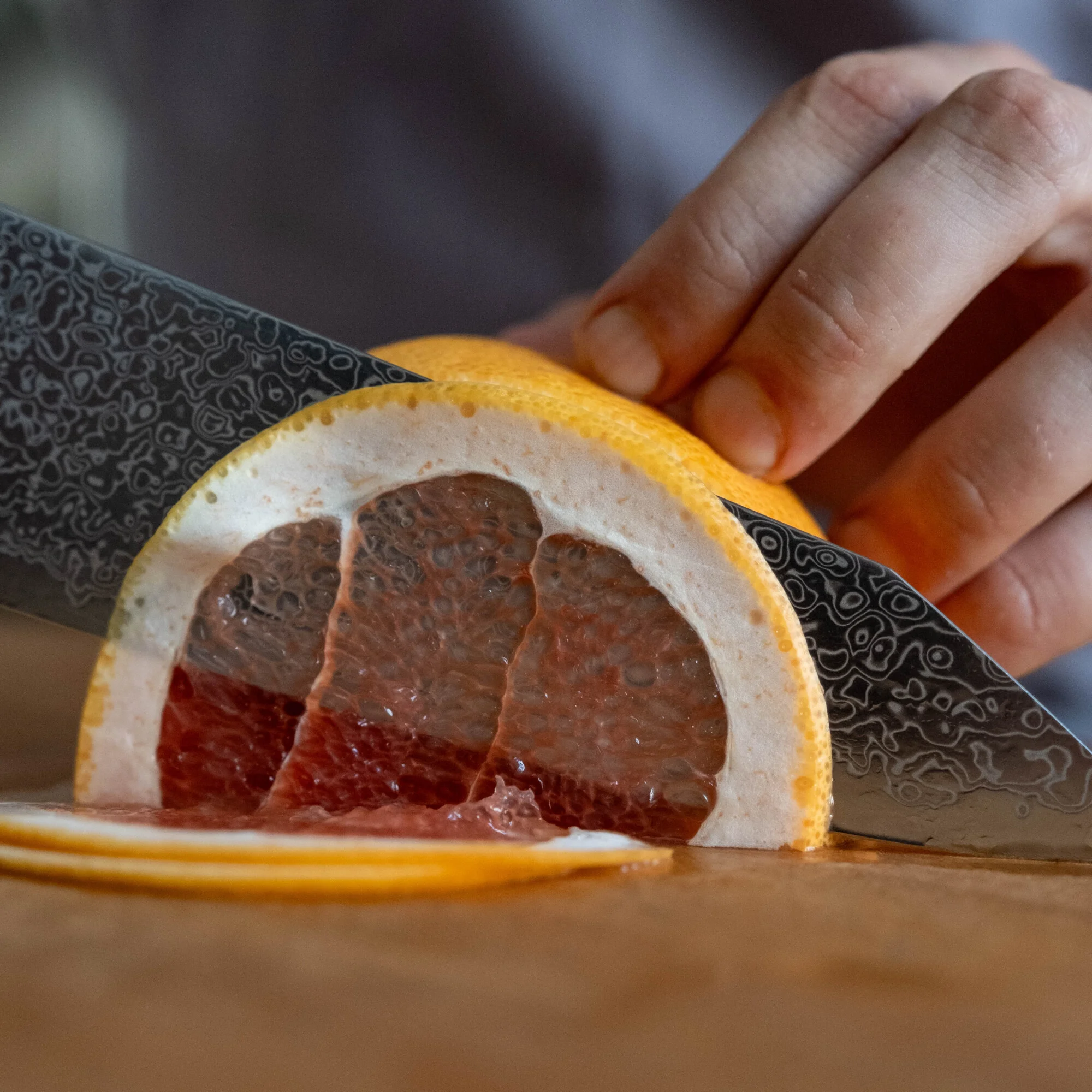
 Seki KyubaSHIN
SG2 (R2) powder steel in 31 layers of Damascus: the hardest steel we work with, and the only line with a Kiritsuke.
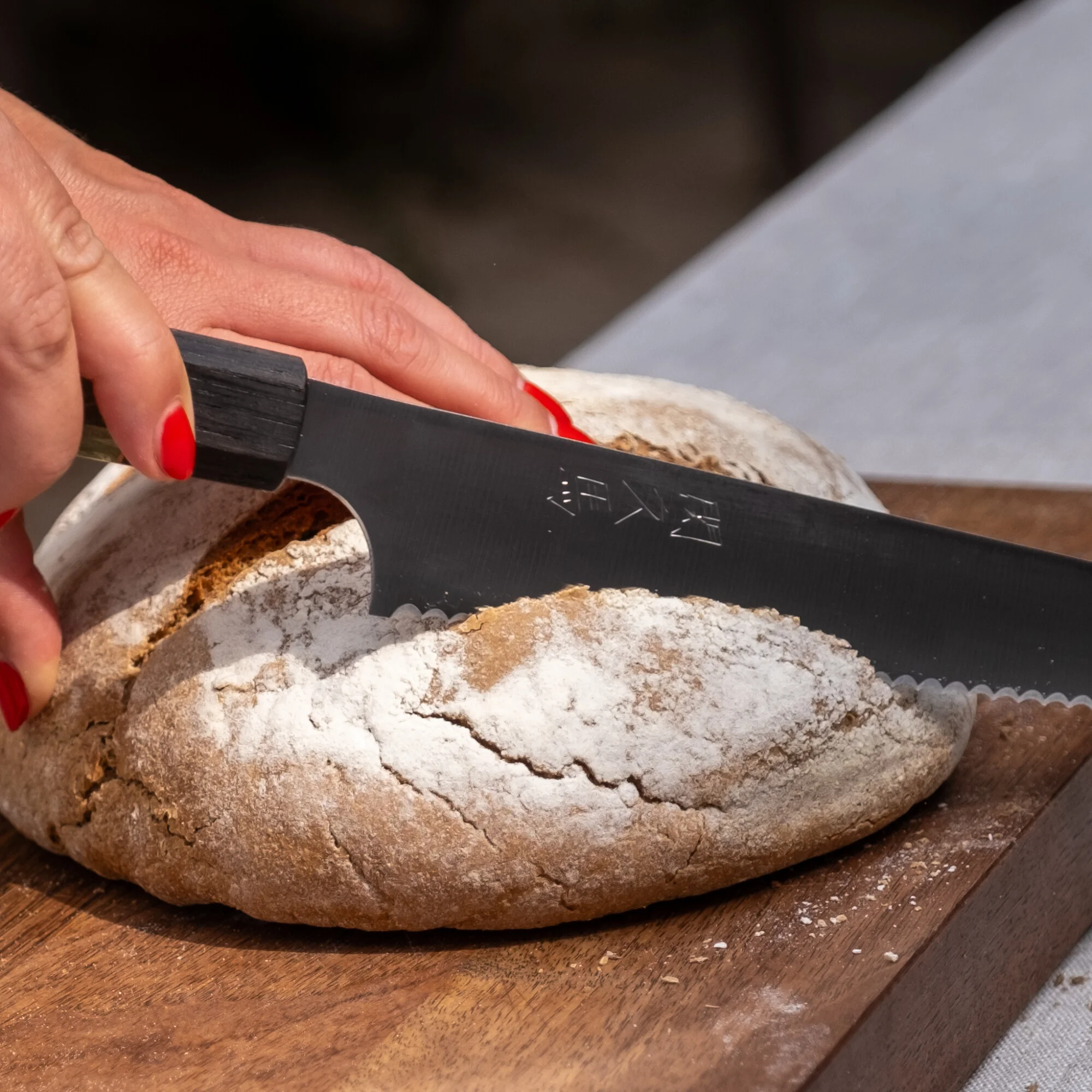
 Seki KyubaPAN
The bread knife: 1K6 carbon-rich steel with a serrated edge set by hand, for crusty loaves and soft brioche alike.
Side by side
The full comparison.
| Seki KyubaKATA | Sakai KyubaKYU | Seki KyubaRYU | Seki KyubaNIJI | Seki KyubaSHIN | Seki KyubaPAN | |
|---|---|---|---|---|---|---|
| Blade | ||||||
| Forged in | Seki, Japan | Sakai, Japan | Seki, Japan | Seki, Japan | Seki, Japan | Seki, Japan |
| Cutting core | VG10 | AUS10 | VG10 | 12Cr18MoV | SG2 / R2 powder steel | 1K6, carbon-rich |
| Construction | 3-layer (san-mai) | 46-layer Damascus | 33-layer Damascus | 37 layers: stainless, brass, copper | 31-layer Damascus | Single steel |
| Hardness | HRC 62 | HRC 62 | HRC 60–61 | HRC 60–61 | HRC 62–63 | HRC 56–57 |
| Finish | Hammered (tsuchime) | Hammered Damascus | Damascus | Shot-blasted rainbow Damascus | Damascus | Serrated edge |
| Range | ||||||
| Shapes | Bunka, Santoku, Nakiri, Petty | Gyuto, Santoku, Nakiri, Petty | Gyuto, Bunka, Santoku, Nakiri, Petty | Gyuto, Bunka, Santoku, Nakiri, Petty | Gyuto, Kiritsuke, Santoku, Petty | Bread knife |
| Sets | Two: Bunka or Santoku, with Nakiri and Petty | Two: Gyuto or Santoku, with Nakiri and Petty | Two: Gyuto or Santoku, with Nakiri and Petty | None | None | None |
| Single knife | ||||||
| Set | None | None | None | |||
| View KATA | View KYU | View RYU | View NIJI | View SHIN | View PAN | |
Shapes
Which knives each line comes in.
Blade lengths in centimetres. Sets pair a main knife with a Nakiri and a Petty.
| KATA | KYU | RYU | NIJI | SHIN | PAN | |
|---|---|---|---|---|---|---|
| Gyuto | – | 21 | 21 | 20 | 21 / 24 | – |
| Kiritsuke | – | – | – | – | 21 / 24 | – |
| Bunka | 18 | – | 21 | 20 | – | – |
| Santoku | 16.5 | 18 | 18 | 18 | 18 | – |
| Nakiri | 18 | 16 | 17.5 | 18 | – | – |
| Petty | 12 | 15 | 15 | 15 | 15 | – |
| Bread knife | – | – | – | – | – | 23.5 |
| Sets | 2 | 2 | 2 | – | – | – |
Whichever you choose
What every line shares.
Waterproof stabilised maple burl with a bog oak kakumaki around 2,500 years old, joined by a hand-fitted copper ring. Octagonal, for either hand.
Blades are forged in Japan, in Sakai or Seki. Handles are made and mounted in Poland.
Each blade carries its line name in kanji, engraved by the blacksmith.
A wooden box, a certificate of authenticity with our hanko stamp, and a 5 yen coin. Knives arrive sharpened and ready to use.
Every Oishya knife, every line.
Send your knife to us and we sharpen it; you cover the shipping both ways.
Chips and broken tips are repaired in our workshop in Poland.
Time to cook with it before you decide.
Reading the table
Three terms, briefly.
The Rockwell C scale. A higher number means harder steel that takes a finer edge and holds it longer, and that asks for a little more care: wooden boards, no twisting through bone.
Most of our blades fold softer stainless around a harder cutting core. The layers protect the core and, on Damascus blades, form the visible pattern.
Hammered (tsuchime) leaves small hollows that help food release from the blade. Damascus shows the folded layers. NIJI adds brass and copper to the fold.
Questions
Choosing a line.
Which line should I choose?
Most home cooks start with KATA. For a full Damascus all-rounder, RYU. For a knife forged in Sakai, KYU. For looks, NIJI. For the longest-lasting edge, SHIN. For bread, PAN. The knife quiz narrows it down in a couple of minutes.
If the handle is the same, what actually changes between lines?
The steel, the number of layers, the finish and the shapes on offer. Every line shares the same stabilised maple burl handle, the same wooden box and the same lifetime guarantee.
Which lines come as sets?
KATA, KYU and RYU, with two sets each. Every set pairs a main knife with a Nakiri and a Petty from the same line. NIJI, SHIN and PAN are sold as single knives.
Is a higher HRC always better?
Not always. Harder steel takes a finer edge and holds it longer, but it asks for a little more care: wooden boards, and no twisting through bone. Between 60 and 62, where KATA, RYU and KYU sit, is the everyday sweet spot.
Can I mix knives from different lines?
Yes, and many people do. A common mix is a KATA Bunka or a RYU Gyuto as the everyday knife with a SHIN Petty for precision. The handles match, so a mixed collection still looks like a set.
Still deciding?
Answer a few questions and we’ll suggest a knife and a line.