Last updated: April 2026
If you are new to Japanese knives, buying a set is the smartest way to build your collection. You get complementary blade styles that cover every kitchen task, matched handles and aesthetics, and better value than buying individually. But which set is right for a beginner? We break down everything you need to know.
Why start with a set rather than a single knife?
A single great knife can do a lot, but there are limits. A gyuto struggles with delicate peeling. A petty cannot break down a butternut squash. A set gives you the right tool for every situation from day one, so you develop good habits instead of forcing one blade to do everything.
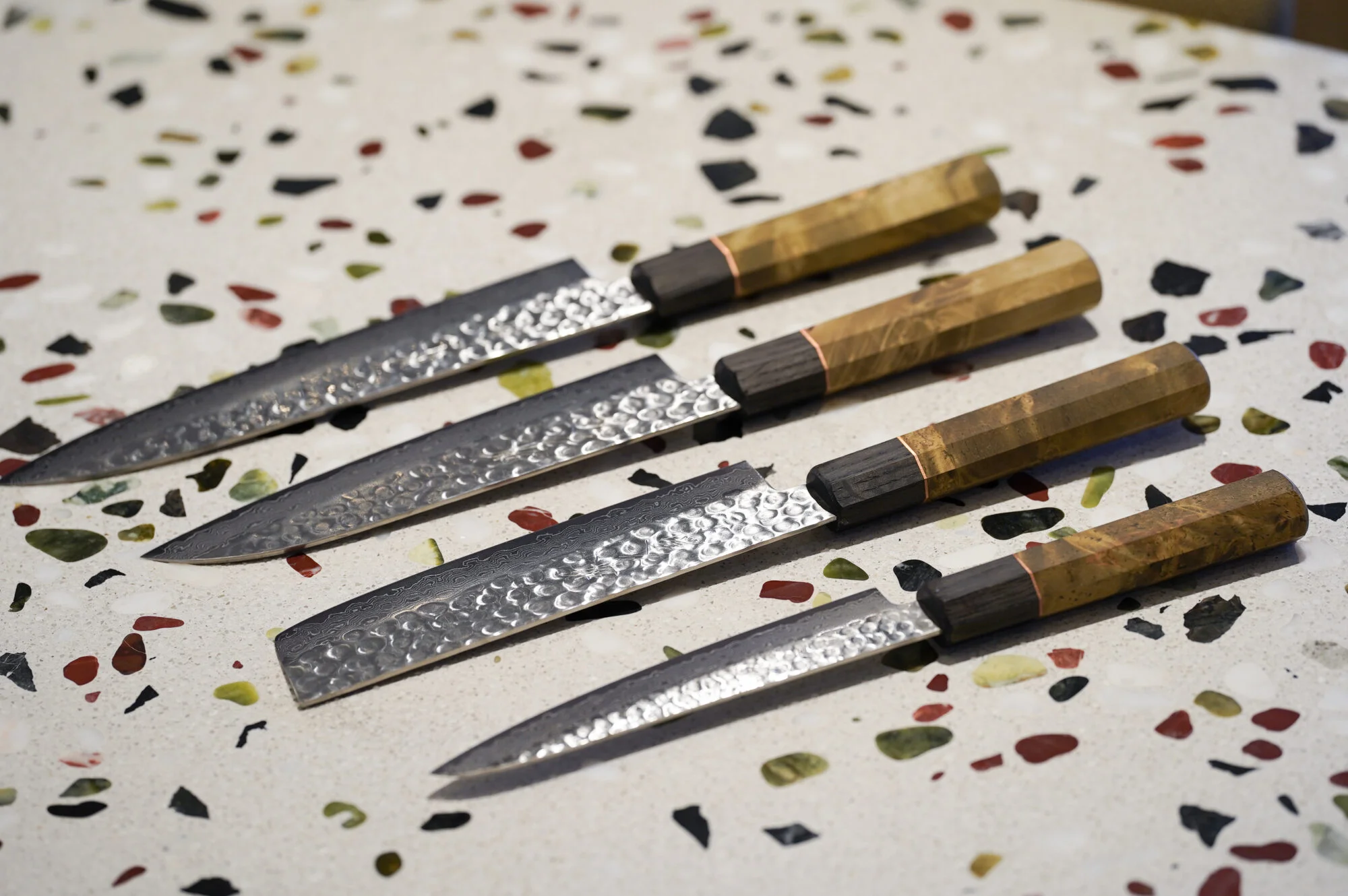
The classic Japanese knife trio — chef knife, vegetable knife, and paring knife — covers 95% of what a home cook needs. This is why all our sets follow this proven combination.
What to look for in a beginner set
Steel quality
As a beginner, you want steel that performs well but forgives small mistakes. VG10 stainless steel is the ideal starting point: it takes a razor edge, holds it well, and resists corrosion if you forget to dry it immediately. Avoid carbon steel for your first set — it stains, rusts, and demands constant attention.
Handle comfort
Japanese knives come with either traditional wa handles (round or octagonal wood) or Western-style handles. Both work beautifully. What matters most is that the handle feels balanced in your hand. All our knives use premium hardwoods — walnut, ebony, or magnolia — shaped for comfortable extended use.
Blade sizes
For beginners, a 18-19cm chef knife (santoku or gyuto), a 16-18cm nakiri, and a 12-15cm petty is the ideal combination. This gives you range without the bulk of professional-length blades.
Our top knife sets for beginners
Best overall starter set: Sakai Kyuba KYU Set (Santoku, Nakiri, Petty)
The Sakai Kyuba KYU Set (€690) is our most popular set and the one we recommend most often to first-time buyers. Here is why:
- Santoku 19cm — rated 5.0 stars, the all-purpose blade you will reach for daily
- Nakiri 16cm — rated 5.0 stars, makes vegetable prep effortless
- Petty 15cm — for peeling, trimming, and detail work
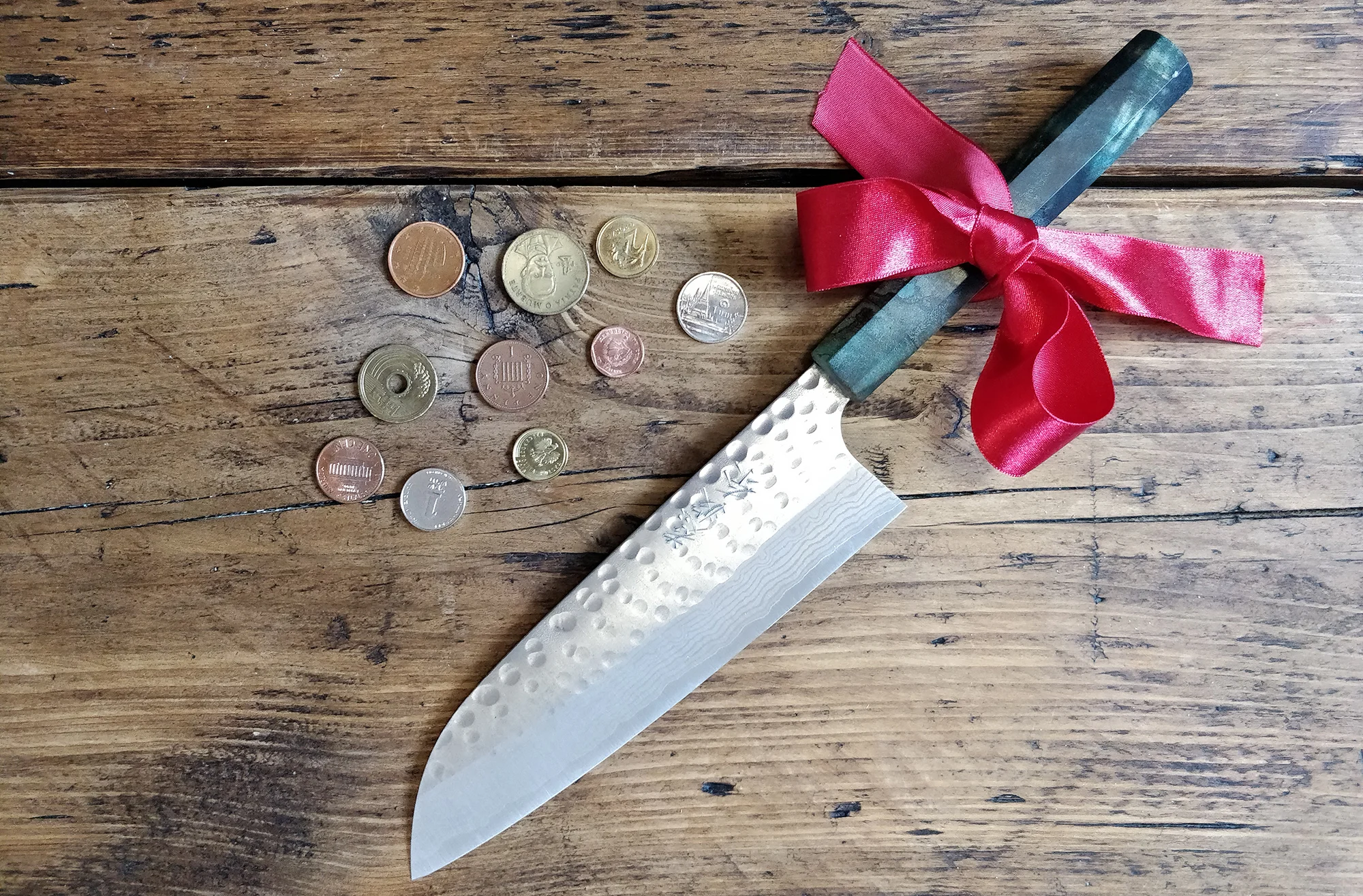
The KYU line is forged in Sakai, Japan — the historical centre of Japanese blade-making since the 14th century. The Damascus pattern is not just decorative: the layered construction creates a blade that cuts cleanly and releases food easily. At €690, you save compared to buying each knife individually (€800 separately).
With 8 reviews averaging 4.9 stars, customers consistently praise the balance, sharpness, and beauty of this set.
Best modern design: Seki Kyuba KATA Set (Santoku, Nakiri, Petty)
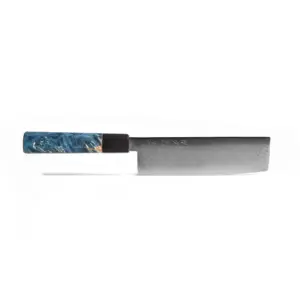
The Seki Kyuba KATA Set (€720) is forged in Seki — Japan’s other legendary knife city. The KATA line features a cleaner, more contemporary aesthetic with a striking blue handle and VG10 three-layer construction.
- Santoku 16.5cm — slightly shorter, ideal for compact kitchens
- Nakiri 18cm — full-size vegetable knife
- Petty 12cm — compact and nimble for precision work
Both sets are rated 5.0 stars. Choose the KATA if you prefer modern aesthetics and a shorter chef knife, or the KYU if you want the traditional Damascus look and a slightly longer santoku.
For the ambitious beginner: Seki Kyuba RYU Set (Santoku, Nakiri, Petty)
If your budget allows, the Seki Kyuba RYU Set (€740) steps up to full Damascus construction with elegant walnut handles. The RYU represents the best of both worlds — Seki precision with the visual drama of a Damascus blade.
Gyuto vs Santoku: which chef knife for beginners?
This is the question we hear most often. Both are excellent, but they suit different cooking styles:
Choose a santoku set if you: do a lot of vegetable prep, prefer a shorter blade, use an up-and-down chopping motion, or are transitioning from a small Western knife.
Choose a gyuto set if you: cook with a lot of meat and fish, prefer a rocking cut, want maximum versatility, or are used to a larger Western chef knife. Our Sakai Kyuba KYU Gyuto Set (€690) is the gyuto equivalent of our top pick.
Not sure? Read our detailed Santoku vs Gyuto comparison.
What else does a beginner need?
A good set is the foundation, but a few accessories will help you get the most from your knives:
A proper cutting board. Hard surfaces like glass or stone will destroy your edge. Use a quality wooden board — our European Walnut Cutting Board (€95) is kind to blades and beautiful on the counter. For a deep dive, see our guide to the best woods for cutting boards.
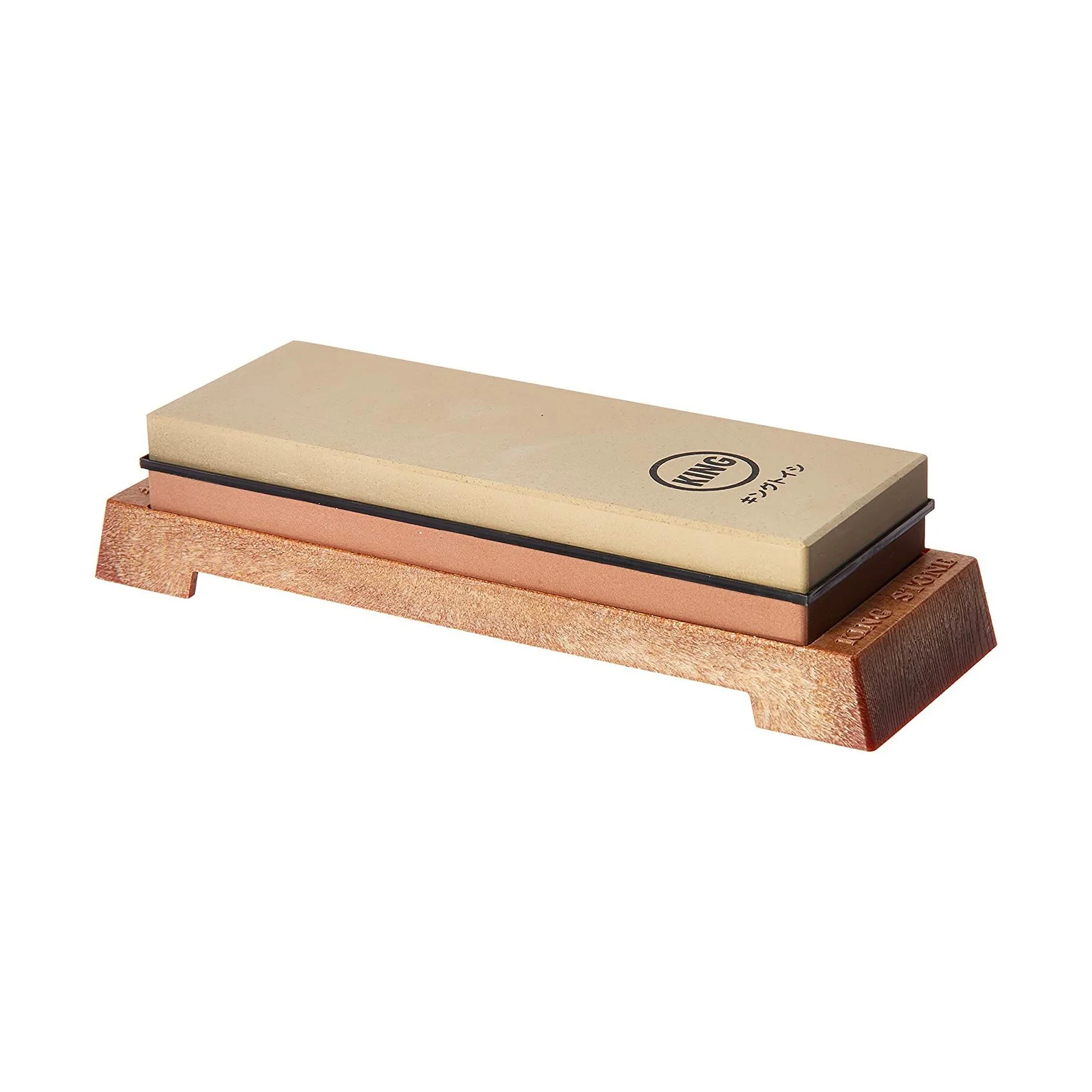
A sharpening stone. Even the best knife dulls over time. The King HT-65 PRO 1000/6000 (€85) is our recommended starter stone — the dual grit handles both sharpening and polishing. Read our whetstone grit guide to learn more.
Safe storage. Never toss Japanese knives in a drawer. A magnetic wall rack (€140) keeps them accessible and protected, or use a magnetic stand (€140) if you prefer counter storage. We compared all options in our knife storage guide.
How to care for your first Japanese knives
Japanese knives are not fragile, but they do ask for a few non-negotiable habits:
- Hand wash only — dishwashers are the number one knife killer
- Dry immediately — even stainless steel benefits from prompt drying
- Use a wooden or plastic cutting board — never glass, stone, or metal
- Cut with technique, not force — let the sharp edge do the work
- Sharpen every 2-3 months — a quick session on a 1000 grit stone keeps the edge pristine
For the complete guide, including sharpening technique and common mistakes, read our Japanese Knife Care & Maintenance guide.
Start your collection
Every serious kitchen starts with the right knives. Browse our full collection or jump straight to our recommended starter set. Every order includes free European shipping, a certificate of authenticity, and a lifetime of better cooking.
Handcrafted Japanese Knives by Oishya
Forged by master craftsmen in Seki and Sakai, Japan. Free shipping worldwide • 100-day money-back guarantee • Lifetime warranty