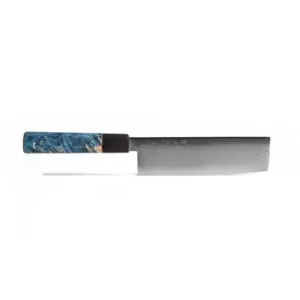
Most British kitchens grew up with a German chef’s knife: heavy, sturdy, with a thick bolster and a blade that could take a knock. Japanese knives arrived later and changed what many home cooks expect a knife to feel like. Neither tradition is wrong. They were designed for different ways of cooking, and the right choice for you depends on how you cut, what you cook and how you look after your tools.
The difference in one paragraph
A German chef’s knife is made from softer, tougher steel, sharpened to a wider angle and built heavier, so it shrugs off rough use and is easy to touch up. A Japanese chef’s knife is made from harder steel, sharpened to a finer angle and built lighter, so it is noticeably sharper, stays sharp for longer and cuts with less effort, but asks for a little more care. Everything else follows from those three things: hardness, angle and weight.
Steel and hardness
Knife steel hardness is measured on the Rockwell C scale, written HRC. German chef’s knives are typically hardened to somewhere around 56 to 58 HRC. Japanese kitchen knives usually sit between 60 and 63. Our own range spans that: KATA, RYU and NIJI at 60 to 61, the Sakai Kyuba KYU at 62, and SHIN at 62 to 63.
A few points on that scale make a real difference. Harder steel can hold a thinner, more acute edge without it folding over, and it keeps that edge for longer. The trade-off is that very hard steel is less forgiving of twisting, prying or hitting bone. Softer German steel bends where Japanese steel might chip. Neither is better in the abstract. It depends on what the knife is asked to do.
Edge angle
German knives have traditionally been sharpened to around 20 degrees on each side, though some modern ones are finer. Japanese knives are usually sharpened at 10 to 15 degrees. That narrower wedge is what makes a Japanese knife feel so sharp: it slips into food with less force, which is why a tomato skin opens under little more than the weight of the blade, and an onion leaves you with fewer tears. The wider German angle is more robust, and better suited to chopping through hard squash rind or the odd joint.
Weight and balance
Pick up both and the difference is immediate. A German chef’s knife is heavier, with much of that weight in the bolster and handle, so you can let it fall through food. A Japanese knife is lighter, with no bolster and a slimmer blade, and the balance sits further forward. You guide it rather than let it drop. Over a long session of prep, many cooks find the lighter knife far less tiring on the wrist. We explain the bolster in more detail in full bolster, half bolster or none.
Shape and how you cut
A German chef’s knife has a pronounced curve along its edge, designed for a rocking motion where the tip stays on the board. Japanese chef’s knives tend to be flatter. A Gyuto has a gentle curve that still rocks, while a Santoku or Bunka is flatter still and suited to push-cutting and up-and-down chopping. If you rock everything, a Gyuto will feel the most familiar. Our guide to choosing between Gyuto, Santoku and Bunka goes into this in detail.
Handles
German knives usually have a Western handle: two slabs of wood or plastic riveted either side of a full tang, often with a bolster. Many Japanese knives use a lighter handle fitted around a narrower tang, finished with a collar. Ours are maple burl stabilised with resin, so they are waterproof and stable, with a bog oak collar, and they are made in Poland. A Japanese handle encourages a pinch grip, holding the blade itself, which gives more control.
Care
This is where the two diverge most in daily life. A German knife will survive more neglect. A Japanese knife rewards a little care with years of a better edge. In practice the difference is small: wash and dry it by hand rather than in the dishwasher, use a wooden or soft board rather than glass or stone, and avoid twisting it through bone or frozen food. Our article on why Japanese knives chip explains exactly what to avoid.
Sharpening is different too. A German knife is often maintained with a steel rod. A Japanese knife is best kept on a whetstone, three or four times a year for most home cooks, and we explain how in our whetstone sharpening guide.
Which should you choose?
A German chef’s knife suits a cook who wants one tough knife that can be used for everything, including jobs it should not really do, and who is happy to sharpen it often. It is the knife for splitting a chicken through the backbone or hacking through a pumpkin without a second thought.
A Japanese chef’s knife suits a cook who does a lot of slicing and vegetable prep, enjoys precision, and will wash and dry a knife after using it. If you would like a Japanese knife that is especially forgiving, the stainless AUS10 of the Sakai Kyuba KYU is the one we suggest for busy family kitchens.
Many kitchens end up with both: a Japanese knife for daily cooking and an old German knife, or a cleaver, kept for heavy jobs. That is a perfectly sensible way to cook.
Frequently asked questions
Are Japanese knives sharper than German knives?
Usually, yes. Harder steel and a finer edge angle let a Japanese knife take a sharper edge and hold it for longer.
Are Japanese knives more fragile?
They are less forgiving of twisting, prying and hard surfaces, which can chip a thin, hard edge. Used on a wooden board for ordinary cooking, a good Japanese knife will last a lifetime.
Which is better for a beginner?
Either can be. A beginner who will wash knives by hand is often happier with a Japanese knife, because it does more of the work. A stainless Japanese steel such as AUS10 or VG10 keeps care simple.
Can I sharpen a Japanese knife the same way as a German one?
Not quite. Use a whetstone at 10 to 15 degrees rather than a steel rod or a pull-through sharpener, which are set for the wider German angle.
Handcrafted Japanese Knives by Oishya
Forged by master craftsmen in Seki and Sakai, Japan. Free worldwide shipping over £270 • 100-day money-back guarantee • Lifetime warranty