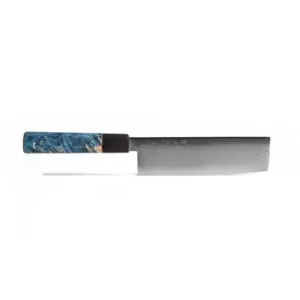
Pick up a German chef’s knife and there is a thick ridge of steel where the blade meets the handle. Pick up a Japanese one and it is usually gone, replaced by a slim collar of wood or horn. That ridge is the bolster, and whether a knife has a full one, a half one or none at all changes how it feels, how it cuts and how easy it is to sharpen for the rest of its life.
What is a bolster on a knife?
A bolster is a thickened band of metal between the blade and the handle. On a forged Western knife it is formed from the same piece of steel as the blade. It does three things. It adds weight towards the handle, which moves the balance point back. It gives your fingers a step to rest against, so a hand is less likely to slide forward onto the edge. And it makes the junction between blade and handle visibly strong, which is part of why it became a mark of a quality European knife.
Full bolster
A full bolster runs all the way down to the cutting edge at the heel. It is the classic look of a traditional German chef’s knife, and it is very good at one job: protecting the fingers of someone who holds a knife by the handle alone.
The trouble starts at the sharpening stone. Because the bolster reaches the edge, the last centimetre or so of the blade cannot lie flat on the stone. Each time the knife is sharpened, the edge in front of the bolster wears back a little and the bolster does not. After a few years there is a small hollow just in front of the heel, and that part of the edge no longer touches the board. You notice it when a slice of carrot stays joined at the bottom. The bolster can be ground down to fix it, but that is a job for a professional.
A full bolster also adds weight. Some cooks like that heft. Others find it tiring over a long session of prep.
Half bolster
A half bolster, sometimes called a semi bolster, keeps the thickened collar but stops short of the edge. You still have a step for your fingers and a little extra weight at the handle, and the whole length of the edge can be sharpened right to the heel. It is a sensible modern compromise, and many Western makers have moved towards it for exactly that reason.
Double bolster
A double bolster adds a second metal cap at the far end of the handle. Its purpose is balance. With weight at both ends of the handle, the knife sits more evenly in the hand, which some people find steadier for rocking cuts. The trade-off is more overall weight.
Why most Japanese knives have no bolster
Traditional Japanese kitchen knives are built differently. The blade has a narrow tang that is fitted into a wooden handle, and the joint is finished with a collar, called a ferrule. There is no steel step at all. On our knives the ferrule is bog oak, wood that has lain preserved in peat for around 2,500 years, set against a handle of stabilised maple burl made in Poland.
Leaving out the bolster has three consequences. The knife is lighter, and the balance sits further forward, so the blade does more of the work. The edge can be sharpened evenly from tip to heel for as long as you own the knife, so it never develops that hollow in front of the handle. And it encourages a pinch grip, with your thumb and the side of your index finger holding the blade itself just in front of the handle. That grip gives far more control than holding the handle alone, and once your fingers are on the blade there is no need for a bolster to stop them sliding.
If you have only ever used a heavy Western knife, a Japanese one can feel surprisingly light at first. Most people adjust quickly, and then find their old knife heavy.
Which should you choose?
If you hold a knife firmly by the handle, like a hammer, and you value the reassurance of a finger guard, a Western knife with a half bolster is a good tool. It protects you and it can be sharpened properly.
If you are happy to learn a pinch grip, or already use one, a bolster-free Japanese knife is lighter, more precise and easier to keep sharp along its whole length. Our article on how to hold a kitchen knife shows the grip, and our sharpening guide explains why an edge that reaches the heel matters.
A full bolster is the one we would think twice about. It looks traditional and protects the hand, but it makes sharpening harder every year you own the knife.
Frequently asked questions
What is the difference between a full bolster and a half bolster?
A full bolster runs down to the cutting edge at the heel. A half bolster stops above it. Both add weight and a finger guard, but only a half bolster lets you sharpen the full length of the edge easily.
Is a bolster a sign of a better knife?
It shows a knife was forged rather than stamped, which is usually a good sign on a Western knife. It says nothing about quality on a Japanese knife, which is designed without one.
Is a knife without a bolster safe?
Yes, especially with a pinch grip, where your fingers rest on the blade behind the edge and cannot slide forward. A sharp knife held properly is safer than a blunt one with a finger guard.
Do Japanese knives have bolsters?
Most do not. Traditional Japanese handles use a wooden or horn ferrule instead, which keeps the knife light and lets the whole edge be sharpened.
Handcrafted Japanese Knives by Oishya
Forged by master craftsmen in Seki and Sakai, Japan. Free worldwide shipping over £270 • 100-day money-back guarantee • Lifetime warranty