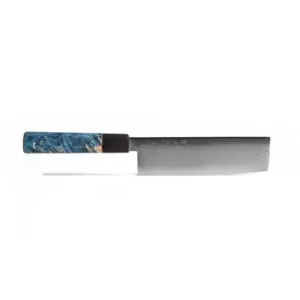
Three Japanese knives do the everyday work in most kitchens: the Gyuto, the Santoku and the Bunka. All three are chef’s knives. All three will slice an onion, dice a carrot and portion a chicken breast. The differences are in the shape of the edge and the tip, and those small differences decide how a knife feels in your hand every evening. Here is how to tell which one is yours.
The short answer
Choose a Santoku if you want one easy, nimble knife for everyday family cooking, mainly vegetables, and you like an up-and-down chopping motion. Choose a Gyuto if you cook with confidence, like a longer blade, carve meat and enjoy a gentle rocking cut. Choose a Bunka if you push-cut most of your vegetables and want a sharp tip for fine work, in a knife with a bit of attitude.
If you are still unsure after reading this, our knife quiz asks a few questions about how you cook and suggests one.
The Gyuto: the Japanese chef’s knife
Gyuto translates roughly as “beef sword”. It began as a Japanese answer to the French chef’s knife and is now widely used as the general-purpose knife in professional kitchens. Ours run from 20cm to 24cm.
Its edge curves gently up towards a pointed tip. That curve lets you rock the blade, keeping the tip on the board and lifting the heel, which is lovely for herbs and garlic. The length lets you slice through a joint of meat or a large squash in one stroke, and the pointed tip handles fine work like scoring fish skin or removing a pepper’s core.
The Gyuto suits someone who already cooks with confidence and has room on the board for a longer blade. If you are coming from a Western chef’s knife, it will feel familiar in shape and far lighter in the hand. See our Gyuto range.
The Santoku: three virtues
Santoku means “three virtues”, usually taken as slicing, dicing and mincing. It was developed in Japan in the middle of the last century as a household knife, and it is still one of the most common knives in Japanese homes. Ours are 16.5cm and 18cm.
The edge is flatter than a Gyuto’s, and the spine curves down to a rounded tip that sits low. That shape encourages an up-and-down chop and a forward push. There is less rocking, more decisive cutting, and the full length of the edge meets the board at once, which is very efficient for onions, carrots and cucumber. The shorter blade feels nimble and approachable, which is why so many people who are new to Japanese knives start here.
The rounded tip is less useful for detailed point work than a Gyuto or Bunka. For most home cooking that hardly matters. See our Santoku range.
The Bunka: the cultured one
Bunka means “culture”. It shares the Santoku’s flat edge and height, then ends in an angled tip, sometimes called a reverse tanto or k-tip. Ours are 18cm to 21cm.
That flat edge is excellent for push-cutting, where you slide the blade forward and down through the food. The angled tip gives you a sharp point for scoring, for fine brunoise, and for getting into tight places like the core of a tomato. It is the most expressive of the three to look at, and the one people often choose when they already own a Santoku and want something with more character. See our Bunka range.
How you cut decides it
Watch yourself chopping an onion tonight. If the tip stays on the board while your wrist lifts and lowers the heel, you are a rocker, and the Gyuto’s curved edge will suit you. If you lift the whole knife and bring it down, or slide it forward through the food, you chop or push-cut, and the flatter edge of a Santoku or Bunka will feel more natural.
Then think about what you cook. A lot of meat, large roasts or big squashes favour the length of a Gyuto. Mostly vegetables, family meals and quick weeknight cooking favour a Santoku. A lot of fine vegetable work and a love of precise detail favour the Bunka.
And think about space. A 21cm or 24cm Gyuto needs a decent board and some room around it. In a small kitchen or on a narrow worktop, a Santoku is simply easier to live with.
What about hand size?
People often assume smaller hands need a smaller knife. Blade length matters less than you might expect, because with a good pinch grip the knife’s balance does the work. What does matter is blade height. A Santoku and a Bunka are taller at the heel than a Gyuto of the same length, which gives your knuckles more clearance above the board. Plenty of cooks with small hands love a Gyuto, and plenty with large hands prefer a Santoku. Choose by how you cut.
Once you have chosen the shape
Every shape is available in more than one of our lines. The line decides the steel and how much care the knife asks for. For a busy household the Sakai Kyuba KYU in AUS10 is the forgiving choice. For a daily cook who sharpens a few times a year, the VG10 lines KATA and RYU. For an enthusiast who sharpens their own knives, SHIN in SG2. Our knife lines comparison sets them side by side, and our guide to choosing a knife steel explains the difference.
If you would like the chef’s knife and the other two shapes that matter most, a knife set pairs a Gyuto or Santoku with a Nakiri and a Petty.
Frequently asked questions
Is a Gyuto or a Santoku better for beginners?
Most beginners find a Santoku easier. It is shorter, less intimidating and suits simple up-and-down chopping. A Gyuto rewards a little more confidence.
Can a Santoku cut meat?
Yes. It handles chicken breasts, steaks and fish portions easily. A Gyuto’s extra length is only a real advantage for large roasts and long slicing cuts.
What is the difference between a Bunka and a Santoku?
They share a flat edge and a tall blade. The Santoku has a rounded tip; the Bunka has an angled, pointed tip that is better for detailed work and scoring.
What is the difference between a Bunka and a Kiritsuke?
Both have an angled tip. A Kiritsuke is longer and flatter, closer to a Gyuto in length, while a Bunka is shorter and taller. We compare them in Kiritsuke vs Bunka.
Handcrafted Japanese Knives by Oishya
Forged by master craftsmen in Seki and Sakai, Japan. Free worldwide shipping over £270 • 100-day money-back guarantee • Lifetime warranty