People choose a knife by its blade and keep it for its handle. The blade does the cutting, but the handle is what your hand holds every evening for years, and it is usually the first part of a knife to show its age. A good one stays comfortable, shrugs off water and still looks beautiful long after the box has been put away. Here is what makes the difference, and why we chose the woods we did.
What a knife handle has to do
A kitchen knife handle lives a hard life. It is wet several times a day, handled with oily or floury fingers, and dried with a towel that is never quite dry. It warms and cools with the kitchen. The wood therefore has to stay dimensionally stable, so it does not shrink away from the blade or crack. It has to resist water and the bacteria that follow it. It has to be comfortable and secure in a wet hand. And ideally it should look better with use, not worse.
Traditional Japanese handle woods
The classic Japanese handle wood is magnolia, called ho. It is light, soft, inexpensive and pleasant to hold, and it is usually paired with a collar of buffalo horn. It is also porous, so it stains and can loosen with years of washing. On a knife used daily, a magnolia handle often needs replacing long before the blade is worn out.
Harder woods such as walnut, cherry, rosewood and ebony last longer and are often used on more expensive knives. Synthetic and composite handles, including resin-impregnated wood laminates, are practically indestructible but can feel lifeless in the hand.
Why we use stabilised maple burl
A burl is a rounded outgrowth on the trunk of a tree, where the grain has grown in tight swirls and knots rather than straight lines. Cut open, maple burl shows extraordinary figure: eyes, flames and ripples that are different in every piece. No two of our handles are the same.
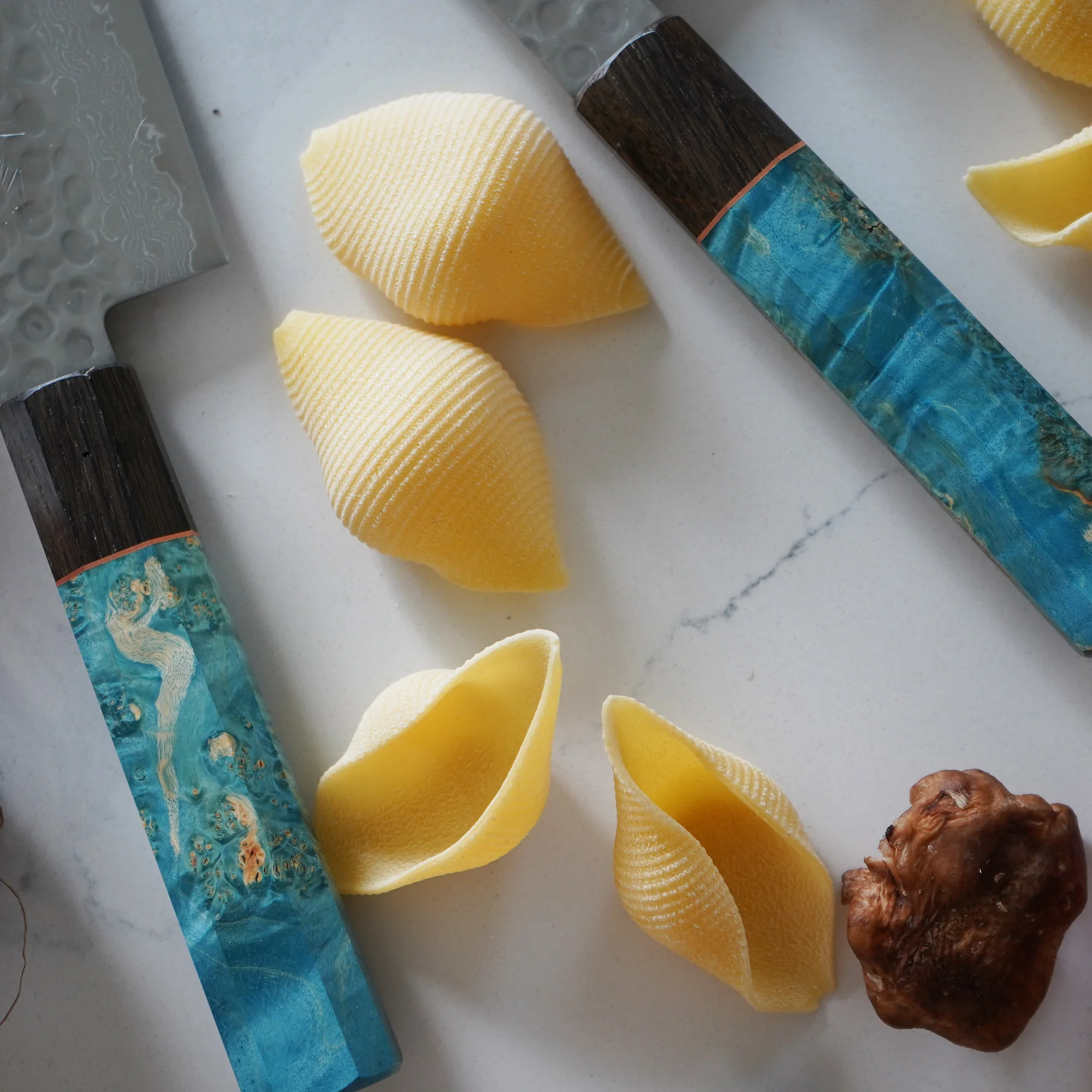
Burl on its own is too irregular to make a reliable handle. Its swirling grain can move and crack with moisture, so it is stabilised. The wood is placed in a vacuum chamber to draw the air out of its pores, then flooded with resin under pressure, which fills the wood right through before it is cured. The result is still wood, with all of its depth and figure, but it no longer absorbs water. It will not swell, shrink or crack in a wet kitchen, and it does not need oiling. The resin can also carry colour into the grain, which is how our Mediterranean Blue and Olive Green handles get their depth.
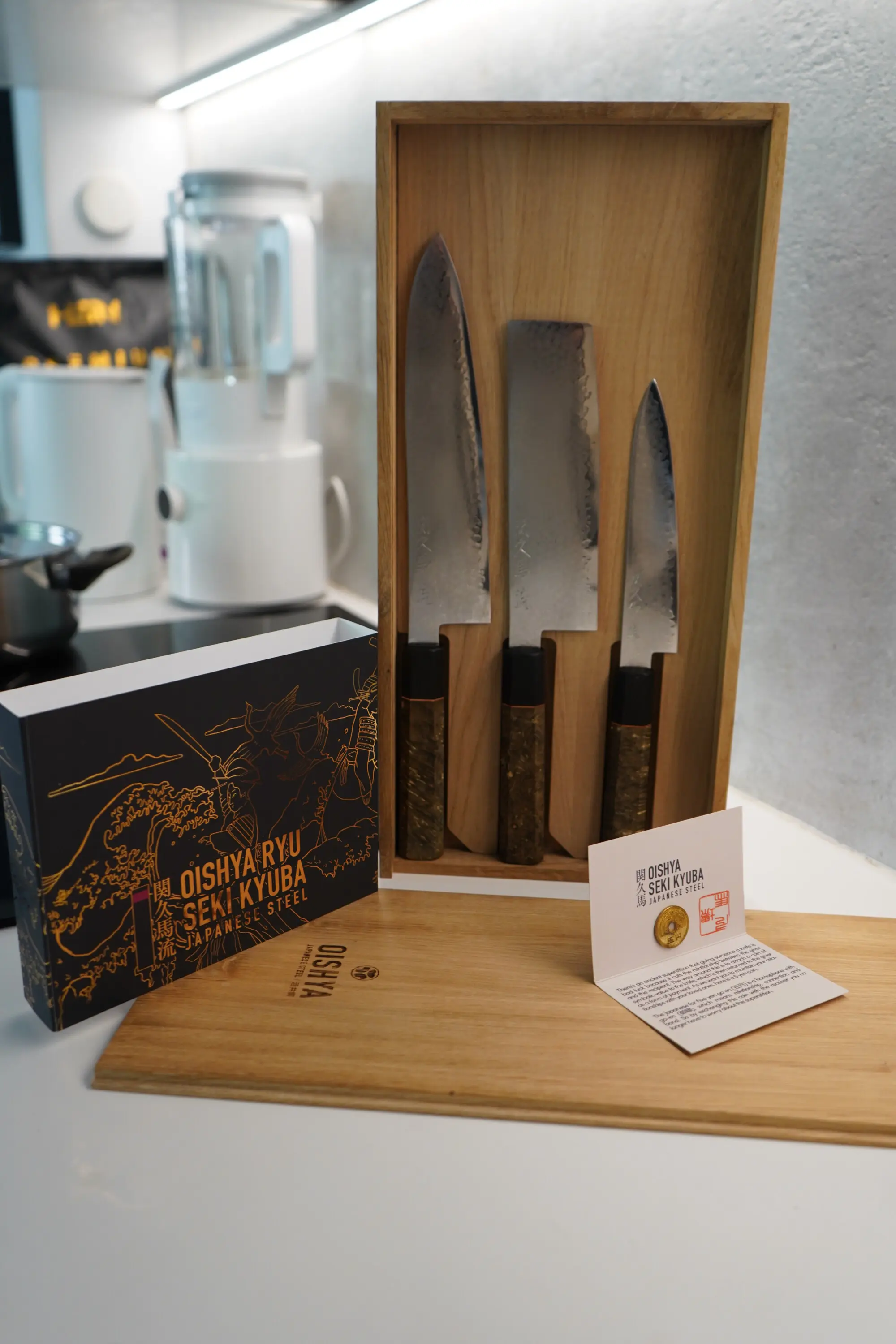
Our handles are made in Poland and fitted to blades forged in Sakai and Seki.
Bog oak: wood with a few thousand years behind it
The dark collar between the handle and the blade is bog oak. Bog oak comes from oak trees that fell into peat bogs and river beds long ago and lay there, sealed away from oxygen, for centuries or millennia. Without oxygen the wood does not rot. Instead, the tannins in the oak react slowly with minerals in the water, and the wood darkens and hardens over time, from brown to deep, almost black tones. The bog oak in our handles is around 2,500 years old.

It is a rare material, recovered rather than felled, and every piece carries that long history. We use it for the collar because it is dense, stable and hard-wearing, and because its dark tone frames the maple burl beautifully. You can read more in what is bog oak.
Why a collar matters
On a Japanese knife the collar, or ferrule, sits where the blade enters the handle. It is the part that takes the most stress and the most water, so it needs to be the hardest-wearing part of the handle. It also gives your fingers a gentle step to find in a pinch grip. A good collar is one of the details that separates a knife made to last from one made to look good on day one. Our article on bolsters and collars explains how this differs from a Western knife.
Choosing a handle colour
All three colours are the same wood and the same construction, so choose with your eyes. Natural Brown is the quietest, warm and at home in almost any kitchen. Olive Green is the colour most people choose at the moment, earthy and calm. Mediterranean Blue is the one people notice from across the room. If you have a wooden worktop, Natural Brown and Olive Green sit beautifully on it. Against white, grey or stone, Mediterranean Blue comes alive.
Looking after a stabilised wood handle
Very little is needed. Wash the knife by hand with warm soapy water, dry it straight away, and keep it out of the dishwasher, whose heat and detergent are hard on any handle and any edge. Because the wood is stabilised, it does not need oiling. Over the years it develops a soft sheen where your hand holds it, which is exactly as it should be.
Frequently asked questions
What is the best wood for a kitchen knife handle?
A dense, stable wood that resists water. Stabilised woods such as stabilised maple burl combine the look and warmth of natural wood with complete resistance to moisture.
What does stabilised wood mean?
The wood has been impregnated with resin under vacuum and pressure, then cured. It keeps its natural figure but no longer absorbs water, swells or cracks.
Is a wooden knife handle hygienic?
A stabilised wood handle is sealed right through, so water and bacteria cannot soak in. Wash and dry it like the blade.
Do I need to oil a stabilised wood handle?
No. Unlike untreated wood, stabilised wood does not dry out. Washing and drying is all it needs.