in Stainless Steels
If you’ve spent any time looking at kitchen knives online, you’ve encountered a wall of steel names: VG10, SG2, AUS10, S35VN, M390, ZDP-189. They appear in product specs like they’re self-explanatory, as though everyone knows what “CPM-154 at 59.8 HRC” means for their Tuesday evening stir-fry.
They don’t. And the knife industry doesn’t make it easy. Marketing copy tends to either drown you in metallurgy or reduce everything to “premium steel” — neither of which helps you understand why one knife costs £120 and another costs £400 when they look roughly the same.
This guide covers the stainless steels you’ll actually encounter when shopping for quality kitchen knives. Not just the popular ones, but the full landscape — from entry-level German steels to exotic powder metallurgy compositions that push the limits of what a kitchen blade can do. For each one, we’ll look at what it’s made of, how it performs, and what that means once it’s in your hand.
The Basics: What All Knife Steels Have in Common
Every knife steel is an alloy — a mixture of iron with carbon and other elements. Carbon is the most important addition. It’s what allows steel to be hardened, and the amount of carbon largely determines how sharp a blade can get and how long it holds that edge. Below about 0.5% carbon, you’re looking at mild steel that won’t hold a useful cutting edge. Kitchen knives typically use steels with 0.6% to 1.5% carbon, though some exotic compositions go higher.
Chromium is the element that makes steel “stainless.” At around 10.5–13% chromium content, the steel forms a passive oxide layer that resists rust and corrosion. This is a big deal for kitchen knives, which spend their lives around water, acids, and salt. Traditional Japanese carbon steels — the ones that sushi masters in Tokyo use — contain little or no chromium, which is why they need to be wiped dry between every cut and oiled after every use. Stainless steels sacrifice a small amount of that carbon steel sharpness in exchange for a blade that can survive a normal kitchen without constant babying.
Beyond carbon and chromium, most knife steels include several other elements in smaller quantities, each with a specific job. Molybdenum improves toughness and helps the blade resist corrosion in warm or acidic environments. Vanadium refines the steel’s grain structure (finer grains mean a sharper possible edge) and improves wear resistance. Cobalt allows the steel to be hardened to higher temperatures without becoming too brittle. Tungsten adds wear resistance and helps the blade hold its edge under heavy use. Manganese and silicon play supporting roles in the steel’s overall performance and manufacturing characteristics.
The balance of these elements creates a steel’s personality. No single element makes a steel “good” — it’s how they work together, and how the blade is heat-treated afterward, that determines what the knife can do.
Understanding Hardness and Toughness (They’re Not the Same Thing)
Two terms dominate any conversation about knife steel: hardness and toughness. They sound like they might mean similar things. They don’t. They’re often in direct opposition, and understanding the tension between them is the key to understanding why so many different steels exist.
Hardness is measured on the Rockwell C scale (HRC) and describes how resistant the steel is to deformation. A harder blade can be ground thinner and hold a sharper edge for longer, because the steel resists the microscopic bending and rolling that makes an edge go dull. Most Western kitchen knives sit around 56–58 HRC. Japanese kitchen knives typically range from 58 to 65 HRC. That might not sound like a big gap, but the relationship between HRC and performance isn’t linear — each point up the scale represents a meaningful increase in edge-holding ability.
Toughness is the steel’s resistance to chipping, cracking, or breaking when it encounters sudden impact or lateral stress. A tough blade can absorb abuse — hitting a bone, twisting slightly in a hard squash, being dropped on a tile floor — without the edge chipping or the blade fracturing. Toughness is typically measured in ft-lbs using the Charpy V-notch impact test, though you’ll rarely see these numbers in knife marketing.
Here’s the fundamental trade-off: making a steel harder generally makes it less tough, and making it tougher generally limits how hard it can get. This is why a soft German knife at 56 HRC can survive being dropped or used to hack through a lobster shell, while a hard Japanese blade at 64 HRC might chip if you look at it sideways near a frozen chicken breast. Neither approach is “better” — they serve different uses and different users.
The chart below plots hardness against toughness for the major stainless steels used in kitchen knives. It gives you a visual picture of where each steel sits on this spectrum, and why certain knives use certain steels.
The Entry-Level Steels: Where Most Knives Start
1.4116 (X50CrMoV15)
This is the workhorse of the European knife industry. If you own a Victorinox, a Wüsthof Pro, or most supermarket-brand knives, you’re already familiar with 1.4116 whether you know it or not. It’s a German-standard steel with about 0.5% carbon and 14–15% chromium, landing at around 56–57 HRC after heat treatment.
At that hardness, 1.4116 won’t hold a razor edge for long. You’ll be reaching for a honing steel regularly, and it won’t reach the same sharpness ceiling as harder Japanese steels. But it’s extremely tough — you can torque it, abuse it, throw it in a dishwasher (though you shouldn’t), and it’ll survive. It sharpens in seconds on a basic sharpener, and it resists corrosion very well. For a utility knife that lives in a busy commercial kitchen and gets sharpened on a steel rod every hour, 1.4116 is perfectly fit for purpose. Where it falls short is when you want refined, precise cutting — the kind where you notice the difference between a sharp knife and a very sharp knife.
Sandvik 12C27 and 14C28N
These Swedish steels from Sandvik occupy a step above 1.4116. The 14C28N in particular — with added nitrogen for improved corrosion resistance and edge stability — appears in better-quality Scandinavian knives. At 58–60 HRC, it takes a meaningfully better edge than 1.4116 while maintaining good toughness. You won’t see these in most Japanese kitchen knives, but they’re worth knowing about because they represent the upper limit of what “Western-style” steels can achieve before you cross into Japanese territory.
The Japanese Kitchen Steels
AUS10
Made by Aichi Steel in Japan, AUS10 contains roughly 1.05% carbon and 14% chromium, with additions of molybdenum and vanadium. It hardens to 60–61 HRC, which puts it in the starting range for Japanese kitchen knives. AUS10 is a genuine all-rounder: it takes a good edge, holds it through a reasonable amount of daily cooking, sharpens without any special technique, and resists corrosion reliably. It won’t win any single performance category against the steels above it on this list, but it doesn’t embarrass itself in any of them either.
What makes AUS10 appealing is its forgiveness. A home cook who’s new to Japanese knives — maybe coming from a set of Wüsthofs or a Victorinox Fibrox — will find AUS10 immediately familiar in terms of maintenance while noticing a significant jump in cutting performance. It’s hard enough to cut noticeably better than European steels, but not so hard that it punishes mistakes like rocking through a sweet potato or accidentally grazing a plate.
AUS10 is sometimes grouped with AUS8, its slightly softer sibling (around 0.75% carbon, 58 HRC). The difference matters — AUS10’s extra carbon content gives it meaningfully better edge retention. If a knife is listed as “AUS steel” without specifying which grade, be cautious; it might be AUS6 or AUS8, which are a clear step down.
VG10 (V Gold 10)
Made by Takefu Special Steel in Japan, VG10 has become the defining steel of the premium Japanese kitchen knife market. Its composition — roughly 1% carbon, 15% chromium, 1% molybdenum, 0.2% vanadium, and critically, 1.5% cobalt — allows it to be hardened to 60–63 HRC while maintaining workable toughness. The cobalt is the key differentiator from AUS10; it enables higher hardening temperatures and contributes to VG10’s ability to take an extremely keen edge.
In the hand, VG10 feels like a step change from AUS10. The edge is noticeably keener out of the box, and it stays there longer. Sharpening on a whetstone is straightforward and satisfying — the steel responds well to abrasives and produces a fine, consistent edge. Corrosion resistance is excellent thanks to the high chromium content, and the cobalt addition means the edge resists the kind of micro-rolling that gradually dulls softer steels during normal use.
VG10’s popularity isn’t accidental. It represents the best balance of performance, maintenance, and value in the Japanese kitchen knife world. Brands at every price point use it, from entry-level Japanese knives to high-end handmade pieces. The difference between a £60 VG10 knife and a £300 one comes down to heat treatment, blade geometry, handle construction, and finishing — not the steel itself. A well-heat-treated VG10 blade, made by a skilled blacksmith who understands how to push the steel to its limits, performs far above what the spec sheet suggests.
AEB-L
Another Sandvik product, AEB-L is a simple carbon-chromium steel (0.67% carbon, 13% chromium) that punches well above its composition on paper. At 63–65 HRC, it achieves excellent hardness, and its fine carbide structure means it takes an exceptionally keen edge. With 13 ft-lbs of toughness even at 64.5 HRC, it’s one of the best performers on the hardness-versus-toughness curve — meaning it gets very hard without becoming fragile.
AEB-L appears in high-end custom knives and some boutique Japanese makers. It’s not as common as VG10 because it requires more precise heat treatment to reach its potential, and its corrosion resistance is slightly lower (13% chromium versus VG10’s 15%). But for makers who know how to work with it, AEB-L produces blades that rival much more expensive steels. If you see it listed on a knife you’re considering, take it seriously — it’s a sign the maker cares about performance over marketing appeal.
Nitro-V
A nitrogen-enhanced version of AEB-L, Nitro-V adds nitrogen to improve corrosion resistance while maintaining the parent steel’s excellent edge-taking ability. At 62.5 HRC with about 14 ft-lbs of toughness, it sits in a remarkable position on the chart — genuinely hard while remaining significantly tougher than most steels at the same hardness level. It’s increasingly popular among American and European custom knifemakers who want AEB-L’s cutting performance with better stain resistance. In kitchen knives it’s still relatively uncommon, but worth seeking out.
SG2/R2: The Powder Metallurgy Divide
SG2 (Super Gold 2), also called R2, represents a fundamentally different approach to making knife steel. Instead of conventional smelting and casting, SG2 is produced through powder metallurgy: the raw materials are atomised into fine powder, then compacted under extreme pressure and sintered at high temperature. This process produces a steel with an extremely fine, uniform grain structure — finer and more consistent than anything achievable through conventional methods.
Why does grain structure matter? Because the size and distribution of carbides (hard particles within the steel) directly determine how sharp an edge can get. Coarse carbides create a microscopically jagged edge, like a saw. Fine carbides allow the edge to be honed to a smoother, keener finish. SG2’s powder metallurgy process produces carbides so small and evenly distributed that the resulting edge is remarkably refined.
The composition — about 1.25–1.45% carbon, 14–16% chromium, 2.5–3.5% molybdenum, and 1.5–2% vanadium — allows SG2 to reach 63–64 HRC with about 8 ft-lbs of toughness. That toughness figure is respectable for the hardness level, and the 31-layer Damascus cladding that typically surrounds the SG2 core in quality knives provides additional shock absorption. The practical outcome: an edge that stays sharp significantly longer than VG10, with excellent corrosion resistance and surprisingly good ease of sharpening given its hardness.
SG2 is the steel that separates the “very good” tier of Japanese knives from the “exceptional” tier. If you cook daily and you care about the difference between a sharp knife and a scalpel-sharp knife, this is where the investment starts paying dividends you can feel.
The American Powder Steels: S30V, S35VN, S45VN
Crucible Industries in the United States developed a family of powder metallurgy steels that have become standards in the premium knife industry, particularly in folding knives and outdoor knives. They appear in some kitchen knives too, and they’re worth understanding even if you encounter them less frequently in that context.
S30V
CPM S30V was designed specifically for knife blades — a deliberate attempt to optimise the balance of edge retention, toughness, and corrosion resistance. At 60 HRC, it offers good edge retention, but its toughness of about 5.5 ft-lbs is on the lower end. In kitchen use, S30V can feel slightly “toothy” when cutting — the vanadium carbides are hard and wear-resistant, which is great for edge longevity but means the edge doesn’t get as refined as simpler steels like AEB-L or VG10. It’s also more difficult to sharpen than most kitchen-oriented steels, requiring diamond or ceramic abrasives rather than traditional waterstones.
S35VN
The successor to S30V, S35VN replaces some tungsten with niobium, which refines the carbide structure and improves toughness to about 8.5 ft-lbs at 62 HRC. It’s a genuine improvement — easier to sharpen, tougher, and slightly better corrosion resistance. S35VN appears in some premium kitchen knives, though it remains more common in EDC (everyday carry) and outdoor knives. For kitchen use, it’s a competent performer that gets overshadowed by purpose-built Japanese steels at similar price points.
S45VN
The latest in the lineage, S45VN further refines the niobium carbide approach for improved edge stability. At 62.5 HRC with about 7 ft-lbs of toughness, it sits in a reasonable position, though the toughness is lower than S35VN at a similar hardness. It’s a good steel that struggles to differentiate itself from established Japanese options in the kitchen context.
The High-Performance Steels
M390 / CPM-20CV
M390 (made by Böhler in Austria) and its American equivalent CPM-20CV are premium powder steels that deliver exceptional edge retention. At 62 HRC with about 9 ft-lbs of toughness, M390 offers a combination that’s hard to argue with on paper. The high vanadium and chromium content (20% chromium) means it resists both wear and corrosion extremely well.
The catch is sharpening. M390’s wear resistance works both ways — the same carbides that keep the edge sharp for a long time also resist the sharpening stone when you eventually need to restore that edge. Sharpening M390 on a traditional Japanese whetstone is a slow, frustrating exercise. Diamond stones or ceramic rods work much better. For kitchen use, this is a real consideration — if you enjoy the ritual of whetstone sharpening, M390 will test your patience. If you sharpen infrequently and prefer to maintain the edge with a ceramic honing rod between sessions, it works well.
Elmax
Another Böhler powder steel, Elmax sits at a more moderate 57.5 HRC with about 10 ft-lbs of toughness. It’s designed as a balance of corrosion resistance, toughness, and machinability rather than maximum hardness. In kitchen knives, it performs similarly to high-end conventional steels — adequate edge retention with easy maintenance. It’s more common in European-made kitchen knives than Japanese ones.
CPM-154
The powder metallurgy version of the classic 154CM steel, CPM-154 sits at about 59.8 HRC with an impressive 17.5 ft-lbs of toughness. That toughness figure is remarkable — it means CPM-154 can be used in thinner blade geometries without chipping concerns, which is exactly what you want in a kitchen knife. The edge retention at 59.8 HRC is modest compared to harder steels, but the combination of toughness and ease of sharpening makes CPM-154 a favorite among custom knifemakers who build kitchen knives for hard daily use.
Vanax
A nitrogen-alloyed steel from Bohler-Uddeholm, Vanax at 60 HRC with 11.5 ft-lbs of toughness is notable for its extraordinary corrosion resistance. It was originally developed for marine and chemical processing applications, and it’s essentially stain-proof in kitchen use. The edge retention is moderate — comparable to VG10 — but the complete immunity to corrosion makes it attractive for knives that will see heavy exposure to acidic ingredients, salt, or irregular washing habits. It’s a niche choice, but a smart one for the right user.
The Specialists and Outliers
Niolox
A German steel designed by Lohmann as a knife-specific alloy, Niolox contains niobium for fine, hard carbides. At 59.5 HRC and 6.5 ft-lbs of toughness, it’s a middle-of-the-road performer that’s easy to sharpen and takes a clean edge. It appears in some German and Austrian kitchen knives and offers an experience somewhere between a good European steel and a Japanese steel — harder than 1.4116, easier to maintain than VG10.
40CP
A Carpenter Technology steel designed for cutlery applications, 40CP at 59.5 HRC and 9 ft-lbs of toughness is specifically optimised for kitchen use. It offers very good corrosion resistance and a fine grain structure that takes a smooth edge. It’s not widely marketed by name, but it appears in some well-regarded American kitchen knife brands. A solid, unshowy performer.
N690
Böhler’s answer to VG10, N690 is an Austrian steel with a similar composition but slightly different characteristics. At 62.8 HRC, it achieves good hardness, but its toughness of just 4 ft-lbs is notably low — making it prone to chipping if used carelessly. In kitchen knives, N690 works well if the blade geometry is appropriate (not too thin behind the edge) and the user avoids lateral stress. It’s common in Italian and Austrian kitchen knives and performs well within its limitations.
NioMax
A relatively new steel from Zapp, NioMax sits in an exceptional position on the hardness-toughness chart: 64 HRC with 17 ft-lbs of toughness. Those numbers are almost contradictory — steels at 64 HRC typically have toughness values in single digits. NioMax achieves this through a nitrogen-niobium approach that creates very fine, very hard carbides without the brittleness that usually accompanies extreme hardness. It’s still uncommon in production kitchen knives, but it represents the direction that knife steel development is heading: ever-improving combinations of hardness and toughness that were considered impossible a generation ago.
ZDP-189
Made by Hitachi, ZDP-189 is the extreme end of kitchen knife steels. With 3% carbon and 20% chromium, it reaches 65 HRC — harder than many file steels. The edge retention is extraordinary; a well-sharpened ZDP-189 blade will hold its working edge through weeks of daily cooking. But at just 2 ft-lbs of toughness, it’s glass-fragile. Any lateral force, any contact with bone or frozen food, any twisting in hard produce risks a chip. ZDP-189 is a steel for experienced users who cut with surgical precision, maintain their knives meticulously, and never use a knife for anything it wasn’t designed for. For everyone else, it’s a fascinating technical achievement that makes a better conversation piece than daily driver.
Heat Treatment: Why the Same Steel Can Behave Differently
If you’ve read this far, you might think that choosing a steel is as simple as finding the best position on the hardness-toughness chart. It isn’t, because the chart shows optimal values — what each steel can achieve when heat-treated by someone who knows exactly what they’re doing.
Heat treatment is the process of heating the blade to a specific temperature (the austenitising temperature), holding it there for a precise duration, then cooling it at a controlled rate (quenching), followed by one or more tempering cycles at lower temperatures. Every variable in this process affects the final result. Heat too high and the grain structure coarsens, making the edge brittle. Don’t heat enough and the steel won’t reach its full hardness. Quench too fast and the blade might crack. Quench too slow and the hardness falls short. Temper at the wrong temperature and you either lose hardness or fail to relieve internal stresses.
This is why two knives using the same VG10 steel can perform very differently. A master blacksmith in Seki who has spent thirty years learning the precise heat treatment protocol for VG10 will consistently produce blades at the top of what that steel can do. A factory using automated ovens and standardised cycles will produce acceptable results, but rarely optimal ones. The craft of the blacksmith sits between the raw steel and the finished blade, and it’s where much of the value in a handmade knife actually lives.
When you’re choosing a knife, the steel tells you the theoretical ceiling of performance. The maker — their skill, their heat treatment process, their quality control — determines how close to that ceiling the blade actually gets.
Corrosion Resistance: A Practical Perspective
“Stainless” is a relative term. No stainless steel is completely immune to corrosion — even steels with 20% chromium will eventually stain if left wet with acidic food for hours. The question is how much neglect a blade can tolerate before it shows damage.
In general, higher chromium content means better corrosion resistance. Steels like Vanax (21% chromium) and M390 (20%) are essentially immune to kitchen corrosion in normal use. VG10 and AUS10 (both around 14–15% chromium) handle normal kitchen conditions well but will develop light staining if left wet with lemon juice or tomato for extended periods. Lower-chromium steels like AEB-L (13%) require a bit more attention — a quick rinse and dry after cutting acidic ingredients is good practice.
Molybdenum also contributes to corrosion resistance, particularly in warm or acidic environments. SG2’s 2.5–3.5% molybdenum content is one reason it handles kitchen conditions well despite being a very hard steel. Nitrogen additions (as in Nitro-V and Vanax) further improve corrosion resistance without the downsides of high chromium content.
For practical kitchen use, any of the Japanese stainless steels discussed here (AUS10, VG10, SG2) will handle normal conditions without issues, provided you follow the basic rule: wash by hand, dry promptly, store somewhere dry. The days when owning a Japanese knife meant constant oiling and anxiety about rust are largely behind us — at least for stainless options.
Ease of Sharpening: The Overlooked Factor
Edge retention gets all the attention, but ease of sharpening matters just as much for most home cooks. A steel that holds its edge for three months but takes an hour on diamond stones to restore is not necessarily better than a steel that dulls in six weeks but sharpens in ten minutes on a basic whetstone.
Simple steels with fewer and smaller carbides — AUS10, VG10, AEB-L, Nitro-V — sharpen quickly and easily on traditional Japanese waterstones (1000/3000 or 1000/6000 grit combinations). The steel responds well to abrasives, and you can feel the edge developing as you work. SG2 takes a bit more time but still responds well to waterstones. These steels are all pleasant to sharpen, which matters because a knife only performs as well as its edge, and its edge is only as good as its last sharpening.
High-vanadium steels — S30V, S35VN, M390 — are a different experience. The vanadium carbides are extremely hard and resist traditional abrasives. You’ll either need diamond stones, ceramic stones, or significantly more time and pressure on waterstones. For a pocket knife that gets sharpened once a month, this is a minor inconvenience. For a kitchen knife that’s your daily workhorse, it becomes a real factor in your relationship with the tool.
This is one reason why Japanese kitchen knife steels — AUS10, VG10, SG2 — remain dominant in the kitchen even though American powder steels might edge them out in some technical specifications. Japanese steels are designed to be sharpened on waterstones, and the sharpening experience is part of the knife’s total performance.
Choosing a Steel: Practical Guidance
After covering all of this, the natural question is: which steel should I get? The answer depends on how you cook, how you feel about maintenance, and how much you’re willing to spend.
If you want a sharp, reliable kitchen knife and you don’t want to think about it much, AUS10 at 60–61 HRC is an excellent starting point. It does everything well, forgives mistakes, and sharpens without special equipment. It’s the steel that makes Japanese knives accessible.
If you cook regularly and you’ve already discovered that knife sharpness makes a difference to your enjoyment in the kitchen, VG10 at 60–63 HRC is the sweet spot. It takes a keener edge, holds it longer, and the sharpening process is satisfying rather than tedious. Most serious home cooks and many professional chefs settle happily on VG10 and never feel the need to upgrade.
If you cook daily, you own a whetstone and know how to use it, and you want the best edge retention available without sacrificing stainless convenience, SG2 at 63–64 HRC is the premium choice. The difference from VG10 is real — you’ll sharpen less often and the edge will feel more refined — but it requires a user who cuts on appropriate surfaces and doesn’t abuse the blade.
And if you find yourself drawn to the exotic options — M390, ZDP-189, NioMax — understand that you’re entering enthusiast territory where diminishing returns are steep and the trade-offs become more pronounced. These steels can be extraordinary in the right hands. They can also be expensive disappointments for someone who just wants to cook dinner.
The steel matters. But what a skilled blacksmith does with it, and what you do with the knife after that, matters just as much. A well-made blade in AUS10, heat-treated by someone who has dedicated their life to the craft, will cut beautifully for years. The spec sheet is the beginning of the story, not the end of it.
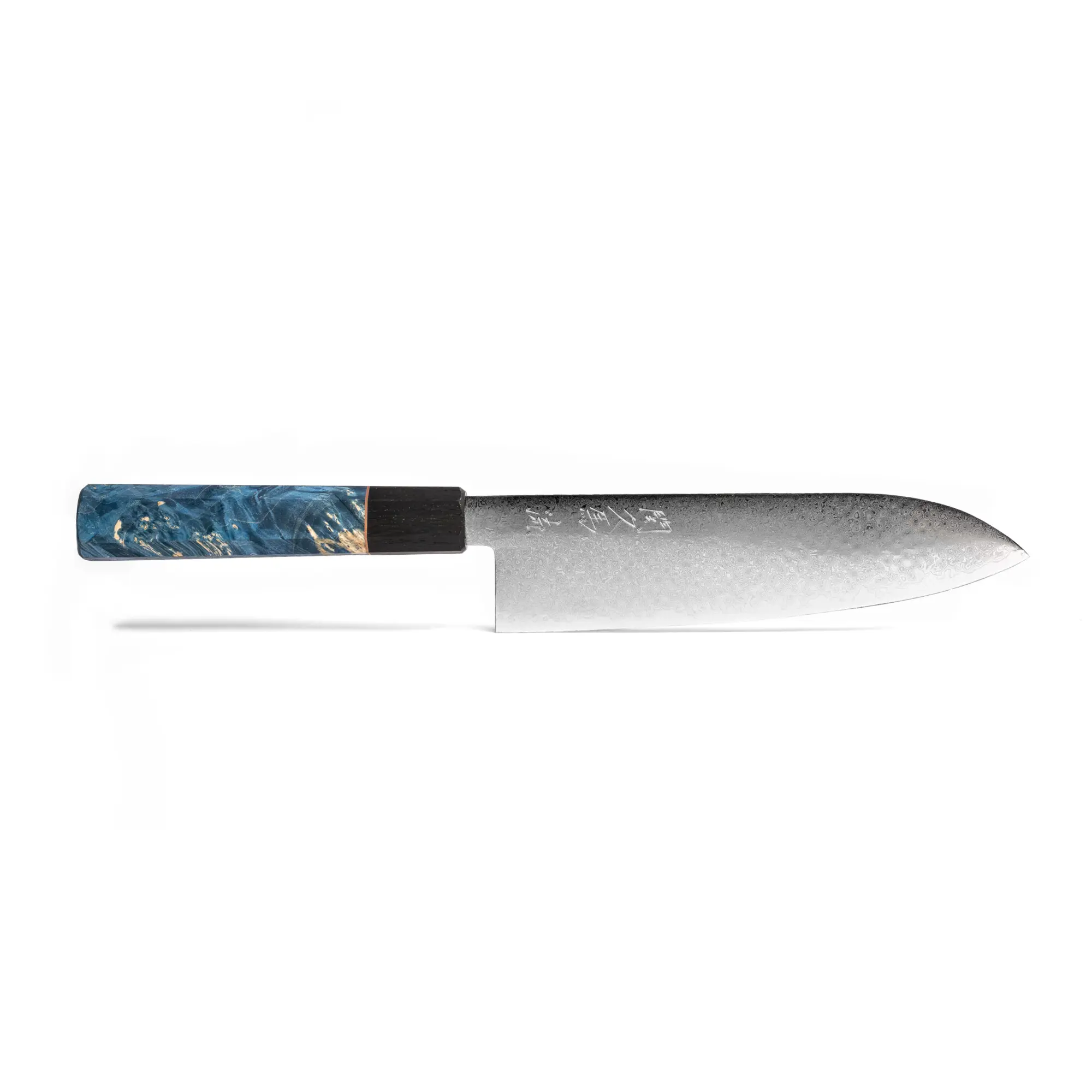
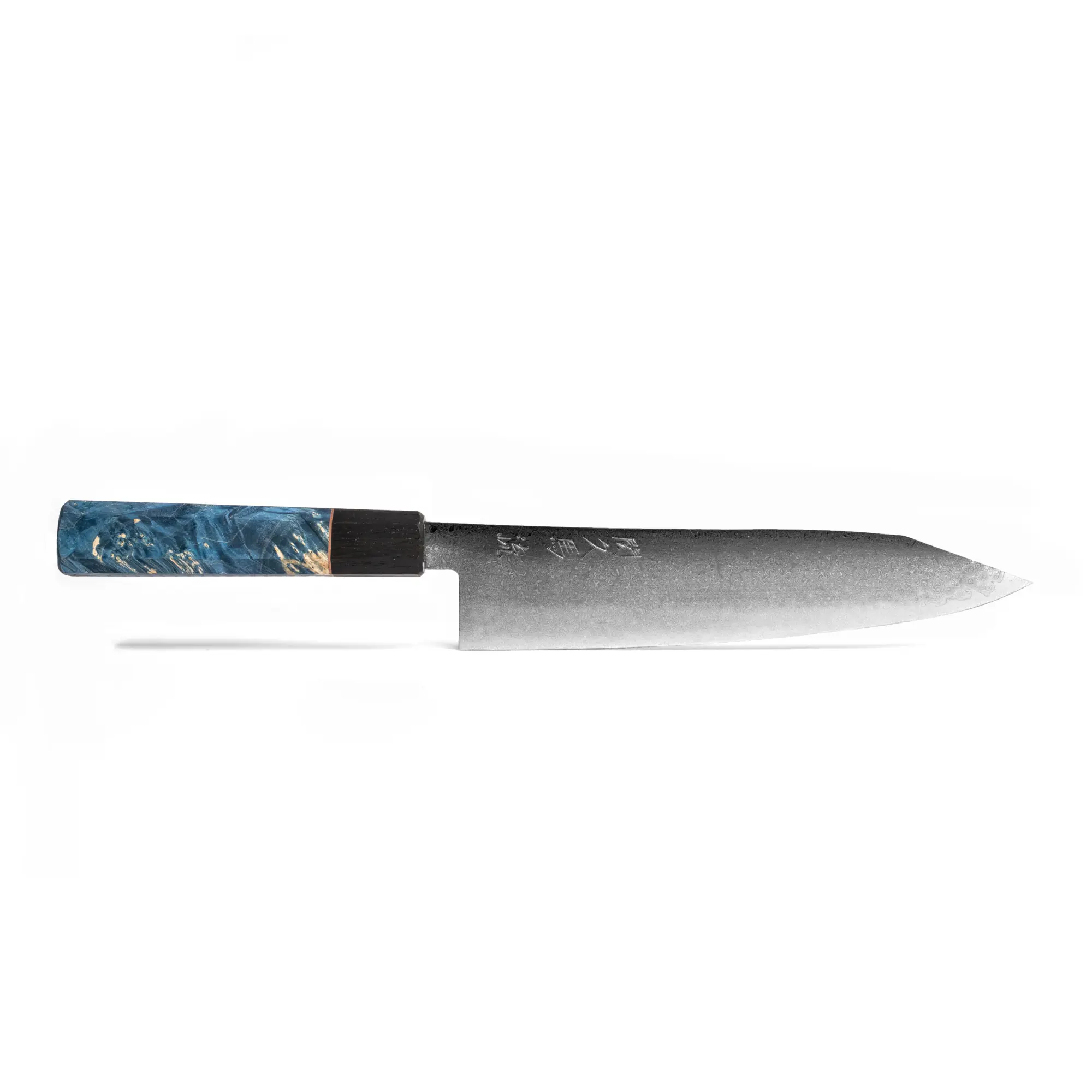
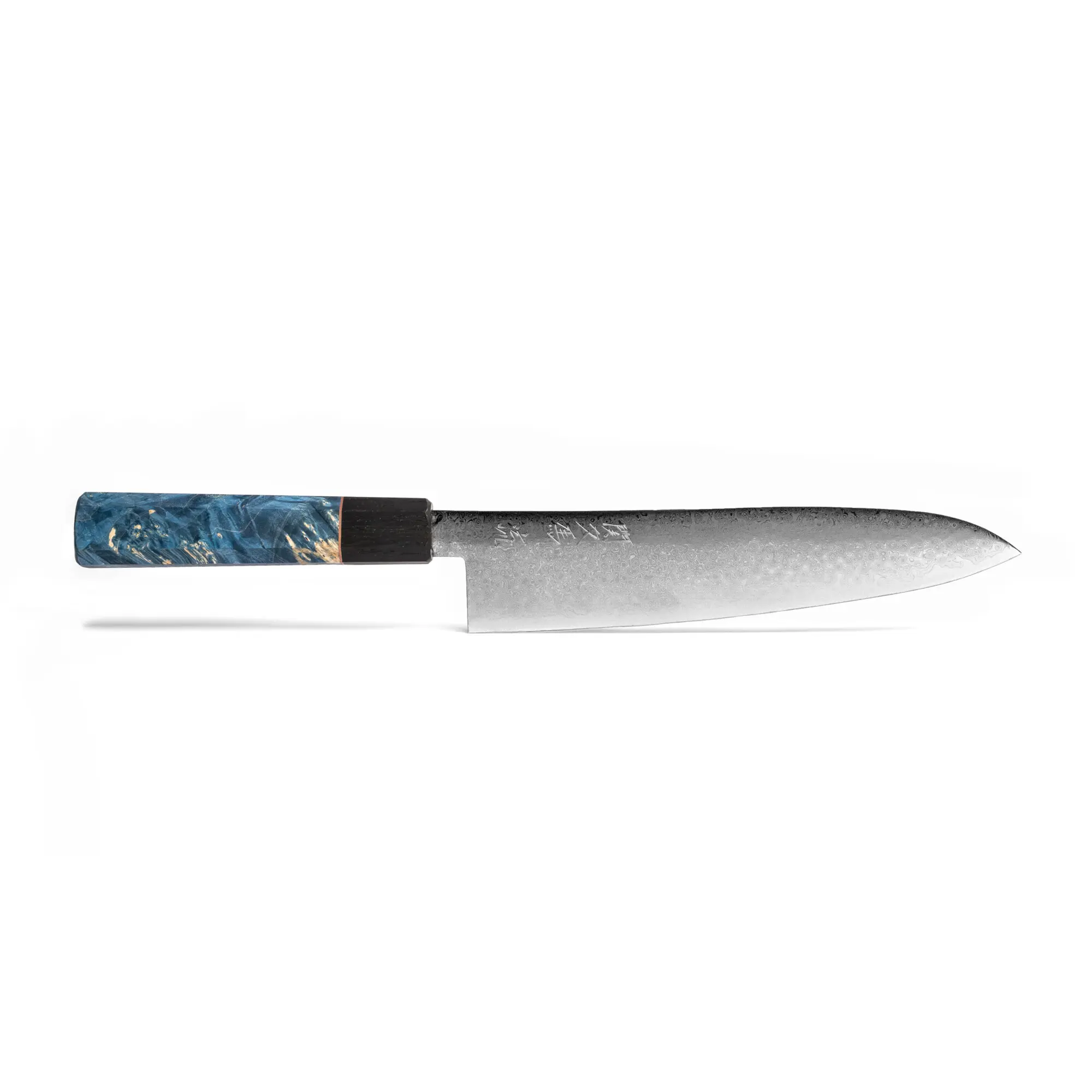


Handcrafted Japanese Knives by Oishya
Forged by master craftsmen in Seki and Sakai, Japan. Free shipping worldwide • 100-day money-back guarantee • Lifetime warranty