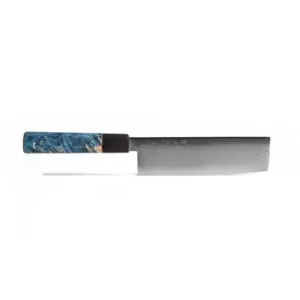
After the knife itself, the board is the tool you use most. Every cut ends on it, which means the board decides how long your edge stays sharp. A fine Japanese edge on a glass board dulls very quickly. The same edge on good wood can stay keen for months. Here is what matters when you choose one, starting with the question people search for most: end grain or edge grain.
End grain, edge grain and face grain
Wood is a bundle of long fibres running the length of the tree. How a board is cut from that wood decides which part of those fibres your knife meets.
An end grain board is made from short blocks glued together so the ends of the fibres face upwards, like the bristles of a brush. That chequerboard look is the giveaway. The edge slips between the fibres rather than cutting across them, and the fibres close up again afterwards. It is the gentlest surface there is for a knife, and the most resistant to visible cut marks.
An edge grain board is made from long strips joined side by side, so the knife meets the narrow edges of the boards running lengthways. A face grain board, sometimes called long grain or plank, is a wide surface of the tree’s grain, often from a single piece of wood. In both, the knife cuts across the fibres. That is a little firmer on the edge than end grain and shows knife marks sooner, but these boards are lighter, thinner, more stable and far less prone to splitting or warping, because there are fewer glue joints and the fibres run continuously.
Which is better for a Japanese knife?
End grain is the gentlest, and if you want one large board that lives on the worktop, it is a lovely thing to own. But the type of wood matters at least as much as the cut. A good edge grain or face grain board in a suitably soft, close-grained wood is kind to a Japanese edge, and it is easier to lift, wash and store. For most home kitchens that practicality wins.
The board to avoid is any hard surface. Glass, marble, slate, granite and ceramic are harder than knife steel, so every cut drives the edge into something it cannot win against. They are fine for serving cheese. Never cut on them. Bamboo is also harder on edges than it looks, because of the silica in the plant and the glue that holds the strips together. Plastic is acceptable, but it scores deeply and is hard to keep clean once it does.
The woods we choose, and why
Aomori Hiba is one of the Three Precious Woods of Japan, long used for shrines and temples. It is soft enough to spare a fine edge, light in the hand, and naturally antimicrobial thanks to hinokitiol, a compound in the wood that also resists odours and gives it a gentle pine-like scent. Our Hiba board is hand-planed and minimally finished so the grain and scent come through.
European walnut sits at a very good hardness for knives, firm enough to last and forgiving enough to protect the edge. Our European walnut board is cut from a single piece, finished with food-safe oil, with grips at each end.
American black walnut is darker and dense. Our American walnut boards are made from several lengths joined edge to edge, which keeps a wide board flat through the seasons where a single plank would want to cup.
Other good choices for Japanese knives include hinoki, maple and cherry. Very hard woods such as some acacias and exotic tropical hardwoods are less kind to an edge.
Size
Choose the largest board your worktop can hold comfortably. A cramped board makes you cut carefully at the edges and pushes food onto the counter. For a 21cm chef’s knife, something around 40cm long is a good minimum. If you prep a lot, a second, smaller board for fruit, garlic or bread keeps flavours apart and saves washing up mid-meal.
Looking after a wooden board
Wash it with warm water and a little mild soap straight after use, rinse, and stand it on its edge to dry so air reaches both sides. Never soak it and never put it in the dishwasher; the water swells the fibres and the heat splits them. Every few weeks, or whenever it looks pale and thirsty, rub in a thin coat of food-safe mineral oil and leave it overnight. Our guide to oiling a wooden board covers it step by step.
For raw meat and fish, many cooks keep a separate board, wash it thoroughly with hot soapy water after use and let it dry completely. A well-kept wooden board is a hygienic surface, and far easier to keep clean than a deeply scored plastic one.
Frequently asked questions
Is end grain or edge grain better for Japanese knives?
End grain is the gentlest on an edge. Edge grain and face grain boards in a suitable wood such as Hiba or walnut are also kind to Japanese knives and are lighter and more stable.
What is the worst cutting board for a knife?
Glass, followed by stone and ceramic. They are harder than steel and dull or chip a fine edge quickly.
Is walnut good for a cutting board?
Yes. Walnut is firm enough to last for years and forgiving enough to protect a sharp edge, and its dark colour hides stains well.
How often should I oil a wooden board?
Every few weeks with regular use, or whenever the surface looks dry and pale. A thin coat of food-safe mineral oil, left overnight, is enough.
Handcrafted Japanese Knives by Oishya
Forged by master craftsmen in Seki and Sakai, Japan. Free worldwide shipping over £270 • 100-day money-back guarantee • Lifetime warranty