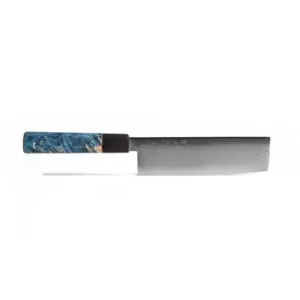
It is one of the worries we hear most often from people choosing their first Japanese knife. Will it chip? The honest answer is that a Japanese knife can chip, and that nearly every chip comes from one of six causes, all of them avoidable. Once you know what they are, a good Japanese knife will stay intact for as long as you own it.
Why Japanese knives can chip at all
A Japanese kitchen knife is made from hard steel, usually around 60 to 63 on the Rockwell scale, and sharpened to a fine angle of 10 to 15 degrees on each side. That combination is exactly what makes it so sharp and so long-lasting. It also means the very edge is thin and rigid.
Softer Western steel tends to bend when it is mistreated. You run it along a steel and it straightens again. Harder steel holds its shape, so under a sudden sideways force or a hard impact it is more likely to lose a tiny fragment. That is a chip. Most chips are tiny, often a millimetre or less. They are a sign of the wrong job or the wrong surface, rarely of a faulty knife.
The six causes, and how to avoid each
1. A hard cutting board
Glass, marble, slate, granite and ceramic boards are among the most common causes of damage. Every cut drives the edge into a surface harder than the steel. Use wood. End-grain and edge-grain wooden boards are kind to a fine edge, and softer woods such as Aomori Hiba are especially gentle. Our guide to choosing a board for a Japanese knife explains the options. Good plastic boards are acceptable. Stone and glass belong under the cheese, never under the knife.
2. Bone and frozen food
Chicken bones, chop bones, the stone in a mango and anything frozen are too hard for a thin edge. Cut around bones, through joints, and let frozen food soften first. For splitting a chicken or cutting through bone, a heavier Western knife or a cleaver is the right tool.
3. Twisting and prying
The edge is strong straight down and weak sideways. Twisting the blade to break open a squash, prying a lid or levering an avocado stone puts sideways force on the edge it was never meant to take. Cut straight down and straight through. To remove an avocado stone, use a spoon.
4. Scraping food with the edge
Dragging chopped vegetables across the board with the cutting edge rolls and nicks it over time. Turn the knife over and use the spine, or lift the food with the flat of the blade. It is a small habit that makes a big difference to how long an edge stays perfect.
5. The dishwasher and the drawer
In a dishwasher, knives knock against plates and cutlery, and the heat and detergent are hard on the handle. In a drawer, they knock against everything else. Wash by hand, dry straight away, and store the knife on a magnetic stand, a wall rack or in its box, where the edge touches nothing.
6. Honing rods and pull-through sharpeners
A steel honing rod is designed to realign a soft Western edge. On hard Japanese steel it tends to cause the very chips it is meant to prevent. Pull-through and electric sharpeners grind the wrong angle and can tear at the edge. Keep your knife on a whetstone. Our step-by-step sharpening guide shows how.
Choosing a knife that forgives more
Not every Japanese steel behaves the same. If you are worried about chipping, or your kitchen is a busy one with several people cooking, choose a tougher stainless steel. The AUS10 used in our Sakai Kyuba KYU is the most forgiving of our lines. The VG10 of KATA and RYU balances sharpness and resilience well for daily cooking, and the 12Cr18MoV core of NIJI is chosen for its chip resistance. SHIN’s SG2 powdered steel is the hardest of our knives and the one that rewards the most careful hands.
Blade shape plays a part too. A Gyuto’s fine pointed tip is the most delicate part of any knife. A Santoku’s rounded tip sits lower and is a little more robust.
What to do if your knife has chipped
A tiny chip, smaller than a millimetre, usually disappears in a normal sharpening session on a 1000 grit stone. It simply takes a few more strokes.
A larger chip needs more metal removed. Start on a coarser stone such as the King #800, work along the whole edge rather than just at the chip so the profile stays even, then refine on 1000 and 6000 as usual. Be patient. Grinding a big chip out by pressing hard in one spot leaves a dip in the edge.
A broken tip, or a chip you would rather not tackle yourself, is something we can help with. Our lifetime guarantee covers any defect in materials or workmanship for as long as you own the knife. Chips from use are not a defect, but we still repair them, and we quote from photographs before any work starts so you know the cost first. Write to us at info@oishya.com with a few photos.
Frequently asked questions
Do all Japanese knives chip?
Any very hard, thin edge can chip if it meets bone, a hard board or a twisting force. Used on wood for ordinary cooking, most Japanese knives never chip at all.
Is a chipped knife ruined?
No. Small chips sharpen out on a whetstone. Larger ones take longer or can be repaired professionally.
Which Japanese steel is least likely to chip?
Tougher stainless steels such as AUS10 are the most forgiving. Very hard powdered steels such as SG2 hold an edge longest but ask for more care.
Can I cut pumpkin or squash with a Japanese knife?
Yes, carefully. Cut straight down, rock it gently rather than twisting, and halve large squash before cutting it further. Use the heel of a sturdy chef’s knife for the tough rind.
Handcrafted Japanese Knives by Oishya
Forged by master craftsmen in Seki and Sakai, Japan. Free worldwide shipping over £270 • 100-day money-back guarantee • Lifetime warranty