




Sakai Kyuba KYU Chef’s Knife 19cm Santoku
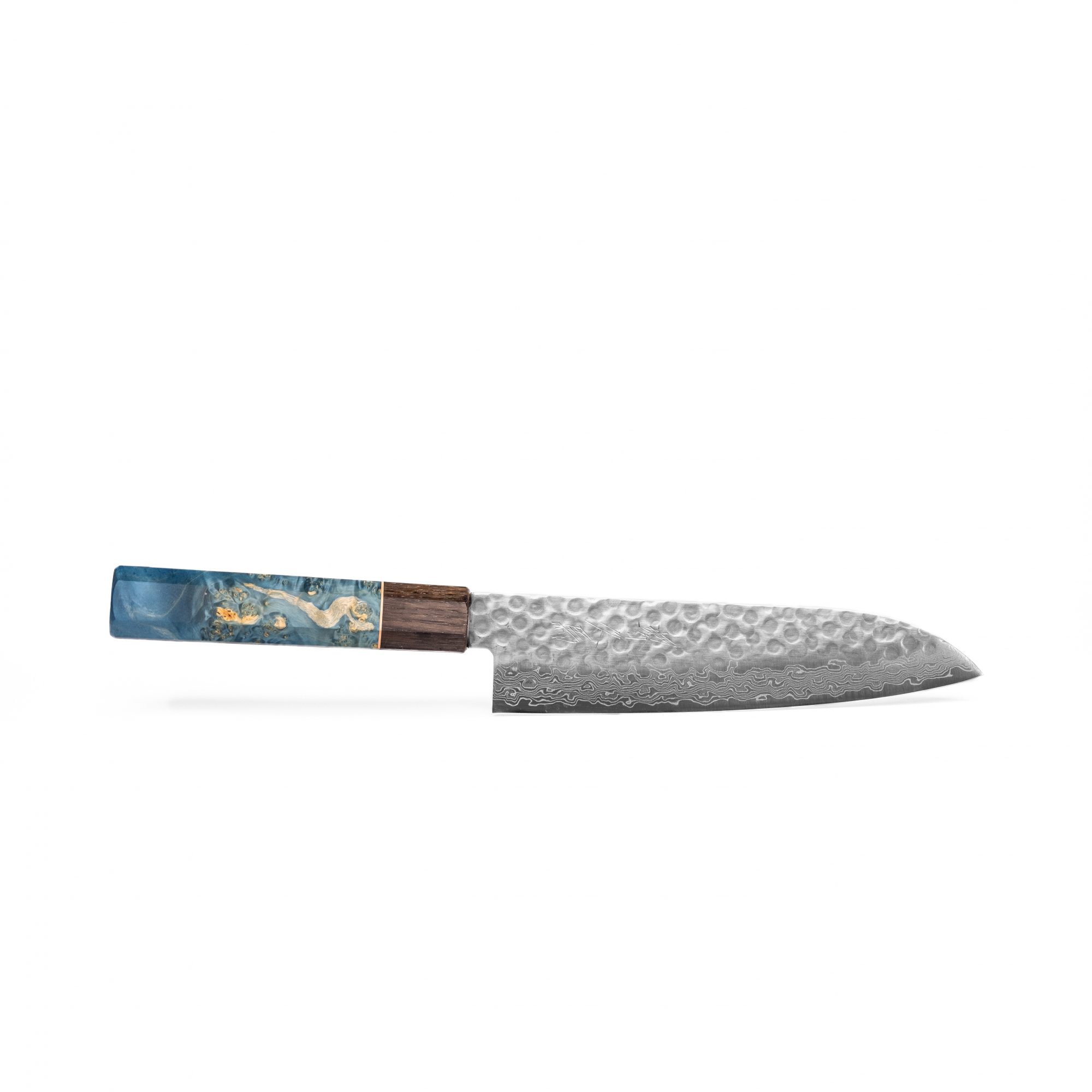
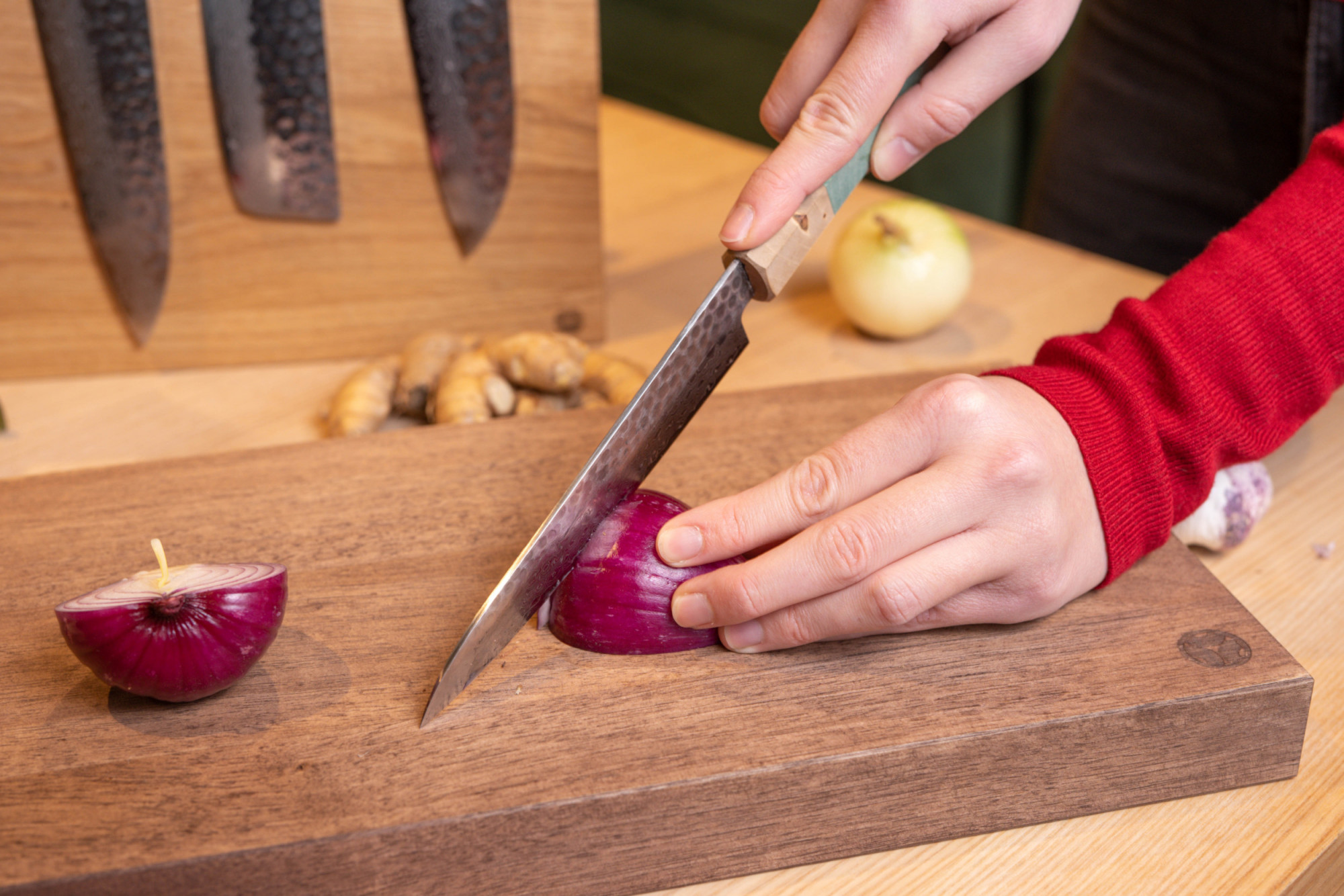
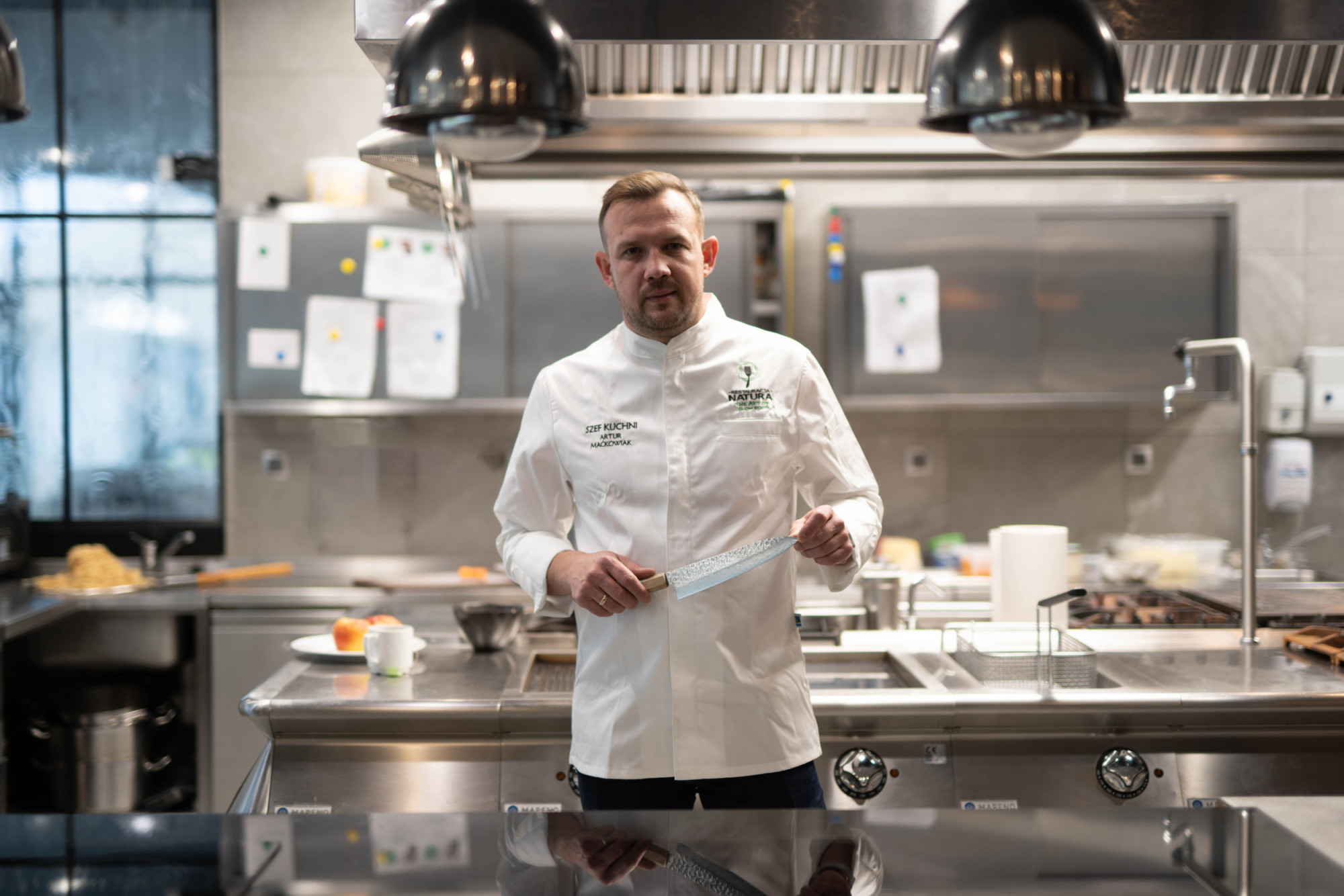
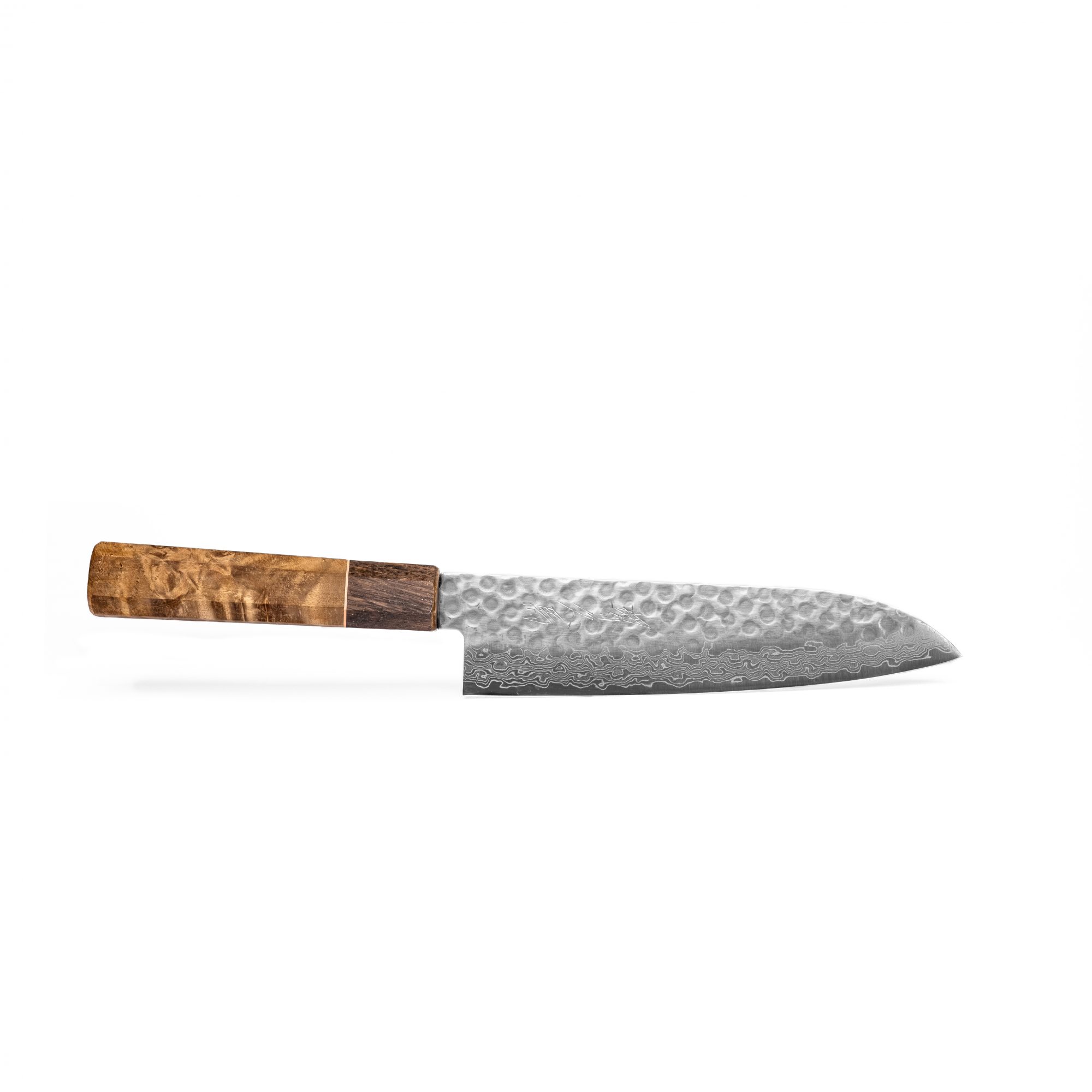
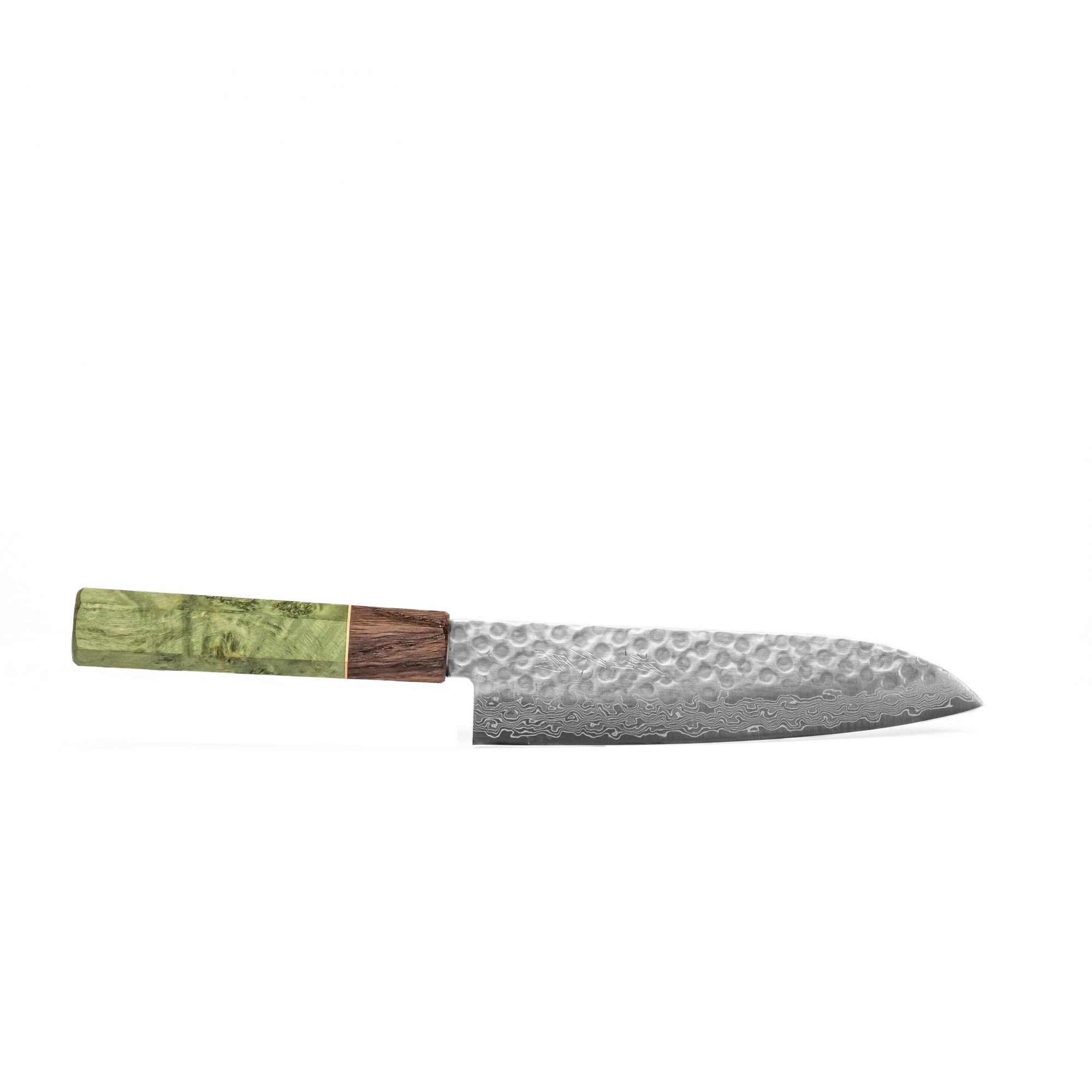
Quality in cut. Beauty in design. Drawing from a 600 year old blacksmithing tradition, The Sakai Kyuba 堺久馬 Santoku knife is designed to intensify pleasure from cooking. The Santoku is a general purpose chef’s knife which serves a variety of functions, it will become your go-to knife in the kitchen. The sharp blade is set in a premium-cut, waterproof stabilised maple burl dyed a Mediterranean Blue colour. The knife comes in a handcrafted, minimalist wooden box wrapped in a unique illustration strip. A lifetime guarantee. Used and recommended by world’s top chefs.
Lifetime warranty
Every knife we have ever made, covered for life.
Free UK delivery
Included on every order over £90.
100-day returns
Use it for three months. Send it back if it isn't right.
Hand-finished box
Hanko-stamped certificate, 5 yen coin tucked alongside.
Why this knife
The blade, and the thinking behind it.
The Santoku - Your Ultimate Chef's Knife
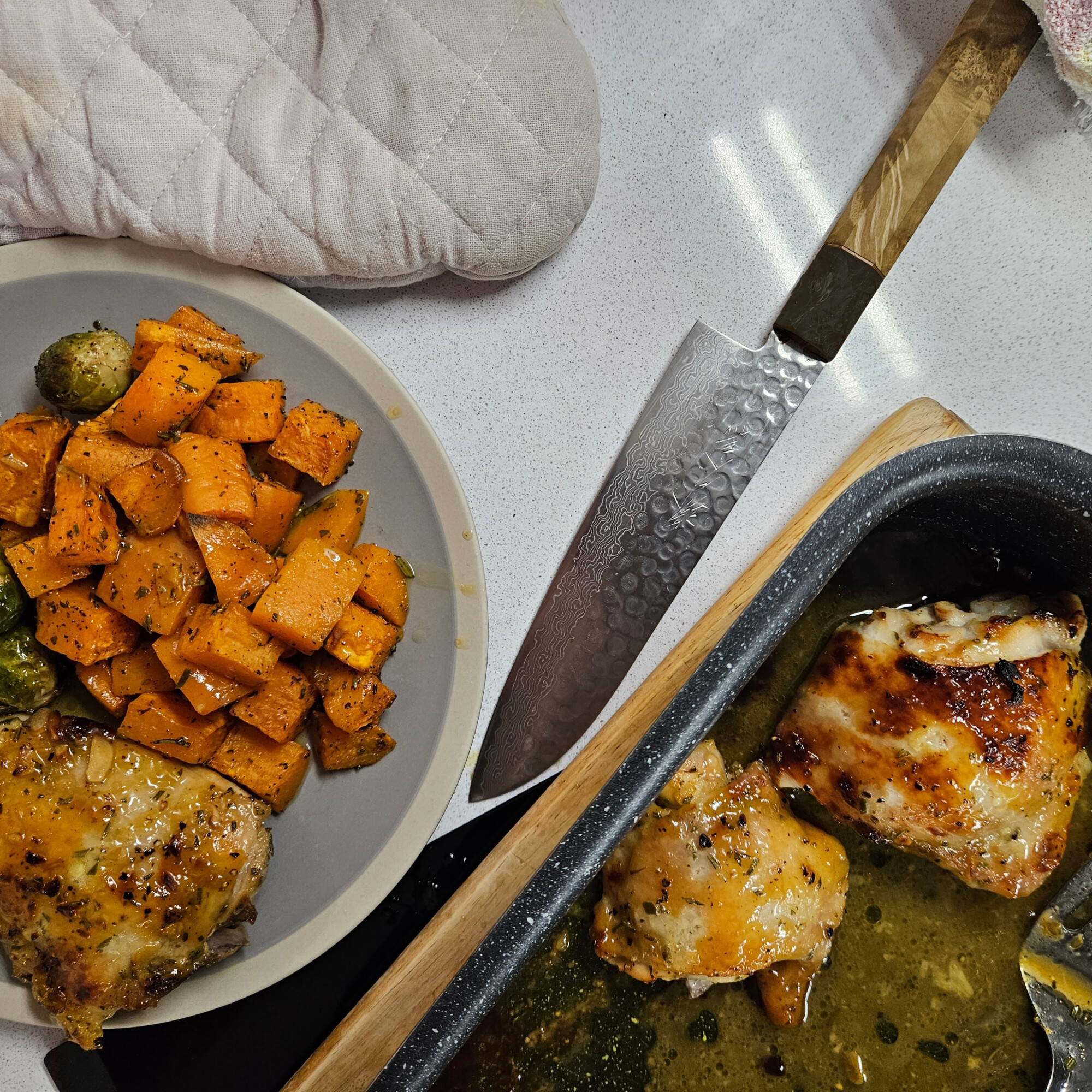
If you’re looking to invest in one good quality knife, then you should be looking at a Chef’s knife: a Gyuto or Santoku knife. While specialised knives may be easier to use in some applications, there are few chores that a Japanese Santoku knife cannot do in a pinch.
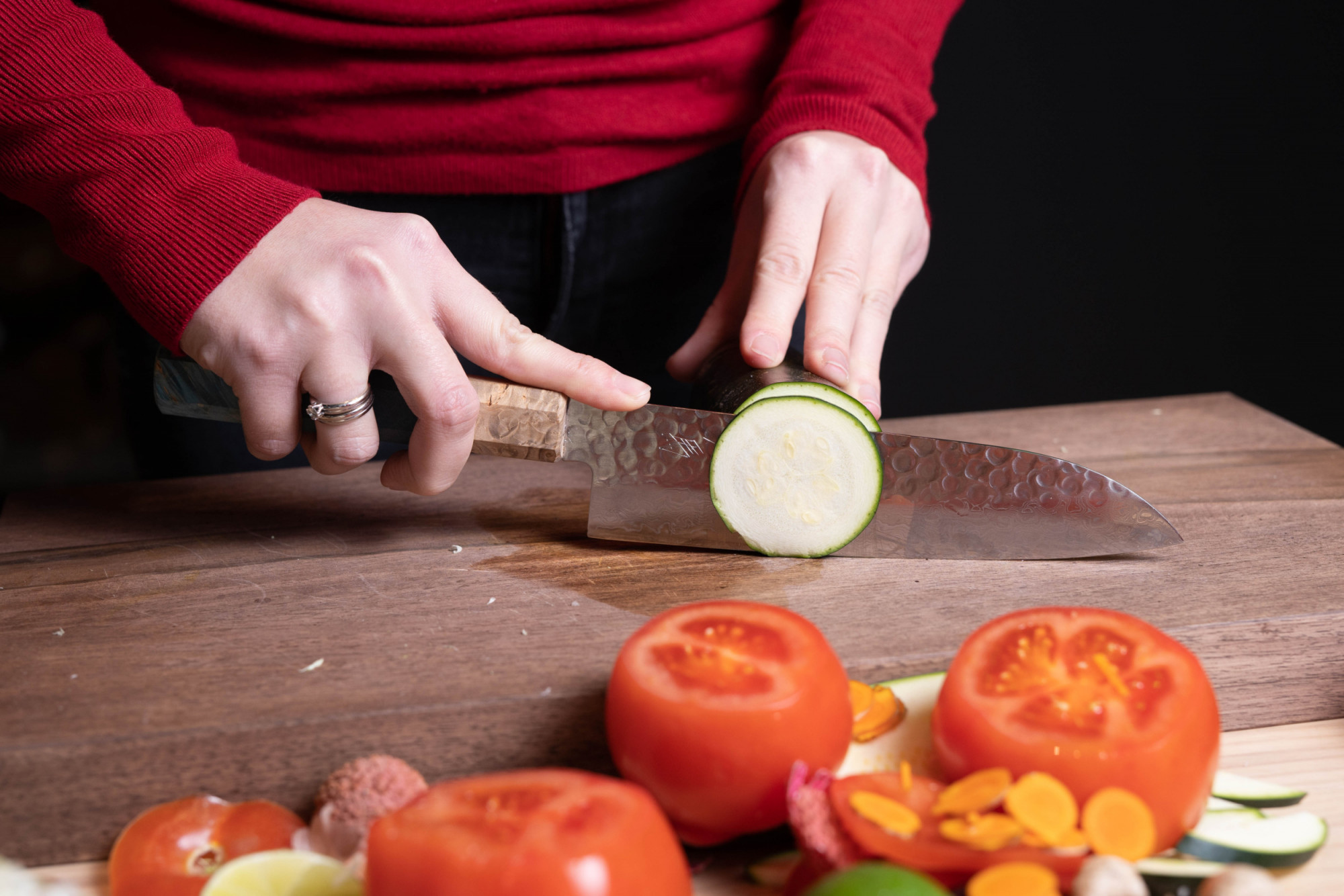
Santoku translates to “three virtues”: slicing, dicing and chopping. You can utilise a Santoku in most recipes that call for knife work, as they are true all-purpose workhorses.
Some (especially women who usually have smaller hands) consider Santoku to be more agile than Gyutos as they fit more comfortably in their hand due to their size. Santoku knives are usually shorter than long chef knives (less than 21cm) and have wide, flat blades and fairly blunt or slightly rounded tips. This helps combat hand fatigue and compensates for the fact that you have to actually chop and not rock.
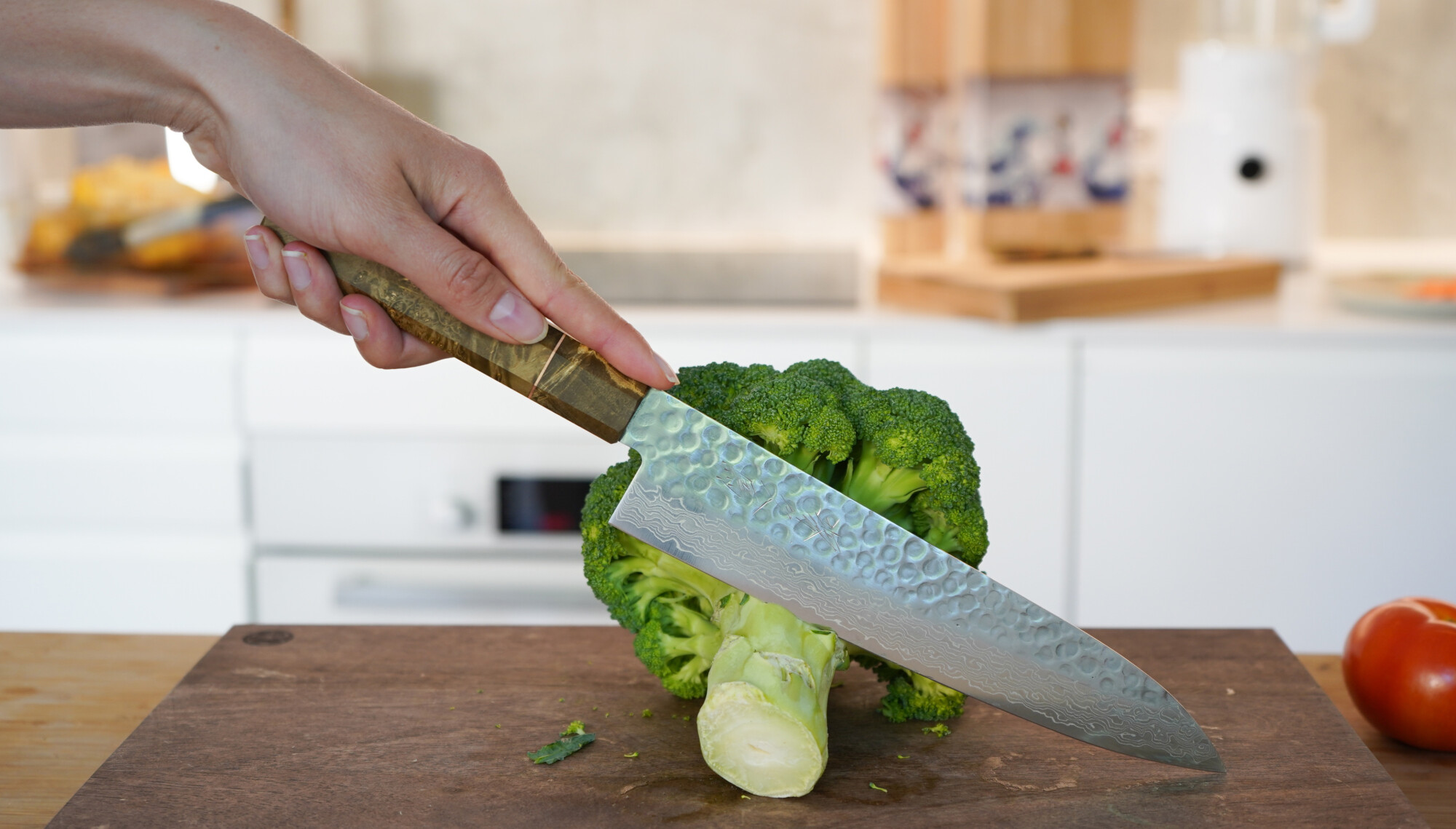
This Japanese Santoku knife is comfortable, light, and fast. Its double bevel makes it perfect for both left and right-handed use. A knife as unique and everlasting as the memories you will create using it.
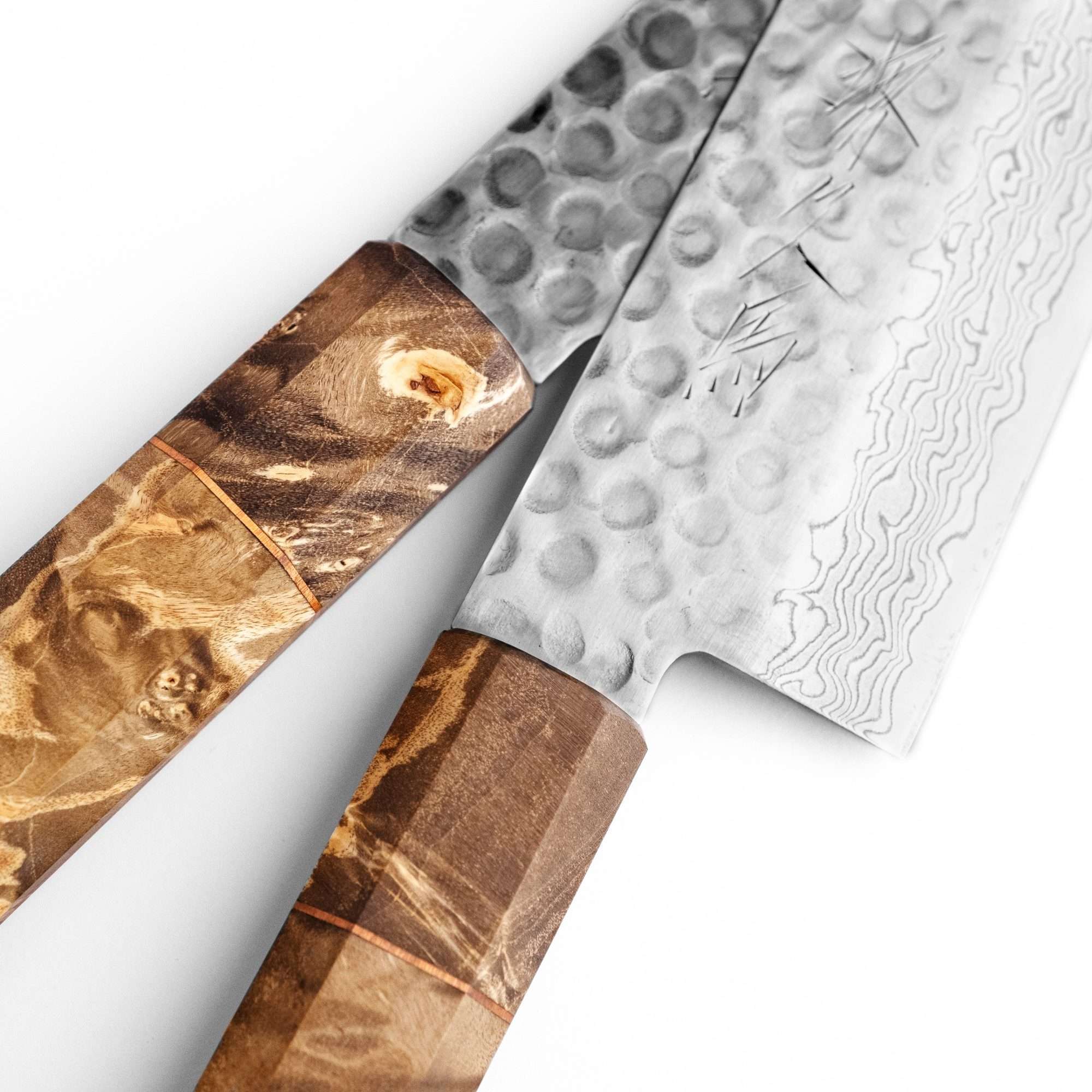

Sharpness, Versatility and Tradition
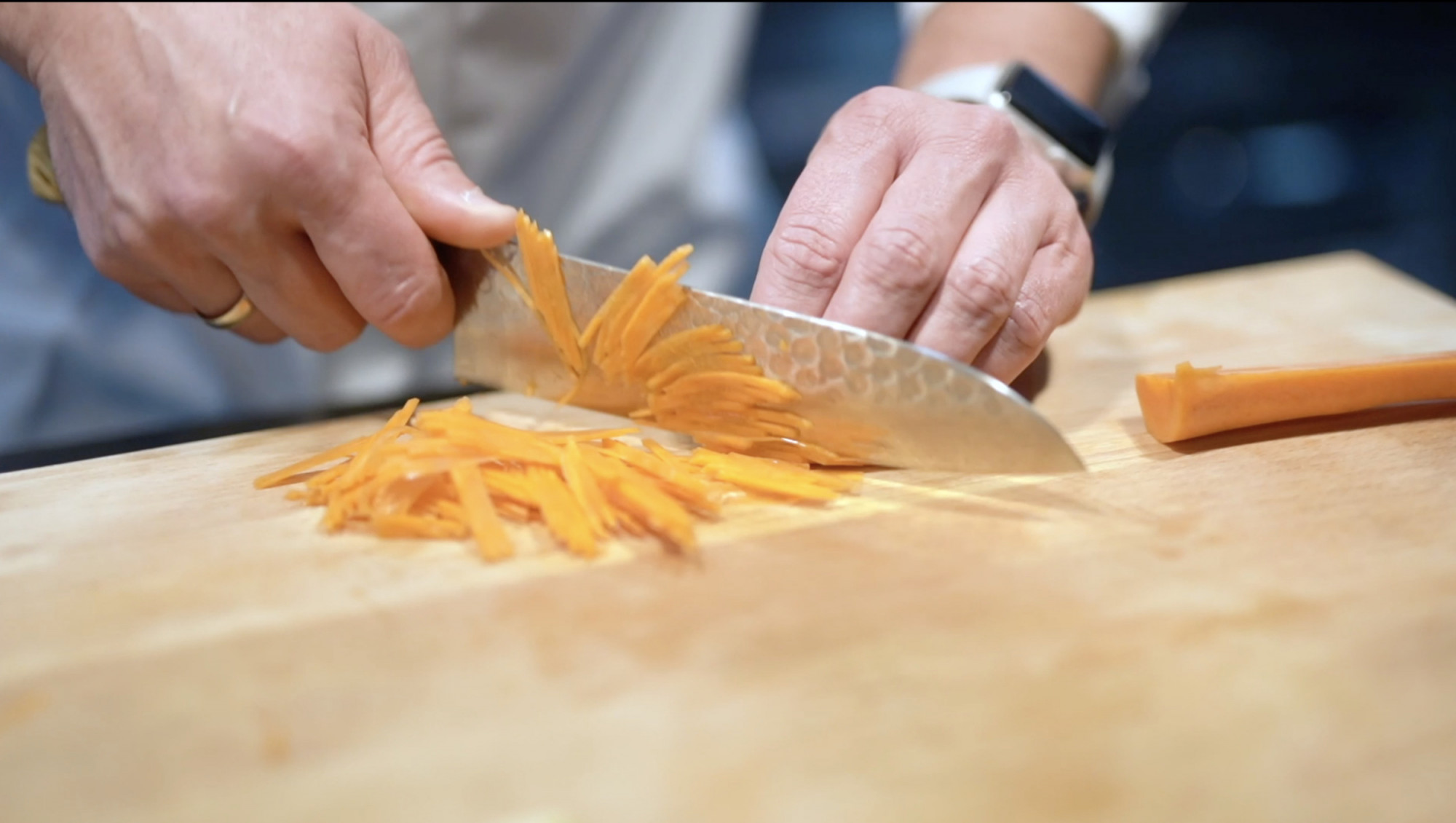
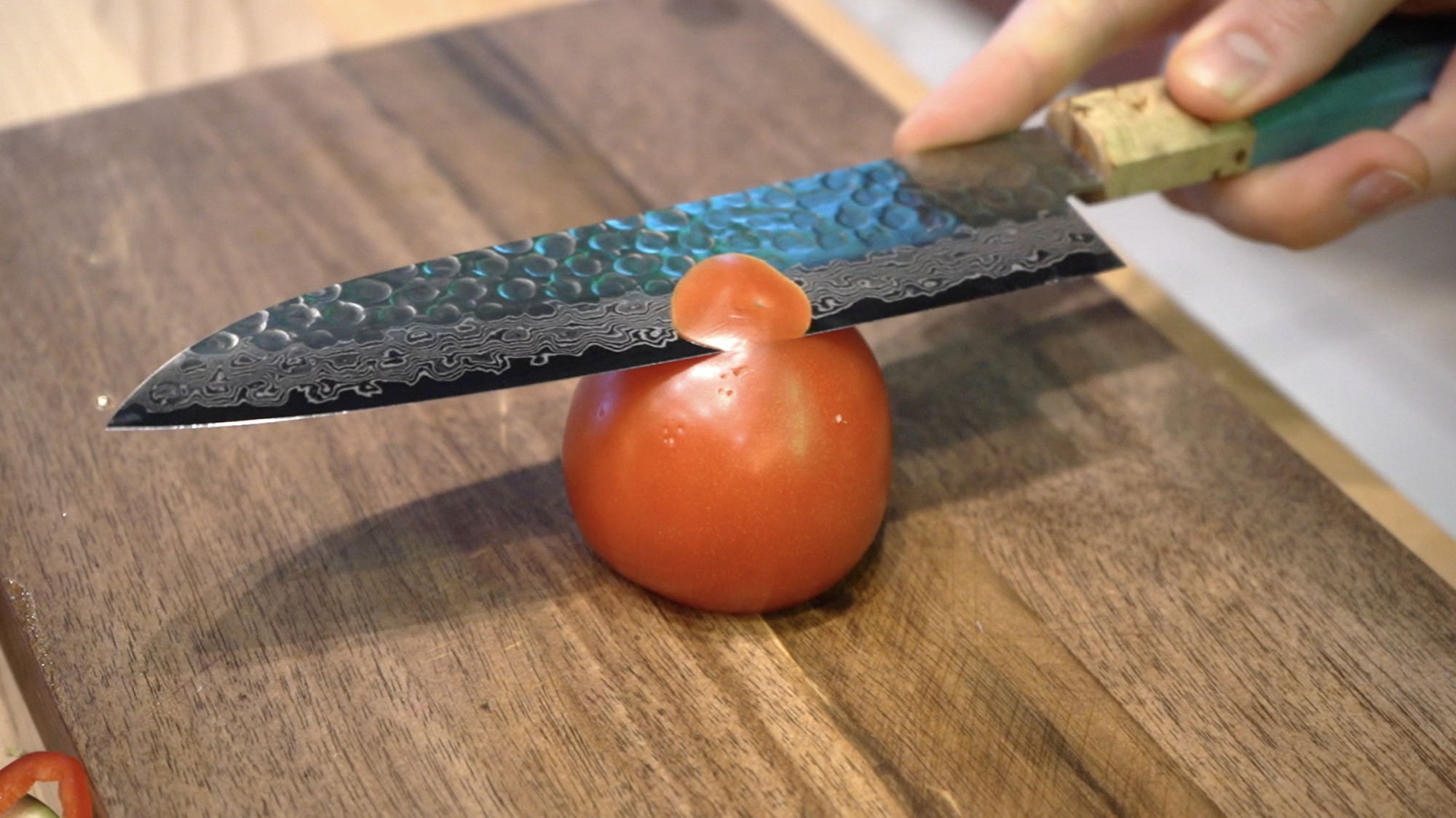
The blade in is designed to make cooking more enjoyable as cutting through produce will become an effortless task.
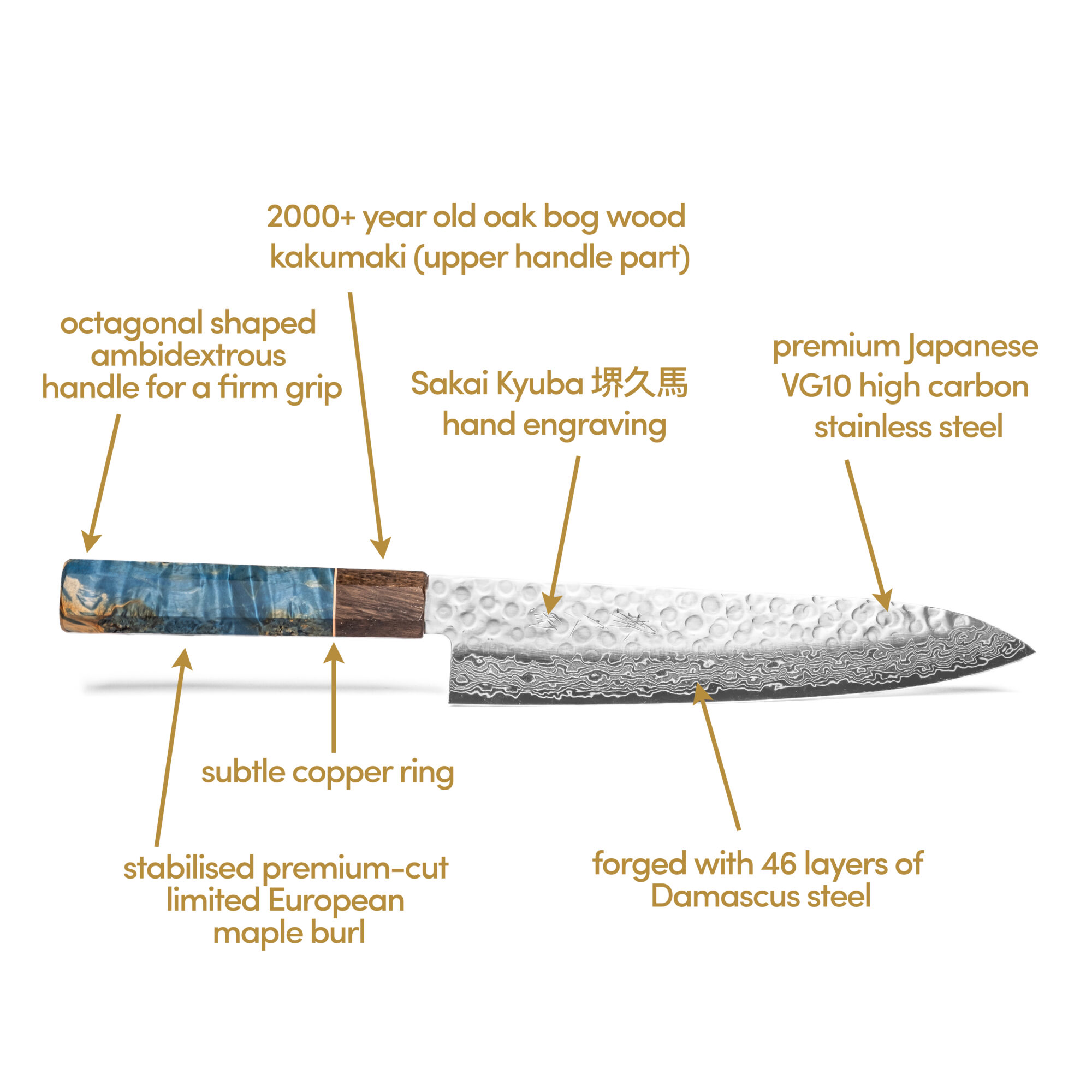
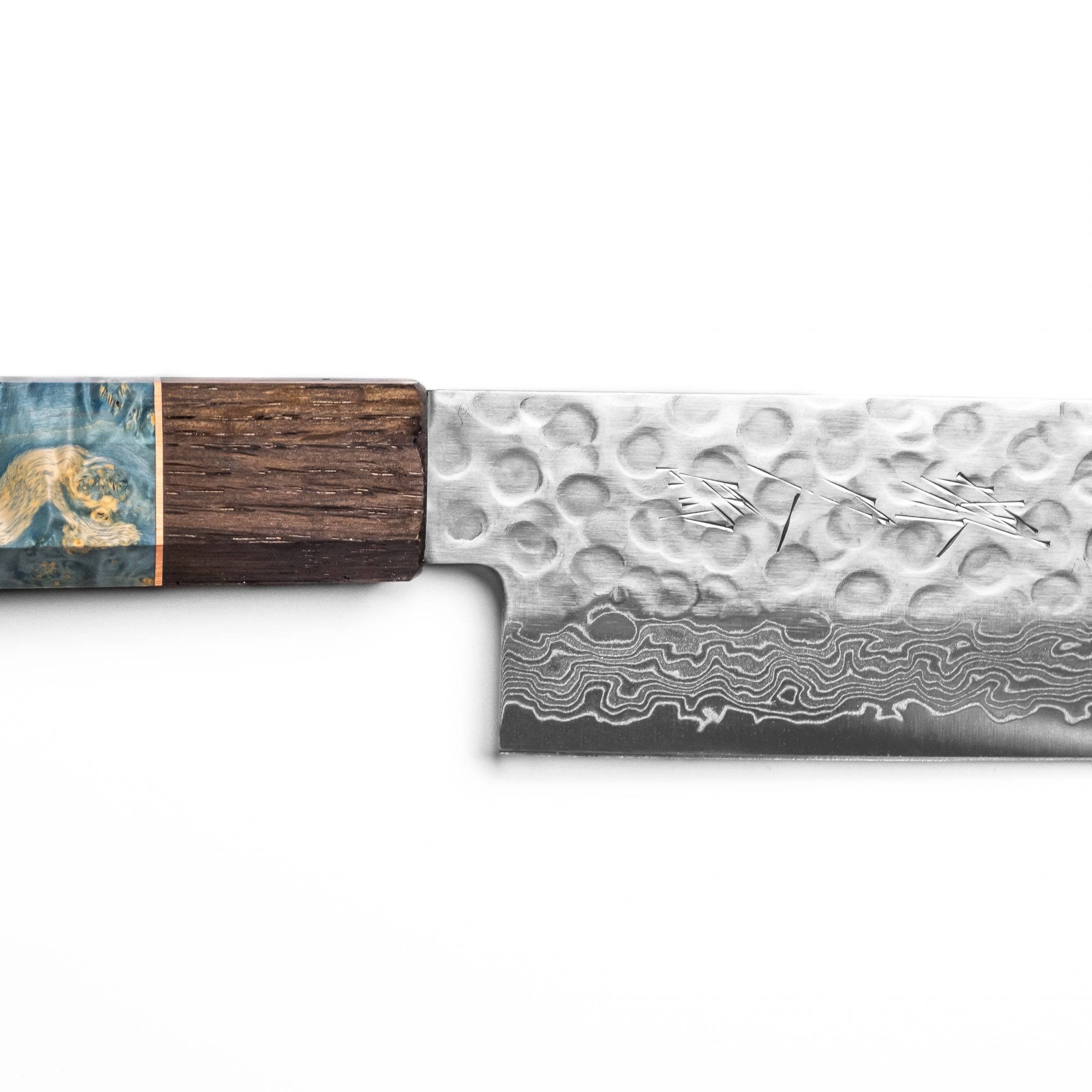
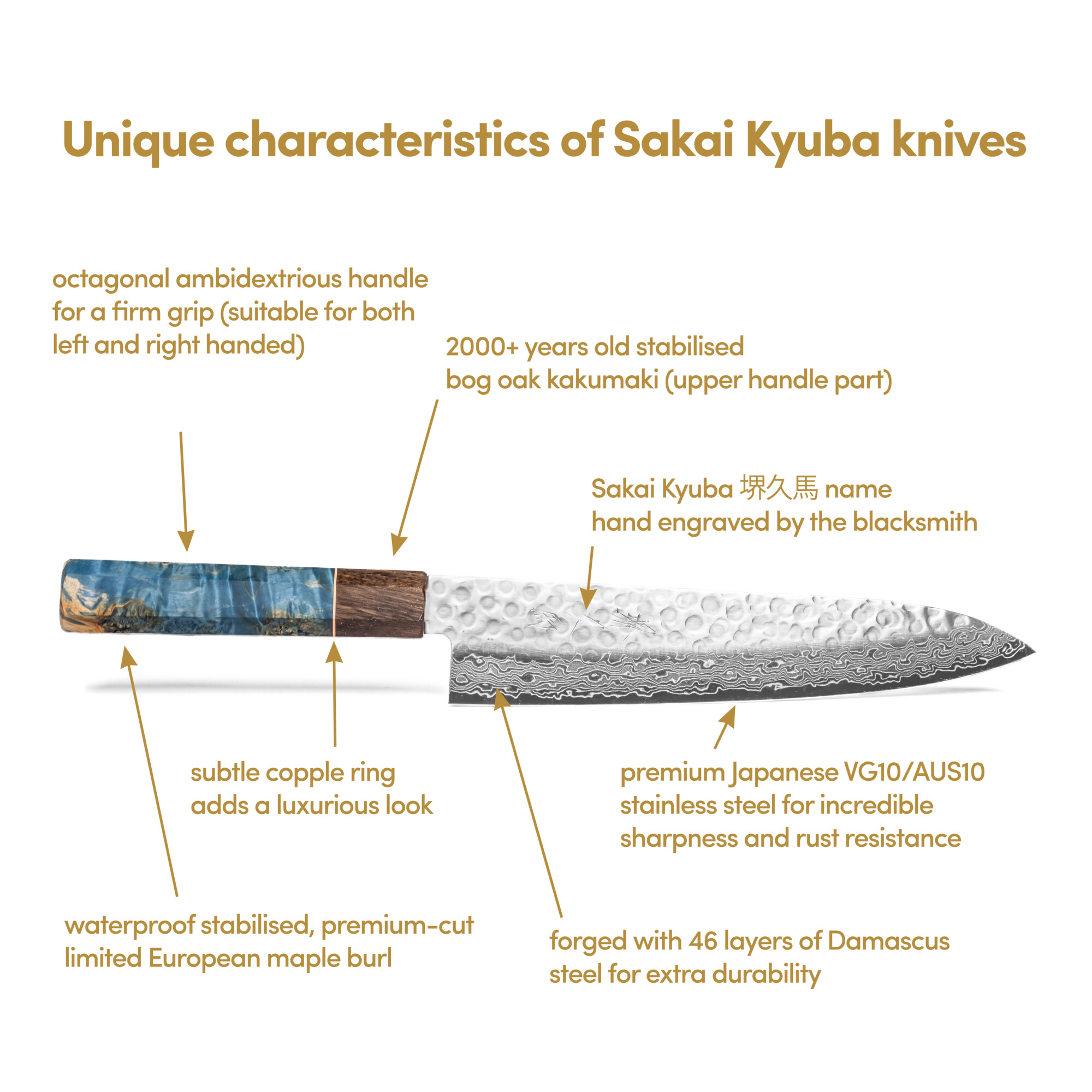
The blade is handcrafted by skilled Japanese blacksmiths in Sakai, Japan with premium Japanese AUS10 stainless steel.
It is a stainless steel with a high carbon content, making it harder than most stainless steel types. You get the hardness of a carbon steel but the corrosion resistance of stainless. Hence, AUS10 steel offers an excellent balance between toughness, durability, and a razor sharpness.
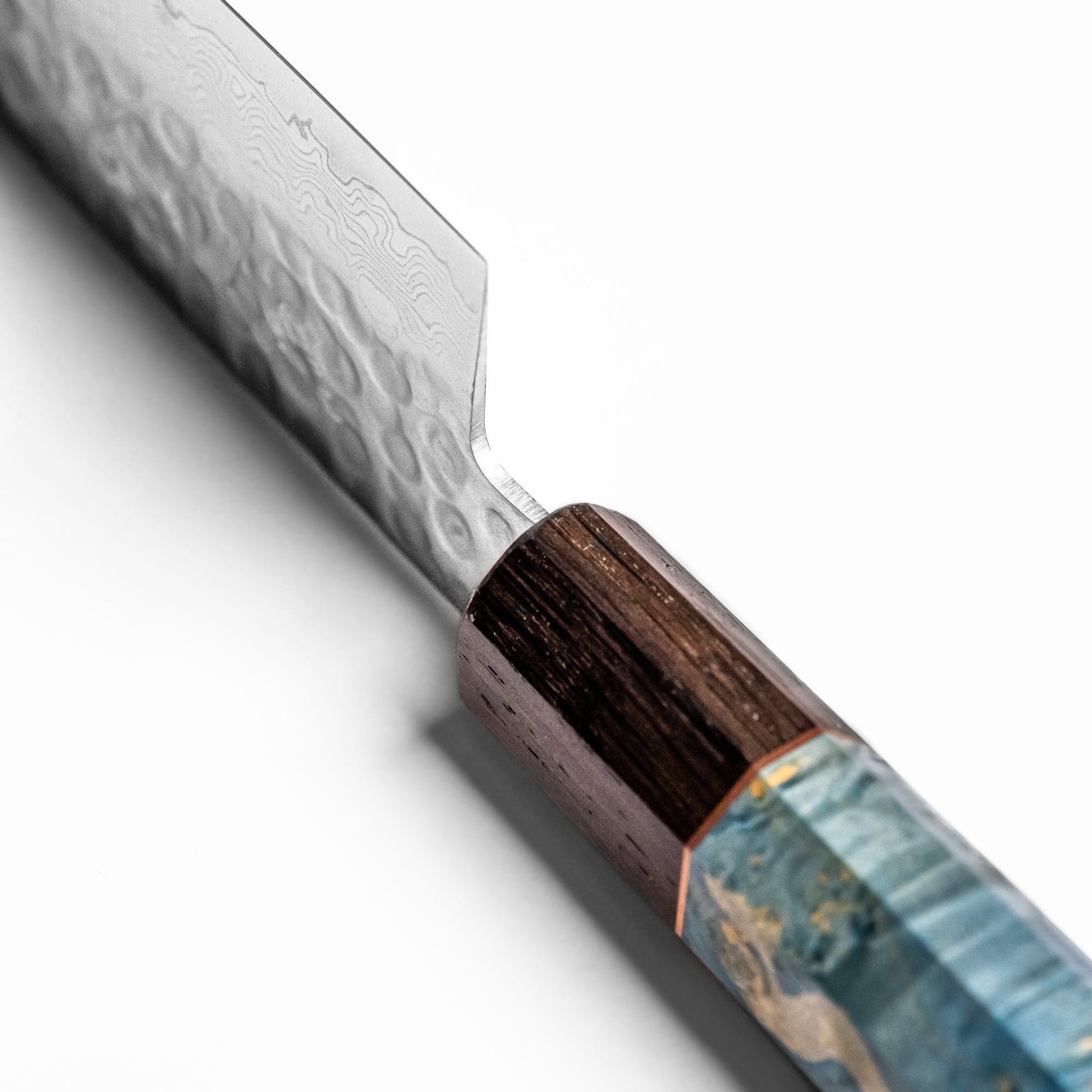
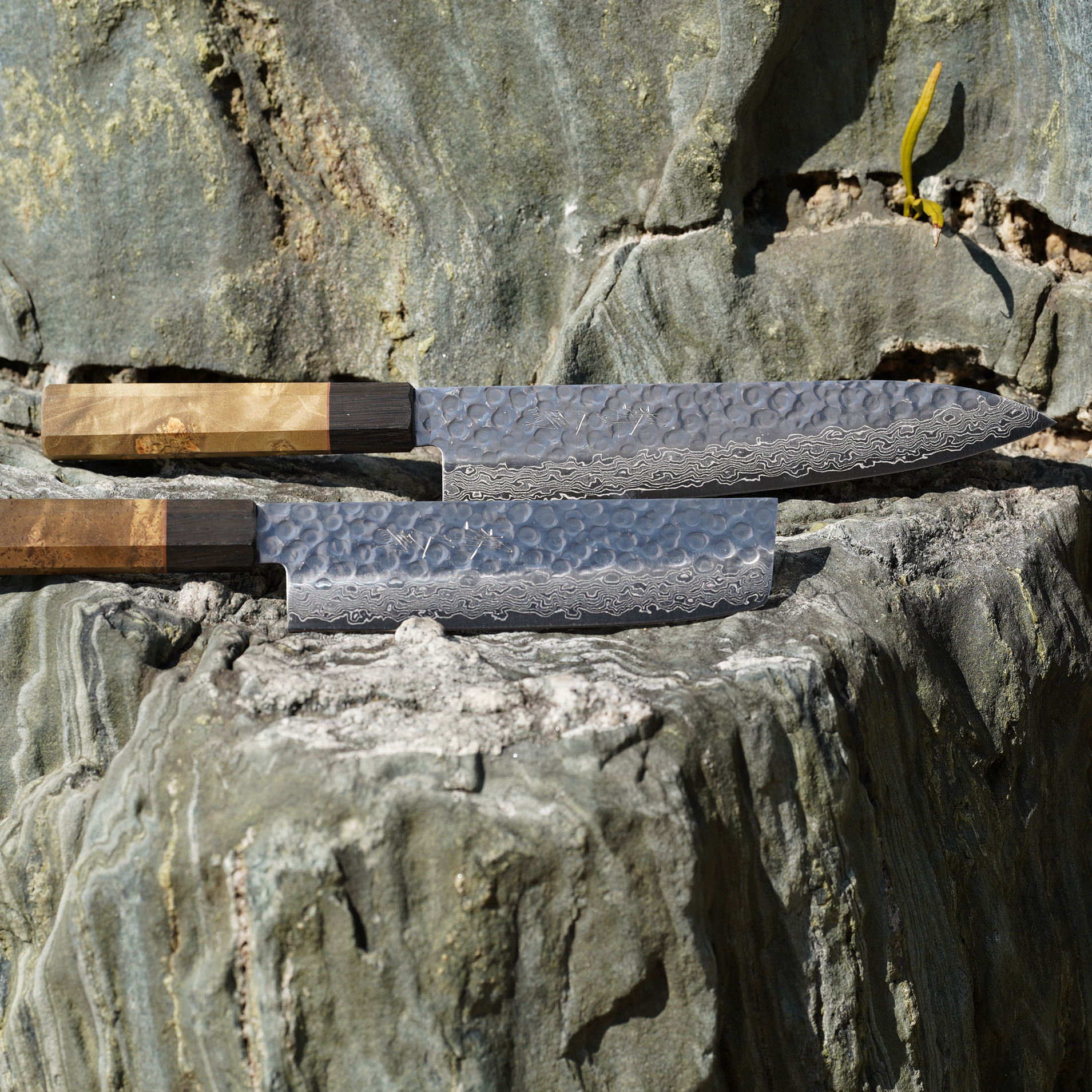
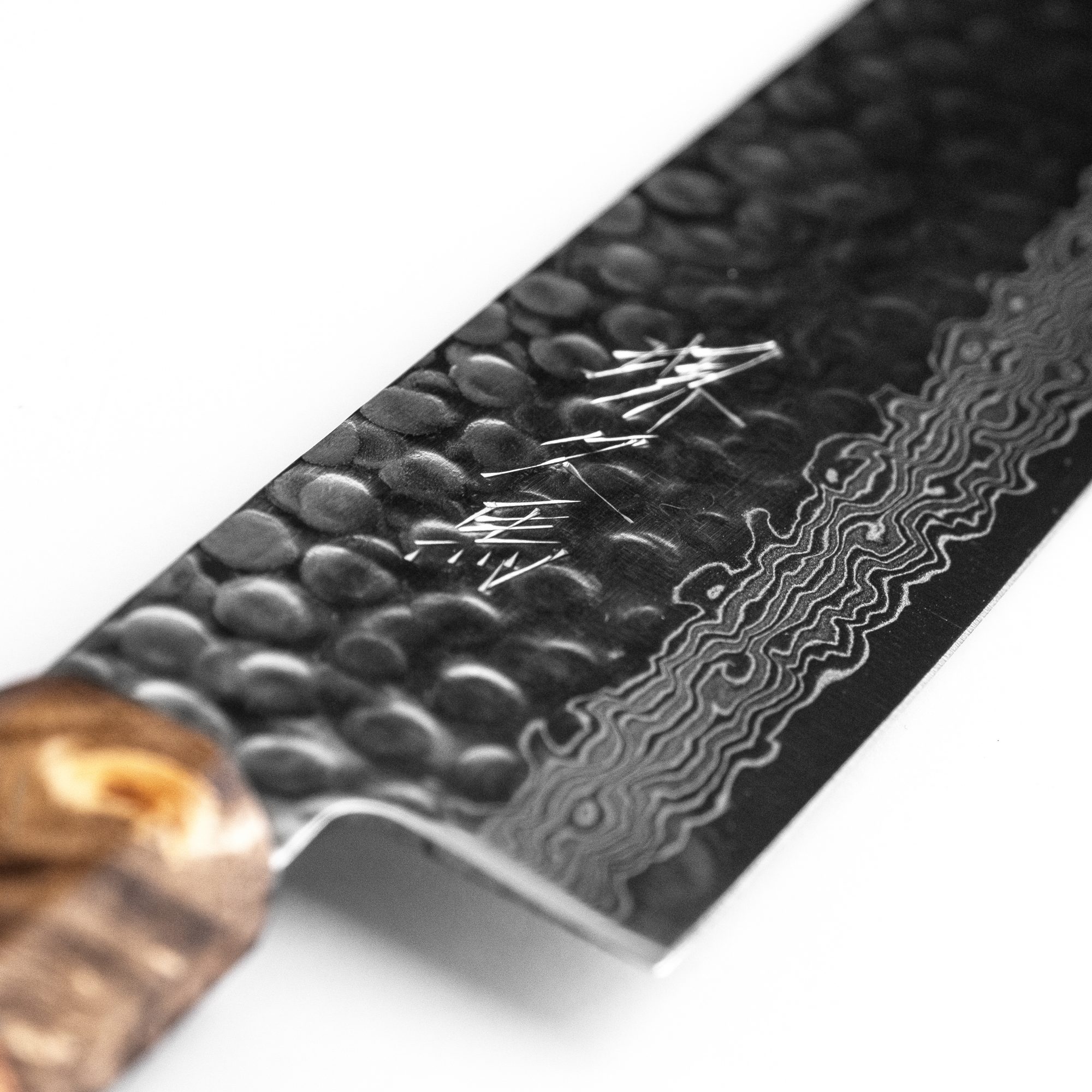
The blade has a Rockwell Hardness rating (HRC) of 62 which means the edge stays noticeably sharper for a longer time. This means you won’t have to worry about sharpening them often. It is forged with 46 layers of Damascus steel which is legendary for its plasticity, hardness and distinctive patterns. The blade will allow foods to be easily and promptly cut with precision.
No Handle Pattern
Is The Same
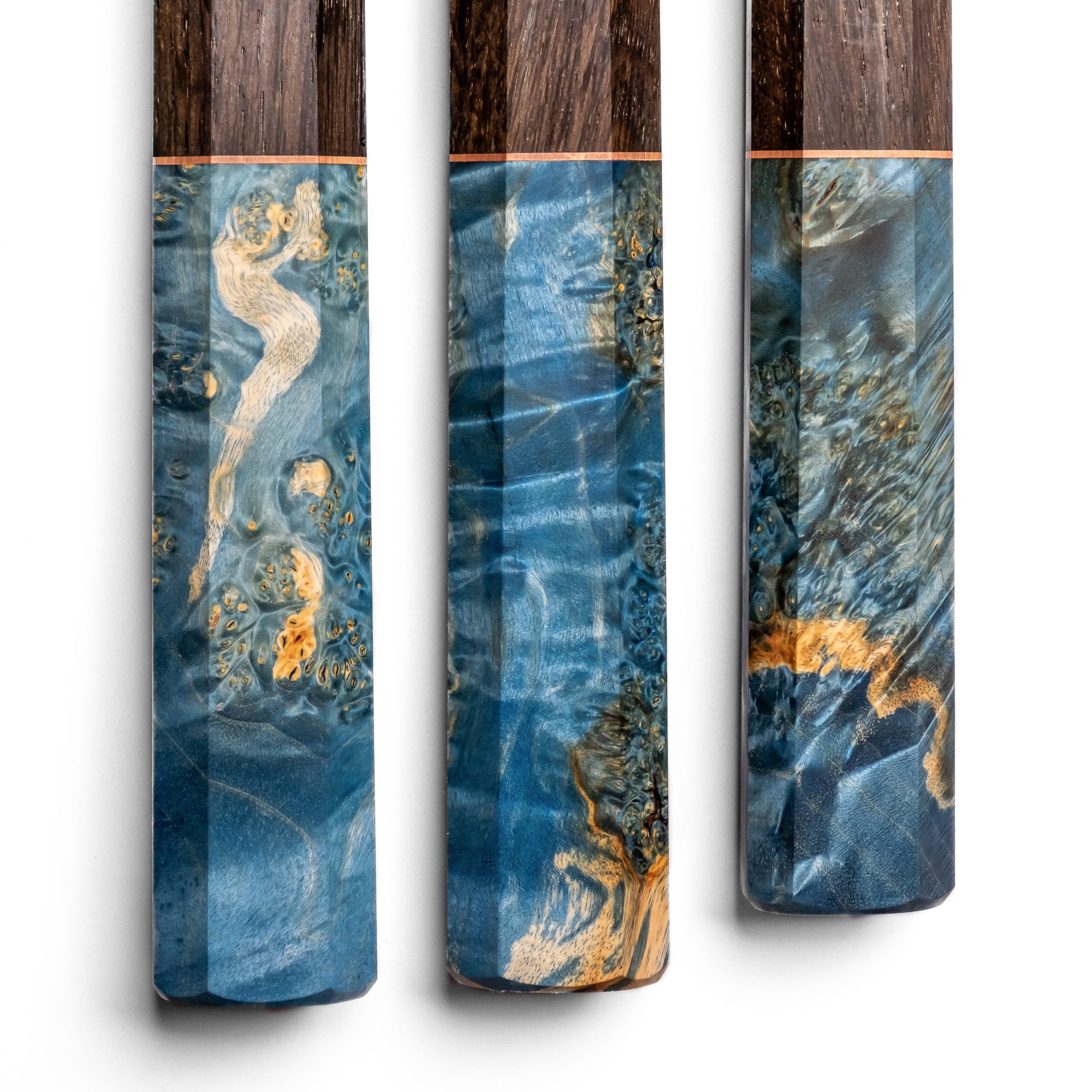
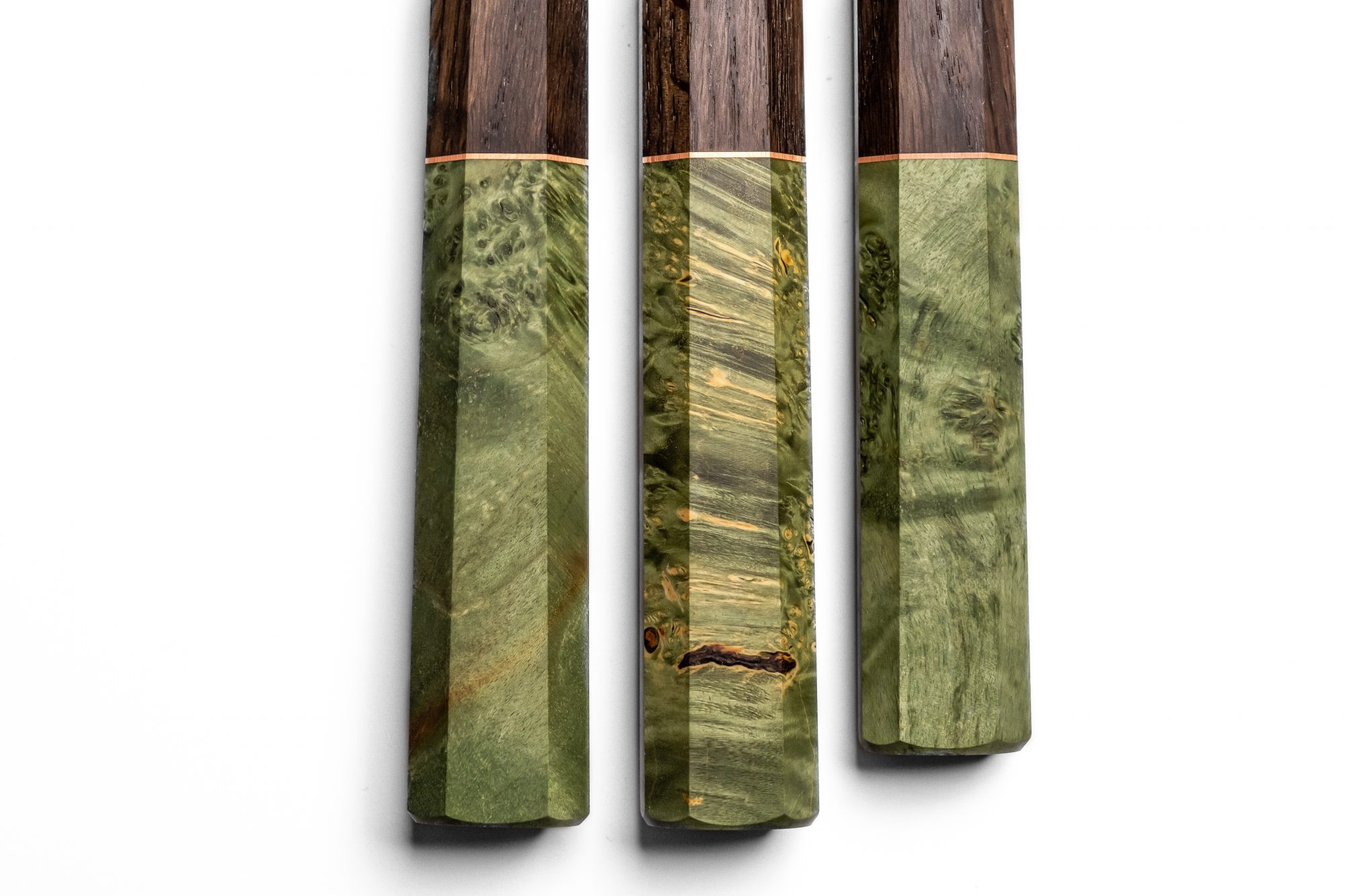
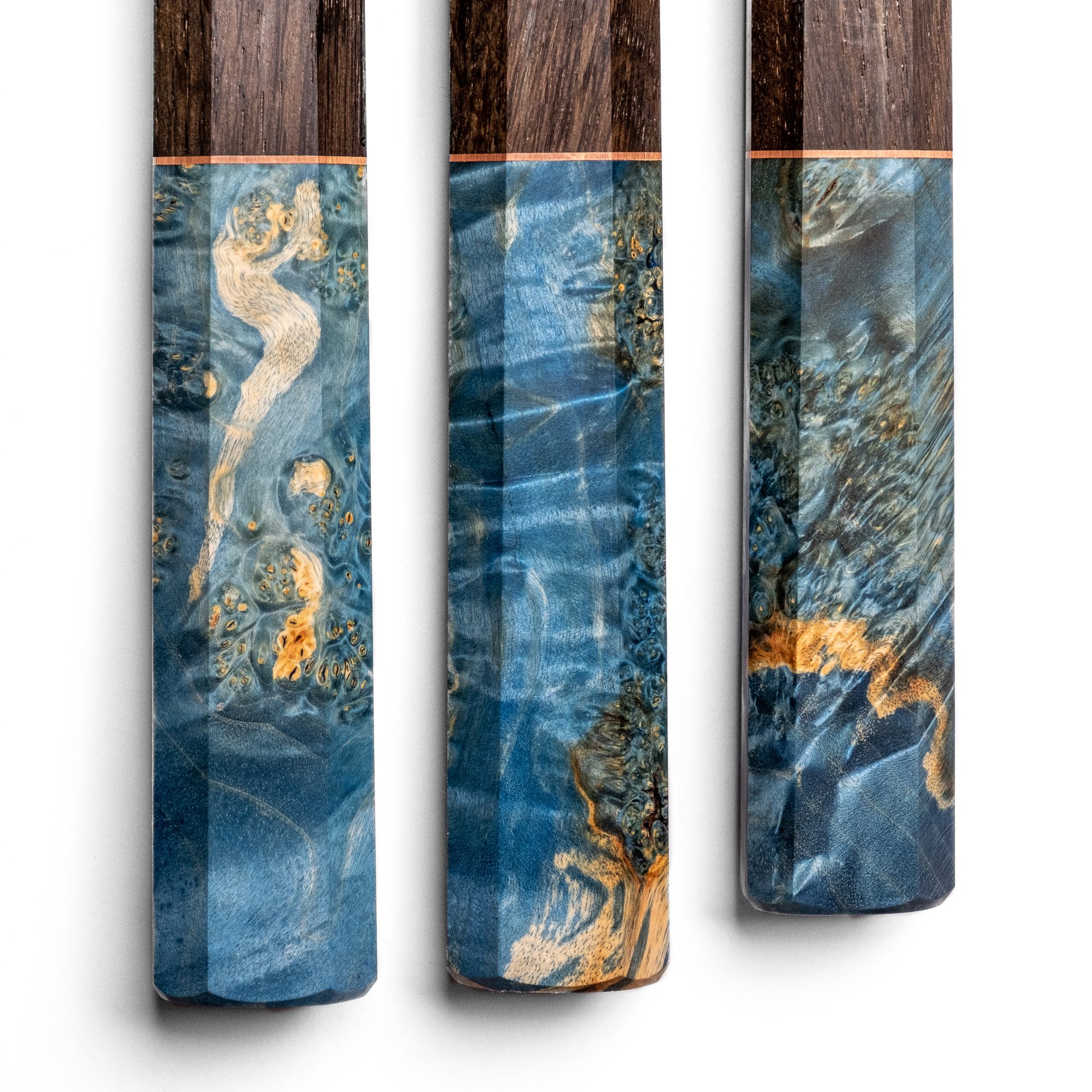
The beautiful handle is made with extremely limited European maple burl dyed in an Mediterranean Blue colour and feature a subtle copper ring under the oak bog wood kakumaki (collar of the handle). The wood has to be dried for two years before it undergoes the process of stabilisation. This ensures the wood is completely waterproof to avoid bacteria growth and is able to last generations.
The blade’s kakumaki (collar) is made with oak bog wood. A wood ranging from 2,500 to 5,000 years in age. Its age and living conditions give it a unique character and rich natural colour variation determined by its age. Giving you a knife with a rich history.
The stabilised premium-cut maple burl is shaped into an octagonal shaped ambidextrous handle to give you a firm grip on the knife. Not only are the handles aesthetically pleasing, they are also perfectly balanced, light and comfortable. This allows for maximum precision and more controlled movements during use.
No two handle colours or patterns are ever the same as the natural properties of each wood block are unique and will absorb the colour dye differently. This will give each knife a beautiful unique look and it can serve as an unforgettable gift.
Because Presentation And Packaging Matter Just As Much

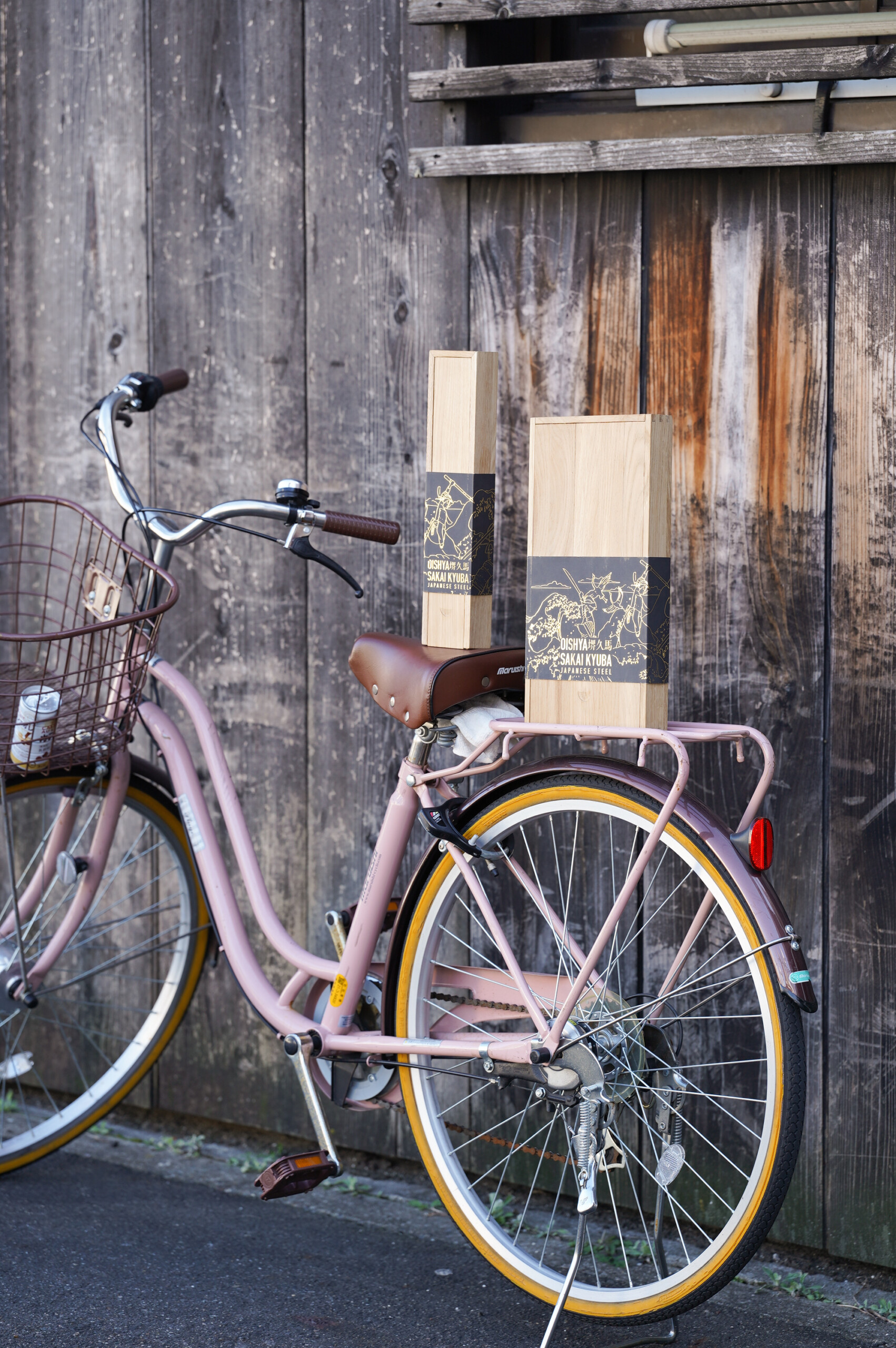
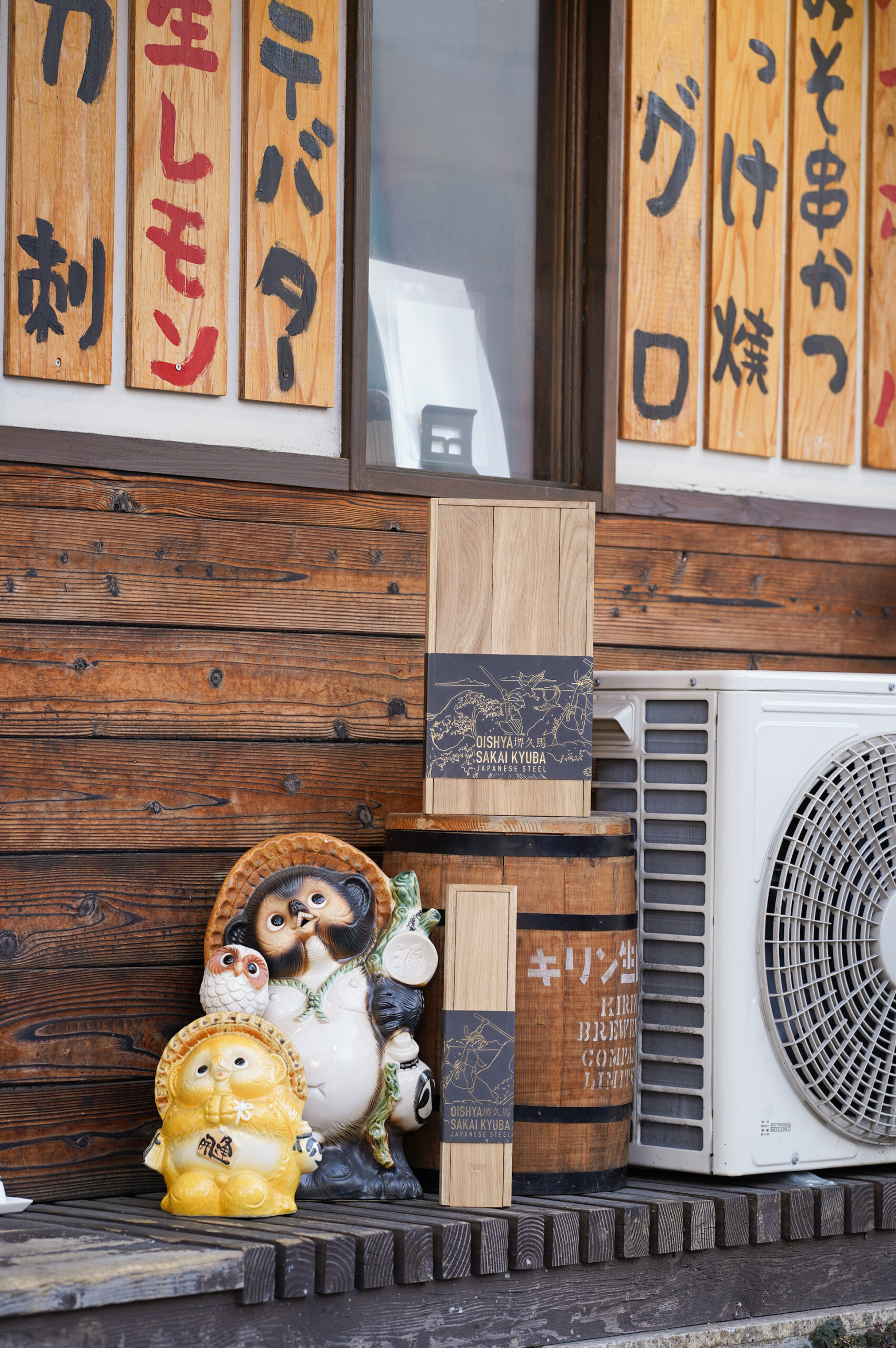
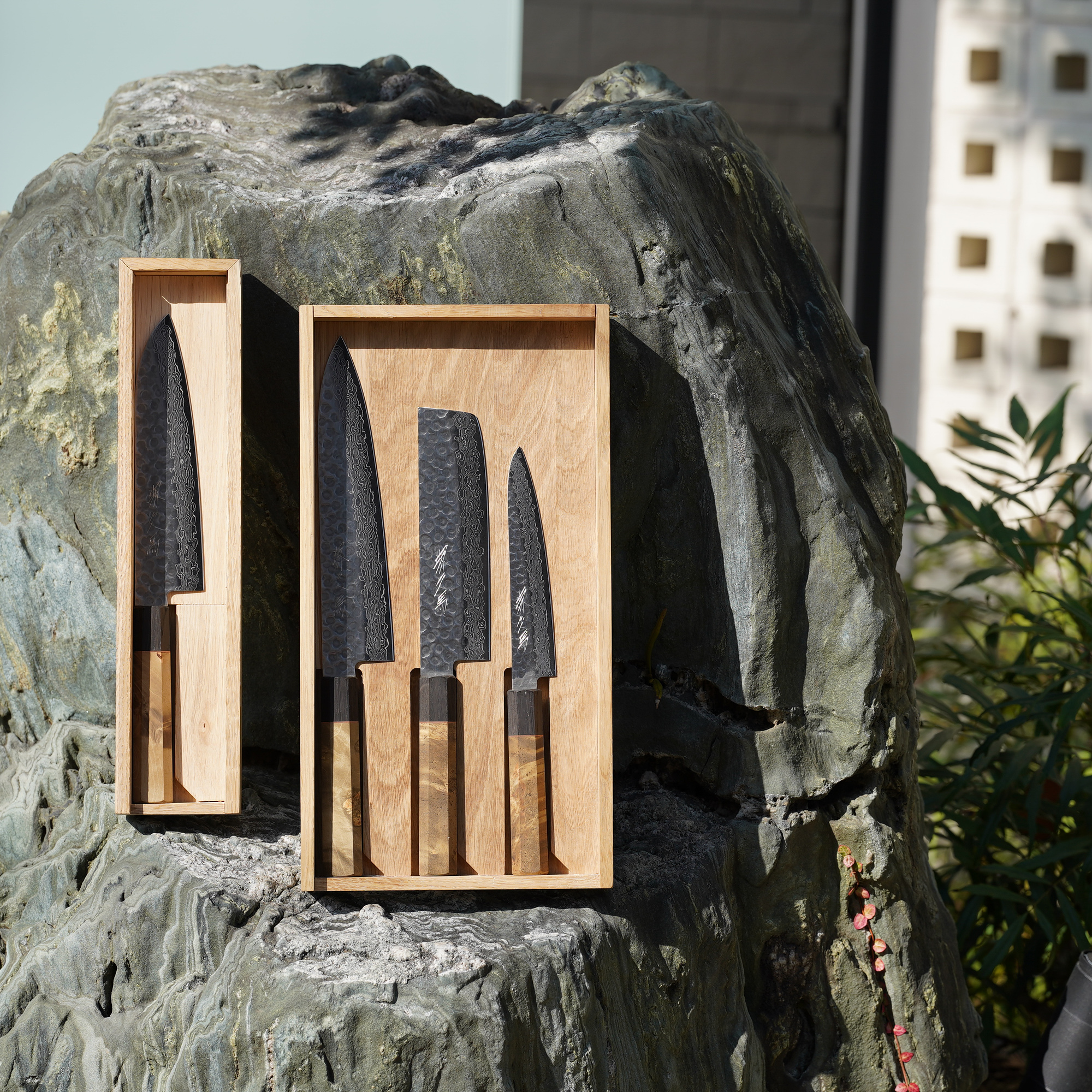
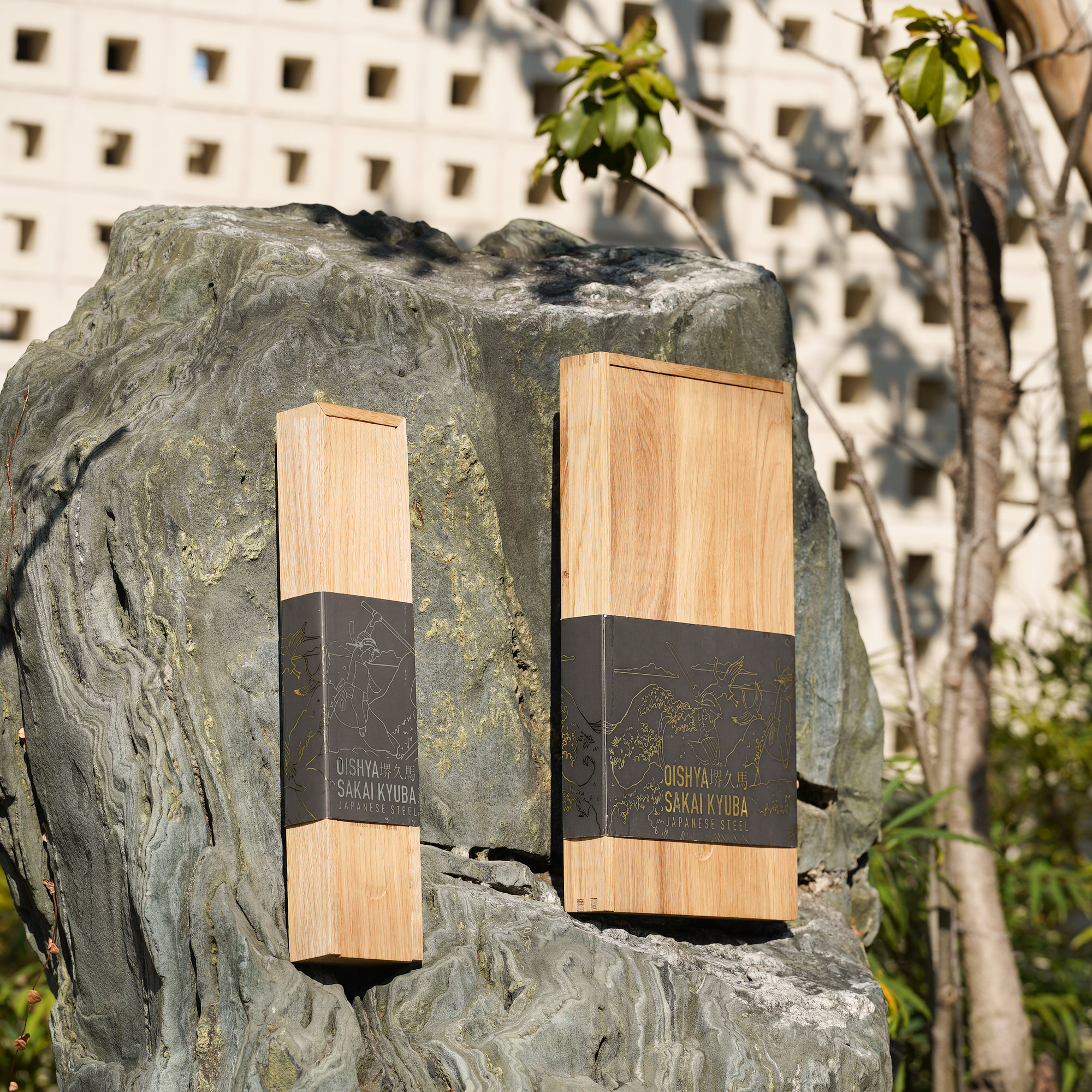
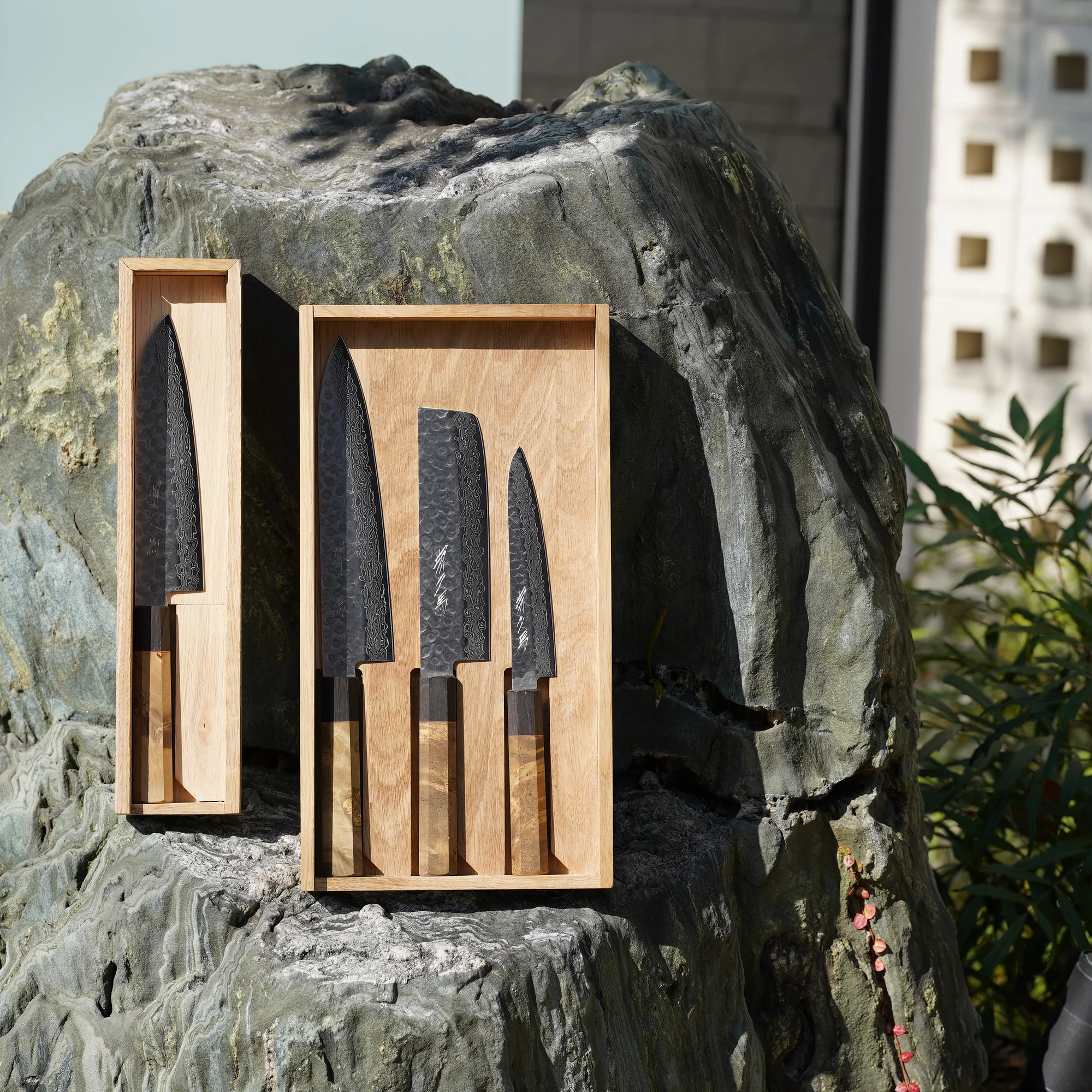
All Sakai Kyuba kitchen knives come in a handcrafted, minimalist European Oak wooden box with a delicate waxed finish. The box is wrapped in a Oishya signature illustration strip featuring the Onna Bugeisha – Japanese female warriors.
Inside, you’ll see a beautiful note with a genuine 5 Japanese yen coin for luck. There’s an ancient superstition that giving someone a knife is bad luck because it cuts the relationship between the giver and the recipient. The way around this is to attach a coin of symbolic value to the knife, which is then returned to the giver as a form of payment. As we want you to maintain your relationships with your loved ones, here is a 5 yen coin.
The Japanese for five yen go en (五円) is a homophone with go-en (御縁), which means relationship, connection and bond. So by exchanging this coin with the receiver you no longer have to worry about this superstition.
The blade
Specifications.
| Weight | 0.7 kg |
|---|---|
| Dimensions | 45 × 10 × 6 cm |
| Knife Type | |
| Blade Length | |
| Steel Type | |
| HRC | |
| Knife Bevel | Double |
| Hand Feature | Ambidextrous |
| Handle Waterproof | Yes |
| Made in | Japan |
| Maker | Sakai Kyuba 堺久馬, Oishya |
| Knife Handle Material | |
| Knife Weight | 150g |
The hands that make it
Sakai. Six hundred years of blade-making.
Sakai, in Osaka, is the birthplace of the traditional Japanese kitchen knife — a craft passed down for six hundred years, descended from the methods used to forge samurai swords. KYU is the flagship of our range, forged there by a master blacksmith whose family has been at this work since 1927. We make his blades under the name Sakai Kyuba.
The steel is AUS10, folded into 46 hammered Damascus layers and hardened to HRC 62. Each blade passes through around two hundred and twenty separate steps over roughly three months — the forging, folding, quenching, grinding, polishing and sharpening all done by hand, on a small scale.
The handle is finished in Małopolska, Poland, by craftsmen who shape every one by hand: a stabilised maple burl body and a bog oak ferrule — the kakumaki. Blade and handle meet at a single hand-fitted copper ring, set with a soft tap of a wooden mallet, in an octagonal profile.
Care, briefly
Three habits, and it outlasts you.
01.
Hand wash, dry immediately.
Never the dishwasher. Sixty seconds at the sink, then a soft towel. Water on hard Japanese steel is the only thing that rusts it.
02.
Wood boards only.
Glass, stone and marble are harder than the steel and dull the edge in a week. End-grain hardwood is the right choice — hinoki cypress if you can find it.
03.
Sharpen on a stone.
Never a honing rod — the steel is too hard, it chips the edge. A 1000/6000 whetstone every three or four months keeps it keen.
What you receive
In the box.
- The knife, sharpened, oiled, wrapped in cloth.
- A hand-finished box for the knife.
- A Certificate of Authenticity, hand-stamped with the maker's hanko, naming the smith and certifying the blade.
- A 5 yen coin tucked alongside. "Go en" — the Japanese for five yen — is the homophone for luck, connection and bond. Returning the coin to the giver turns the gift-knife into a symbolic purchase, neutralising the old superstition that a knife as a gift cuts the bond between giver and receiver.
- A care card with the sixty-second wash routine and a link to Knife School.
- Your lifetime warranty, registered to you automatically when the order ships.
Frequently asked.
Is it dishwasher safe?
How often will I need to sharpen it?
Can I use it to cut meat?
How long does shipping take?
What if it isn't right for my kitchen?
From the people who cook with it
Reviews.
Absolutely gorgeous. Balanced very well. It’s sharp but not scary sharp where you would be scared of hurting yourself easily. Definitely a display knife.
Perfect knife to add to our collection from Oishya! The handles color stands out and these knives are ALWAYS the focus in the kitchen!
Knife is excellent. were some issues with the delivery but the team was very helpful.
This Santoku has become my go-to knife. The olive green handle is beautiful.
This Santoku has become my go-to knife. The natural brown handle is beautiful.
More from the line
The rest of the line.
Related products


Not sure this is the one?
Take two minutes.
Six questions about the way you actually cook. We'll point you to the knife that fits.
Take the Knife Quiz