
Our story
It started with a knife Kamila couldn't find.
A Christmas gift in 2015. A letter to a Japanese blacksmith. Ten years later, knives in twenty-eight countries. This is the long way around.
Oishya is a London company, founded in 2016 as Japana (Japana Home) and renamed Oishya in 2022, selling Japanese kitchen knives forged in Sakai and Seki with handles made in Poland, direct to home cooks.
The names on the boxes meant nothing to her.
Late in 2015, Kamila went looking for a Japanese kitchen knife to give her partner for Christmas. Something proper. Something he would keep.
In a London department store she saw a Damascus blade for the first time. Over £500, with a maker’s name on the box. In the same shop, others cost a thousand pounds and more, each with a name that collectors clearly knew.
Kamila didn’t. She could search the names, but what came back was written for collectors, on websites half in kanji and half in marketing copy. None of it answered the questions she actually had: who had made the knife, what made it worth the price, and whether it would last.
So she did the one thing she could. She found a Japanese bladesmith online, wrote to him directly and asked if he would make her one. He did. Hand-forged, engraved, wrapped in cloth and posted from a town in Japan she had never been to.

He looked at it for a long time before he said anything.
On Christmas morning he unwrapped it carefully, set it on the counter and looked at it the way you look at something that matters.
Then he used it. Then he showed it to people. At every dinner that followed, out came the knife, the story of where it was made, and a friend's hand weighing it.
The surprise was Kamila. Cooking had been the part of the day she rushed, the thing between work and dinner. With that knife in her hand the chopping slowed down and became its own small pleasure. She found herself in the kitchen an hour before a meal that did not need an hour.
That is still the idea underneath everything we make. With the right tool in your hand, the rhythm of a kitchen changes.
Ten years on, plenty of customers buy a knife for their partner and come back a few months later for a second one. We have a quiet theory about who is doing the cooking. We keep it to ourselves and ship the second knife.
If one well-made knife could change the way two people felt about cooking, there had to be others looking for the same thing, and just as lost in front of the names as she had been: a knife that would last, from someone you could name, at a price that made sense. The thought sat there for about six months.
“Cooking is the closest thing humans have to a shared language. It runs above politics, above religion, above whatever divides every other room. It is how we learn a culture, how we get close to a person, and where the best laughter of a life still gets made.”
Two friends, almost no plan, and a lot of careful emails to Japan.
In early 2016 Kamila called Anna, a friend from school who was looking for a business of her own. The pitch fitted in a sentence. Bring good Japanese knives straight to the people who will use them, made properly, built to last and honestly priced, without the importers’ and resellers’ mark-up, and pay the bladesmiths what their work is worth. Anna said yes. They started with no investors and no marketing budget.
At first everything happened by email, through translators and the patient back and forth of people 9,000 kilometres and a language apart. Two young women with no track record, writing to fourth-generation craftsmen and asking to be taken seriously. On paper it should not have worked.
In December 2016 the emails became a plane ticket.
Japan, December 2016
Sakai first, then Echizen.
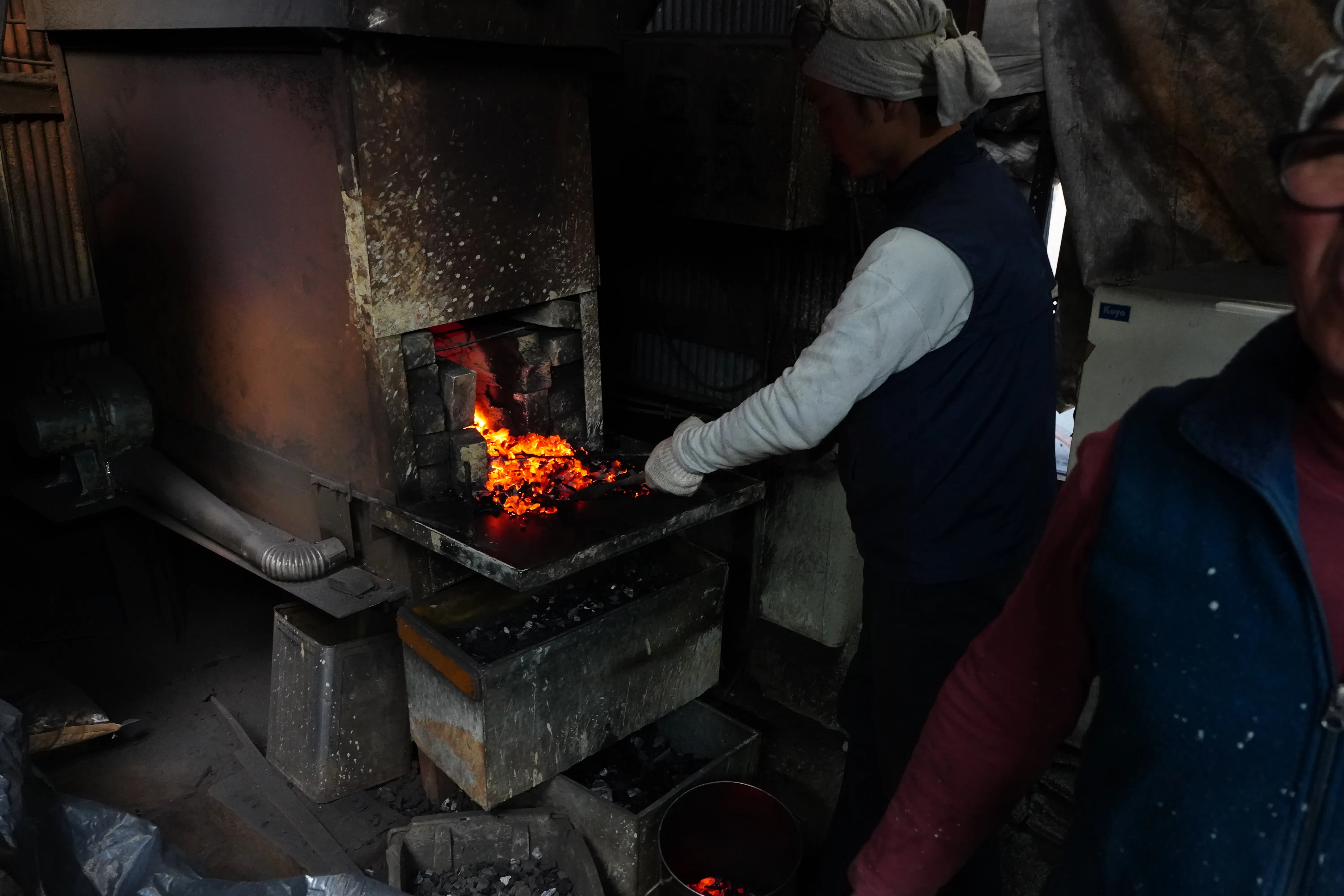
Workshops lit mostly by the fire. Steel taken out orange, struck, put back. Then Takefu Knife Village in Echizen, its grinding rooms, and the people we had only ever known as names at the bottom of an email.
This is where all those emails had been going.
One knife at a time.
The first hundred knives sold one at a time.
By 2020 a handle workshop in Europe had joined the blacksmiths, and by 2022 the company had outgrown its first name, Japana Home, and became Oishya.
And we kept going back.
Japan, spring 2019
Back in the spring.
Fuji from the water, a forge again, and cherry blossom on the way to everywhere.
Some steps belong to machines, because they should be identical every time. The hammering, the finishing and the sharpening stay in human hands.
Nara, April 2019
A day off, and a lot of deer.
The deer in Nara bow for biscuits. They do not always wait to be offered one.
Ten years in. The same direction for ten more.
Today Oishya ships to twenty-eight countries. We work with blacksmiths in Sakai and Seki, and with the handle makers, board makers and workshops in Europe that finish what arrives from Japan. Every knife that leaves us has been touched by between three and five people whose names we know. It carries a 5 yen coin and a hand-carved hanko stamp, and it is covered for life.
The price is what a knife costs to make properly. We work at the blacksmith's pace, which sometimes means ordering two years ahead, because some blades simply take that long. We would like to make the knife a daughter inherits, the one a chef reaches for first. Same workshops, same craftsmen, same standards. More countries, more years, more meals.
If you are reading this, you are part of it, whether you have had an Oishya for nine years or found us tonight. Thank you for caring about the small things in your kitchen. We'll see you on the other side of a meal.
Kamila and Anna
“Every family has a recipe that came from somewhere. We make the tools that carry those recipes forward.”
Our mark
The kamon.
A kamon is a Japanese family crest. Ours is adapted from a traditional three-fan crest, the kind worn on samurai armour, with the fans turned. We chose it as a quiet tribute to the onna-bugeisha, the women samurai whose dedication, precision and bravery we hope to honour in every blade we send out.
You’ll find it on the sleeve of every Oishya box, woven into the warrior’s armour. When you see it, the knife inside is a true Oishya.
What to read next