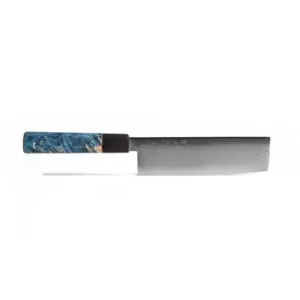
A good knife is one of the few presents that gets used every single day. It sits in the hand at breakfast and again at dinner, and in ten years it is still there. That is why so many people choose one for Christmas, for a wedding or for someone who has just moved into their first proper kitchen. It is also why choosing one feels like a big decision.
This guide is for the person doing the giving. You do not need to know what HRC means or which steel is harder. You need to know a little about how the person you love cooks, and we will help with the rest.
Start with how they cook
Forget the knife for a moment and picture their kitchen. Do they cook most nights, or mainly at weekends? Is it a busy family kitchen with children and a dishwasher that gets loaded in a hurry, or a calm one where knives are washed by hand and put away? Do they grow vegetables, bake bread, roast a chicken on Sundays?
Those answers matter more than any specification. A knife that suits the way someone already cooks gets reached for every day. A beautiful knife that asks for more care than they will give it ends up in the drawer.
Which knife to give
If you are giving one knife, give a chef’s knife. It does most of the work in any kitchen. The question is only which shape.
A Santoku is the safest choice for most people. It is a little shorter, with a flatter edge and a rounded tip, and it feels nimble and unintimidating in the hand. It suits someone who chops vegetables, slices onions and does everyday family cooking.
A Gyuto is the Japanese chef’s knife, longer and with a gentle curve towards a pointed tip. It suits someone who already cooks with confidence, carves a roast or prefers a longer blade.
A Bunka sits between the two, with a flat edge for push-cutting and a sharp angled tip for fine work. It is the choice for someone who enjoys a knife with character.
If you are still unsure, choose the Santoku. Very few people are unhappy with one.
When a set makes more sense
About a third of our orders are sets, and for a wedding or a new home it is often the better present. Our sets pair a chef’s knife, either a Gyuto or a Santoku, with a Nakiri for vegetables and a Petty for small, precise work. Those three cover almost everything a home cook does. You can see them together on our knife sets as gifts page.
Choosing the line
Each of our lines suits a different kind of cook, and this is where knowing their kitchen pays off.
For a busy household where the knife will be used hard and occasionally forgotten on the side, the Sakai Kyuba KYU is the forgiving choice. It is forged in Sakai from AUS10 stainless steel in 46 layers of Damascus with a hammered finish, and it is the easiest of our knives to live with.
For someone who cooks every day and will sharpen a few times a year, the VG10 lines from Seki, KATA and RYU, take a very fine edge and are still straightforward to care for. KATA is a three-layer blade with a clean look; RYU carries 33 layers of Damascus.
For the person who sharpens their own knives on a Sunday afternoon and talks about steel at dinner, SHIN uses SG2 powdered steel in 31 layers. It holds an edge for a very long time and is the line for an enthusiast.
And for someone who would love something unusual to look at, NIJI is made with layers of stainless steel, brass and copper, so every blade carries its own warm, rainbow-toned pattern.
If you would rather answer a few questions than read about steel, our knife quiz takes about a minute and suggests a knife based on how they cook.
The handle colour
Our handles are stabilised maple burl with a bog oak collar, made in Poland, and most knives come in Mediterranean Blue, Olive Green or Natural Brown. Olive Green is the colour most people choose at the moment. Natural Brown is the quietest and suits almost any kitchen. Mediterranean Blue is the one people notice. If you know their kitchen, match the wood and the light in it. If you do not, Natural Brown or Olive Green are hard to get wrong.
Is it bad luck to give a knife?
In Japan, as in many cultures, a knife given as a present is said to cut the bond between giver and receiver. The tradition has a gentle answer: the person receiving the knife gives a small coin back, so the knife is bought rather than given.
That is why every Oishya knife comes with a 5 yen coin in the box. The 5 yen coin has a special place in Japan because its name, go-en, sounds like the word for a good connection. Your recipient hands it back to you, and the knife becomes theirs with the friendship intact. We have written more about it in is it bad luck to gift a knife.
What arrives in the box
Each knife comes in a handcrafted oak box wrapped in our Onna Bugeisha illustration, a female samurai drawn for us, with a hanko stamp and the 5 yen coin. It is designed to be opened slowly. It is also the box many people keep the knife in for years.
Every knife carries our lifetime guarantee, and you have 100 days to return it if it is not right. That matters with a present. If you have chosen a Gyuto and they would have preferred a Santoku, it can be changed.
Plan around the making time
Our knives are made by hand, so some pieces are made to order. The product page shows the current making time for each knife and colour. If you are buying for Christmas, check that line before you order and allow for delivery after it. If a date matters, write to us at info@oishya.com before you order and we will tell you honestly what is possible.
Something to go with it
A knife is only as good as what it meets. A wooden board protects the edge every time it is used, and our Aomori Hiba board is soft enough to be kind to a Japanese blade. A 1000/6000 whetstone keeps the edge for life, and a magnetic oak stand keeps it off other metal. Any of the three is also a lovely present on its own for someone who already owns a good knife. You will find more ideas on our gifts for cooks page.
Frequently asked questions
What is the best Japanese knife to give as a gift?
For most people a Santoku. It is versatile, comfortable and easy to use. Choose a Gyuto for a confident cook who likes a longer blade, or a set of three for a wedding or a new home.
Is a Japanese knife a good present for a beginner?
Yes, if you choose a forgiving one. A stainless steel knife such as the KYU or KATA is easy to look after and will make cooking more pleasant from the first meal.
Why is there a coin in the box?
Japanese tradition says a gifted knife cuts the bond between two people. The recipient gives a coin back so the knife is bought, and the 5 yen coin is chosen because its name sounds like the Japanese for a good connection.
Can a knife be returned if it is the wrong one?
Yes. You have 100 days to return it, which leaves plenty of time after Christmas to change the shape or colour.
Handcrafted Japanese Knives by Oishya
Forged by master craftsmen in Seki and Sakai, Japan. Free worldwide shipping over £270 • 100-day money-back guarantee • Lifetime warranty