Last updated: April 2026
A Japanese kitchen knife is not merely manufactured. It is born from a tradition stretching back over 600 years to the swordsmiths of feudal Japan. When you hold one of our knives, you are holding the result of dozens of individual steps, most performed by hand, in workshops where the craft has been passed down through generations. This is the story of how a Japanese knife comes to life.
Two cities, two traditions
Japan’s knife-making heritage is concentrated in two cities: Sakai and Seki. Both produce world-class blades, but their approaches differ in ways that matter to cooks.
Sakai, in Osaka Prefecture, has forged blades since the 14th century. When Portuguese traders introduced tobacco to Japan in the 1500s, Sakai’s smiths began making the knives used to cut tobacco leaves, and the shogunate granted them an official monopoly. Today, Sakai produces around 90% of Japan’s professional kitchen knives. The process here is deeply traditional: each knife passes through multiple specialist craftsmen, each responsible for one step.
Seki, in Gifu Prefecture, is known as the “City of Blades.” Its history begins with swordsmiths in the 13th century who were drawn to the area by its pure water and high-quality clay, both essential for traditional blade-making. Seki has embraced modern manufacturing techniques alongside traditional methods, producing knives that blend precision engineering with handcraft.
Our Sakai Kyuba knives come from Sakai, while our Seki Kyuba knives are forged in Seki. Same commitment to quality, different personality.
Step 1: Selecting and preparing the steel
Everything begins with the steel. For our Damascus knives, multiple layers of different steel types are stacked together, sometimes as many as 46 layers. The core layer is the cutting edge: a hard, high-carbon steel like VG10 (in our RYU and KATA lines) or SG2 powdered steel (in our SHIN series). The outer layers are softer stainless steel that protects the core and creates the distinctive Damascus pattern.
For our NIJI series, the layering includes brass and copper alongside steel, 37 layers total. When etched, these different metals reveal a rainbow pattern that is impossible to replicate with steel alone.
Step 2: Forging
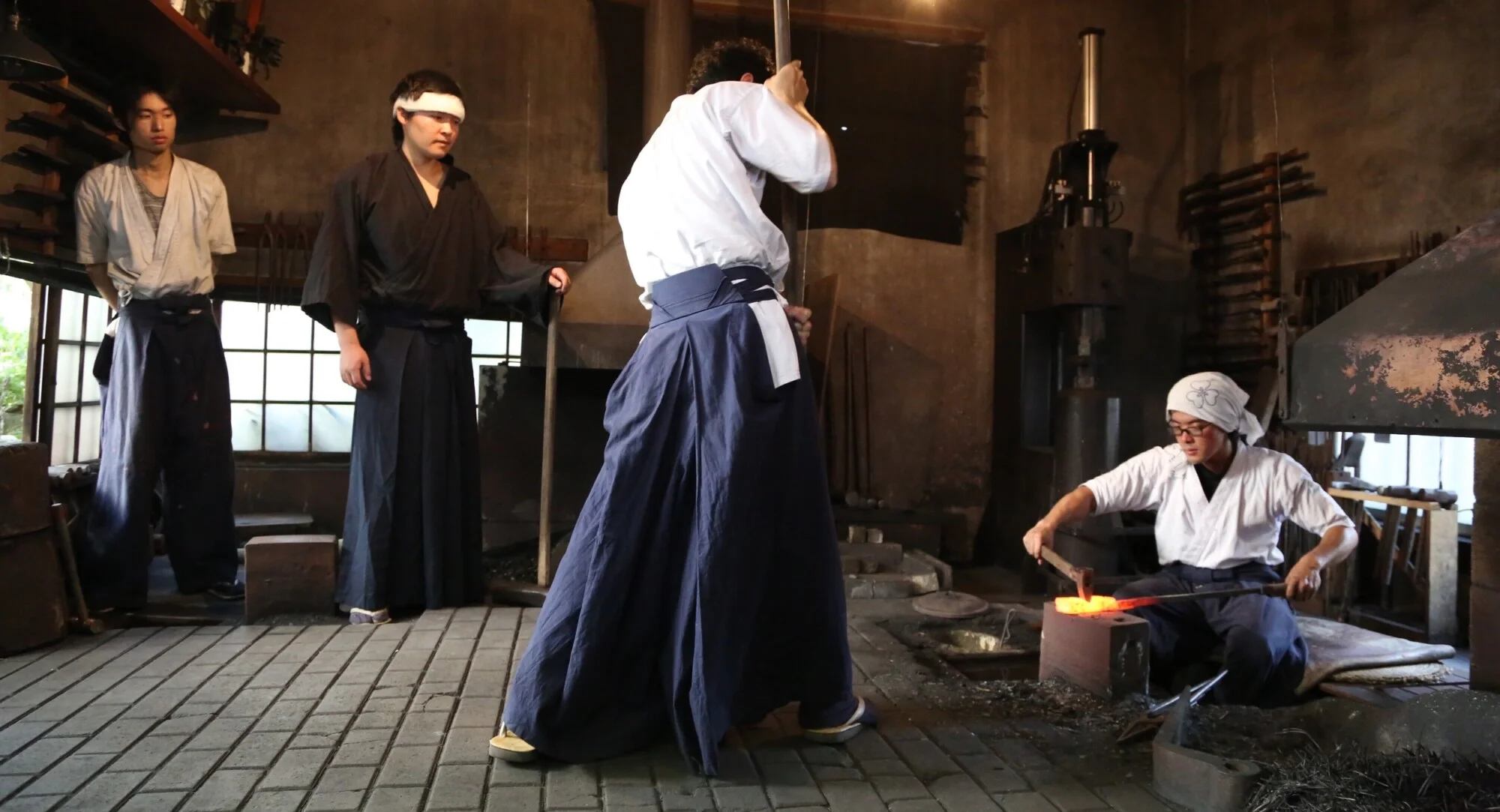
The stacked steel is heated to approximately 1,100°C, hot enough to glow bright orange, and hammered to fuse the layers into a single billet. This process is repeated multiple times: heat, hammer, fold, heat, hammer, fold. Each fold doubles the layer count, and the repeated forging refines the grain structure of the steel, making it stronger and more uniform.
In Sakai workshops, this is still done with power hammers guided by a smith who reads the colour and behaviour of the metal by sight and sound. The temperature, force, and timing of each blow are critical, too cold and the layers delaminate, too hot and the carbon burns out of the steel.
Step 3: Rough shaping
The forged billet is heated again and hammered into the rough shape of a blade. The smith works from thick to thin, drawing the steel out to the correct length and taper. At this stage, the blade looks nothing like a finished knife. It is a rough, dark slab of metal with the general proportions of the final product.
Some of our knives, like the SHIN series, retain a hand-hammered (tsuchime) finish on the blade flats. These hammer marks are not decoration, they create tiny air pockets between the blade and the food being cut, reducing friction and preventing sticking.
Step 4: Heat treatment (quenching and tempering)
This is the most critical step, and the one that separates a mediocre knife from an exceptional one. The blade is heated to a precise temperature (determined by the steel type) and then rapidly cooled, a process called quenching. This transforms the molecular structure of the steel, making it extremely hard.
But pure hardness is brittle. So the blade is then tempered: reheated to a lower temperature for a specific duration, which slightly reduces hardness but dramatically increases toughness. The exact temperatures and timing are closely guarded secrets in most workshops.
Our VG10 blades are hardened to approximately 60-61 HRC (Rockwell hardness). Our SG2 blades reach 63-64 HRC: among the hardest kitchen knives in the world.
Step 5: Grinding and sharpening
In Sakai, grinding is a separate speciality. The togishi (sharpener) is a different craftsman from the smith. The blade is ground on a series of progressively finer whetstones, first to establish the blade geometry (the angle, thinness, and taper) and then to create the cutting edge.
A Sakai togishi may spend 30 minutes or more on a single knife, working through 4-5 different stones. The final edge is sharp enough to shave hair, and the evenness and symmetry of the grind determine how the knife will perform for its entire life.
This is also where sharpening your knife at home connects to the craft. When you use a whetstone to maintain your edge, you are performing a simplified version of what the togishi does at the factory. Our whetstone guide can help you learn this skill.
Step 6: Etching (Damascus blades only)
The Damascus pattern is invisible until the blade is dipped in acid. An acid bath (typically dilute ferric chloride) reacts differently with each layer of steel, darkening some and leaving others bright. The result is the flowing, organic pattern that makes each Damascus knife unique. No two are exactly alike.
For our NIJI knives, the etching reveals not just light and dark steel but also the warm tones of brass and copper layers, creating the signature rainbow effect.
Step 7: Handle making and assembly
Japanese knife handles are works of art in themselves. Our handles use premium hardwoods: walnut for the RYU series, ebony and magnolia for the KYU series. The wood is seasoned, turned on a lathe, and fitted with a bolster (the metal collar between blade and handle) before the tang of the blade is inserted and secured.
The balance point of a finished knife, where it sits naturally when you lay it across your finger, is carefully calibrated. A well-balanced knife feels effortless; a poorly balanced one causes fatigue. Our artisans adjust handle weight and shape to ensure each knife style balances perfectly for its intended use.
Step 8: Final inspection and quality control
Every knife is individually inspected before it leaves the workshop. The edge is tested for sharpness and consistency, the handle is checked for fit and finish, and the blade is examined for any cosmetic defects. Knives that do not meet the standard are sent back for correction or recycled.
When a knife reaches you, it carries a certificate of authenticity documenting its origin, steel type, and the craftsmen involved in its creation.
Why craftsmanship matters in the kitchen
It would be cheaper and faster to stamp out knife blades from sheet steel and bolt on plastic handles. Many companies do exactly that. But the difference in the hand is immediate and lasting: a hand-forged blade cuts more precisely, holds its edge longer, and feels more alive in your grip.
Japanese knife-makers have spent centuries perfecting a process that makes cooking more precise, more enjoyable, and more respectful of ingredients. When you invest in one of their knives, you are not just buying a tool. You are participating in a tradition that connects your kitchen to six hundred years of craft.
Explore our collection of handcrafted Japanese kitchen knives and find the blade that was made for your kitchen.
Handcrafted Japanese Knives by Oishya
Forged by master craftsmen in Seki and Sakai, Japan. Free worldwide shipping over £270 • 100-day money-back guarantee • Lifetime warranty