Veggie Knives
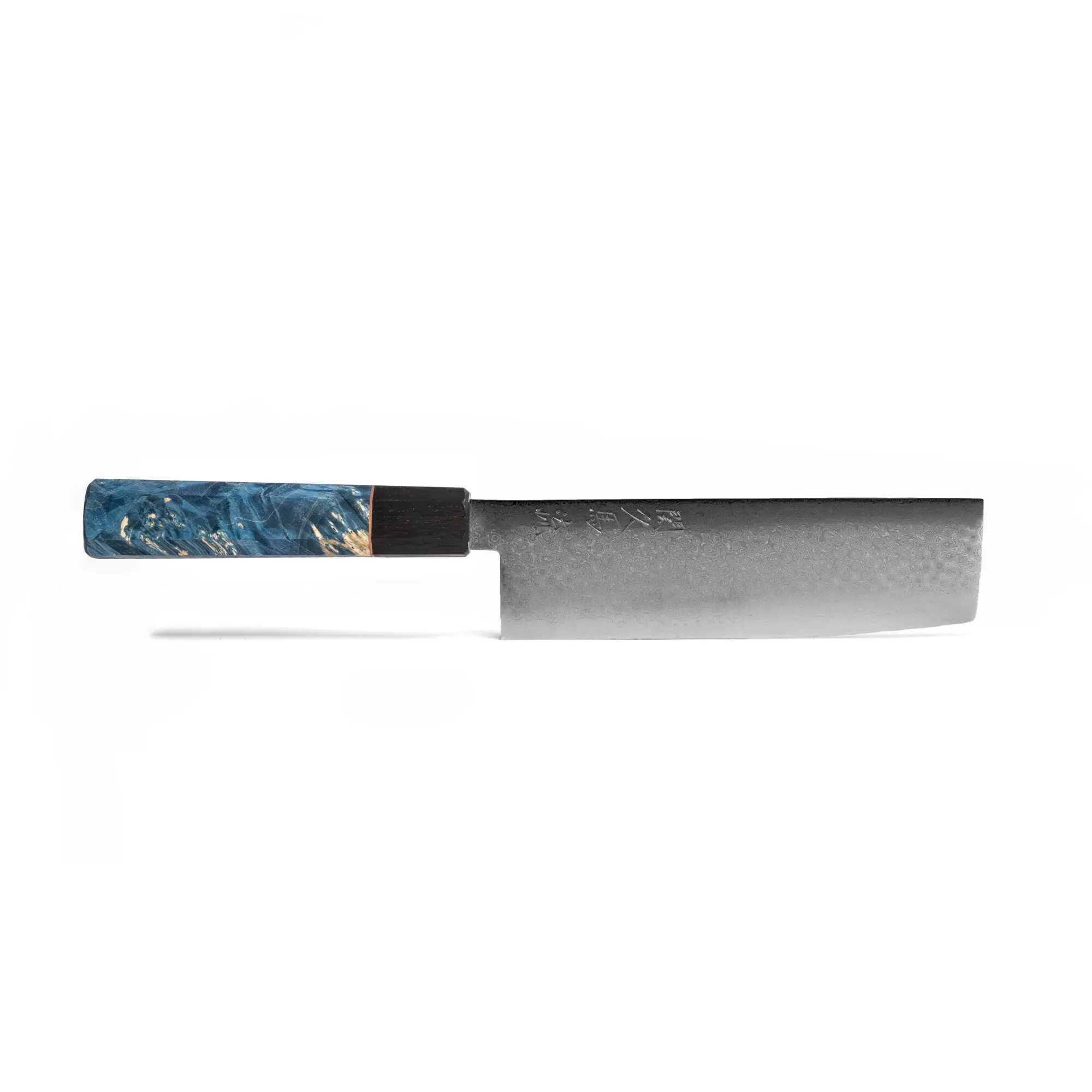
Japanese Nakiri knives are the Japanese style knives used mostly for cutting vegetables. They feature a thin, wide blade with a flat cutting edge, which makes them ideal for clean, precise cuts.

Why a Nakiri Knife Is the Best Tool for Vegetables
The Nakiri was purpose-built for one thing: processing vegetables quickly and cleanly. Its flat cutting edge makes full contact with the cutting board along the entire length of the blade, so every downward stroke produces a complete cut without the need to rock or saw. This is particularly valuable when working with leafy greens, where a single clean pass produces uniform shreds, and when slicing root vegetables, where the wide blade keeps your knuckles safely above the board.
The thin blade profile of a Japanese vegetable knife also matters more than most cooks realise. A thinner edge creates less resistance as it passes through dense produce, which means cells are sliced rather than crushed. The practical result is that onions release fewer irritating compounds when cut, herbs stay vibrant rather than bruising, and delicate vegetables like tomatoes retain their shape and juice. Our Nakiri knives, available in 16cm and 18cm across the KYU, KATA, NIJI, and RYU lines, range from 58 to 63 HRC on the Rockwell scale, allowing an edge angle fine enough to make this difference apparent from the very first cut.
Nakiri vs Santoku: Which Should You Choose?
This is one of the most common questions among cooks exploring Japanese knives for the first time. Both are excellent kitchen tools, but they serve different roles. A Santoku is a general-purpose knife with a slightly curved belly and a pointed tip, making it capable of slicing, dicing, and performing light protein work. A Nakiri, by contrast, is a specialist: its flat edge and squared-off profile are optimised purely for vegetables.
If you already own a gyuto or Santoku as your primary chef’s knife, adding a Nakiri gives you a dedicated vegetable tool that will noticeably speed up your prep. The flat edge excels at the straight up-and-down chopping motion and tap-cutting technique that make short work of large volumes of produce. If you cook a lot of plant-heavy dishes, stir-fries, or salads, a Nakiri will quickly become one of the most-used knives in your kitchen.
Choosing the Right Nakiri for You
Our Nakiri range spans four distinct lines, each with its own character. The Sakai Kyuba KYU Nakiri is hand-forged in Sakai from Aogami Super carbon steel, delivering the sharpest possible edge and a blade that develops a unique patina over time. The Seki Kyuba KATA Nakiri uses VG-10 stainless steel for low-maintenance performance that resists staining from acidic produce. The NIJI line offers an accessible entry point without compromising on sharpness, while the RYU Damascus Nakiri pairs VG-10 steel with a stunning 67-layer Damascus pattern for cooks who value both beauty and function.
All Nakiri knives ship from our European warehouse with a 100-day money-back guarantee. Browse our complete Japanese knife collection to see how a Nakiri fits alongside the rest of your kitchen tools.
What is a Nakiri knife used for?
A Nakiri is designed specifically for cutting vegetables. Its flat edge makes full contact with the board in a single downward stroke, producing clean, uniform cuts through everything from leafy herbs to dense root vegetables. While it excels at vegetable prep, it is not intended for cutting through bones, hard-skinned squash, or proteins with connective tissue.
Is a Nakiri better than a Santoku for vegetables?
For pure vegetable work, yes. The Nakiri’s flat cutting edge and wide blade are purpose-built for the straight up-and-down chopping motion used in vegetable prep, making it faster and more precise than a Santoku for this task. However, a Santoku is more versatile overall, as its curved belly and pointed tip allow it to handle proteins and detail work as well. Many cooks find the ideal setup is owning both.
What size Nakiri should I get?
Nakiri knives are typically available in 16cm and 18cm. The 16cm blade is ideal for smaller hands or compact cutting boards, and it handles most everyday vegetable prep comfortably. The 18cm blade offers a wider cutting surface, which is helpful when working with larger produce like cabbage or aubergine. Most home cooks find the 16cm perfectly sufficient, while those who regularly cook in larger quantities may prefer the 18cm.
Do Nakiri knives need special care?
Nakiri knives benefit from the same care as any quality Japanese knife. Hand wash and dry immediately after use, store on a magnetic rack or in a blade guard, and sharpen on a whetstone as needed. Carbon steel Nakiris, like our KYU line, require a bit more attention to prevent rust, including prompt drying and occasional oiling. Stainless options like the KATA and RYU are more forgiving but still should not go in the dishwasher.