https://www.finecooking.com/article/how-to-choose-a-chefs-knife
Why buy a chef’s knife?
A chef’s knife is an all-purpose, versatile knife with a blade that usually measures around seven to nine inches. Long blades can be a bit intimidating to newbies (I was certainly a bit daunted at first), but you’ll quickly grow accustomed. Of course, cooking is personal, and if you want to do all your chopping and slicing with a small paring knife, that’s your prerogative.
A chef’s knife, however, will become your most important kitchen utensil. According to Justin Kowbel, co-founder of Borough Kitchen cookshop, you’ll use it about 70pc of the time, so it’s worth spending a little more for a quality blade. “You can get away with just two knives if you have a good chef’s knife,” Kowbel says.
Speaking with several chefs in researching this article, it became clear that cooks build a real bond with their knife. Richard Bainbridge, chef owner of Benedicts Restaurant in Norwich, says: “Your knife is your old friend that sticks with you through thick and thin. If you want to cook well, build a relation with your knives.” Scott Smith of Fhior in Edinburgh agrees. “Your knife is the most fundamental tool of your craft, you need to look after it the best you can. The oldest knife I have is 13 years old. When you have a knife for that long it becomes an extension of you – you understand the weight, become comfortable with its size and using it becomes second nature,” says Smith.
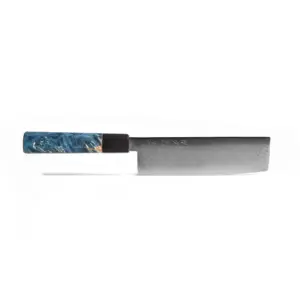
Few chefs are as infatuated by knives as Henry Harris, chef-director of The Hero of Maida, The Coach and Three Cranes. Harris owns around 100, and uses a dozen or so regularly. “A sharp knife, and the right knife for the task at hand, is the chef’s most important tool,” Harris adds. With a very good nakiri (a Japanese vegetable knife), Harris explains, you can chop onions without spraying juice everywhere, meaning you won’t cry – the same can be said for a good, sharp chef’s knife.
Chef’s knives aren’t perfect for everything . You may struggle to carve meat, peel a potato or slice bread – and, for me, a paring knife works better for mincing garlic, for example. But for your overall, everyday chopping, it’s a real workhorse.
What are the most important features to look out for?
There are several important features determining a good knife. A sharp, robust blade is paramount. Good-quality steel (most tested are stainless steel, which is easier to look after, but carbon and Damascus steel are having a resurgence) is sharp, durable, easy to clean, strong and flexible. Ceramic knives – sharp but brittle – haven’t been included in this test.
“Comfort and balance are absolutely key,” says Laurie Timpson, founder of Savernake Knives, which produces handmade knives in Wiltshire. When holding a well-balanced knife properly, with forefinger near the heel, it should feel equally weighted on each side, so neither the blade nor handle is significantly heavier than the other.
A good handle is crucial for comfort. It should be smooth with no jagged edges, but the material shouldn’t affect the overall quality. It could be a grippy silicone, a beautiful wood, or Pakkawood – just make sure it sits comfortably in your hand.
Weight should also be considered. You don’t want something too heavy. If doing long shifts – cutting for half an hour or more – something too cumbersome will eventually tire you out. “Lightweight knives are easier to move around and less tiring. If you have a sharp knife, it’s your muscles rather than the weight of the blade that’s doing the cutting. A heavy knife is to be avoided,” Timpson explains.
On the other hand, a light and flimsy knife isn’t great either. Cheap knives tend to be light – as do very expensive ones (though light and sturdy rather than light and flimsy). Mid-range blades can be a bit heavier, but none of those tested were too weighty.
What material should the knife blade be?
Stainless steel, carbon steel, Damascus steel and ceramic are the most common types of chef’s knife blades. Carbon steel and Damascus steel knives are making a comeback, with artisan manufacturers producing beautiful tools, like Blenheim Forge in London or Joel Black in Herefordshire.
Carbon steel looks rustic, and stays sharp for longer than stainless steel. But it rusts quite easily and is difficult to maintain. “Some people like the patterning on the side, it develops a story and a patina that looks rustic,” says Timpson. “If you like that sort of stuff, go for it, but I can’t see the point.” They can also be quite expensive.
Damascus steel, also known as wootz, was a historic method of blending strong brittle steel with soft, malleable, ductile steel, in order to get a perfect blend. “This was fantastic for the time,” says Timpson. They are currently popular for their beautiful patterning, and high-end manufacturers make very good ones. “I’d still suggest if you’ve got a really high-tech blade, made from one homogenous bit of really good quality steel, it will outperform the Damascus,” says Timpson, who focuses on stainless steel at his Wiltshire workshop.
Why go for stainless steel? Firstly, it’s pretty good at resisting rust and corrosion, unlike carbon steel. Stainless steel is softer, which means it’s easier to sharpen – although this can mean they’ll lose their edge quicker than carbon steel. They are fairly durable and won’t chip or rust easily. As they don’t require a protective non-stick coating, it’s unlikely the knife will alter the taste of your food.
“Cheap stainless steel is terrible,” Timpson explains. “It’s not very durable, nasty to get an edge on, and can’t be hardened. But if you buy a really good stainless steel these days, in terms of being able to take an edge, hold the edge, get sharp and all of that, a good stainless steel will be identical to good carbon steel.”
Does it need to be forged?
Knives can be cast or forged. Casting involves pouring molten metal into a mould and waiting for it to harden; forging indicates a piece of metal is heated until soft then bashed into place. Brands often make a big song and dance about forged knives, but it isn’t necessarily an indicator of quality. It can be handmade, with a master craftsman in a cavernous workshop hammering it into shape. “It’s a very skilled thing to do,” Timpson says.
But many mass-produced, machine-made knives are also forged. Big machines will get a piece of molten metal and stamp it. “Look at a machine-made knife, perhaps a Wüsthof Dreizack Classic,” writes Hayward. “It has been forged by giant machines exerting unimaginable force, ground by computer-guided mills precise to a micron in their choreography. This is one of those objects that represents the pinnacle of what human science, design and technology can achieve.”
Timpson agrees that mass manufactured forged knives (which make up most of those tested) can be done very well. “I just wouldn’t get excited by things being forged just because they say they’re forged. It’s not the be all and end all,” he says.
What’s better: a Japanese or Western knife?
There are countless knife traditions around the world, each developed over centuries to cater to a particular culture, cuisine, or aesthetic. Western knives have developed mainly from French and German traditions. French knives tend to have straighter blades, while German-style knives curve along the cutting edge. Increasingly, Japanese-style knives are becoming popular in Western kitchens, but what are the main differences?
While there is plenty of crossover these days (Japanese-style knives are commonly made in Europe, incorporating typically Western features), there are still some defining features. Western knives tend to use a softer steel (measured by the Rockwell scale: 53 is very soft, 64 is hard but brittle). There will also be a full tang, meaning the knife will have a spike coming out of the end of the blade, onto which a handle is attached. Western knives tend to be heavier too.
The advantage of a softer steel is that it’s easier to hone and keep in top condition. A good Western knife will range from about 56 to 58 on the Rockwell scale, while a Japanese might go up to 64 (hard and brittle, so they can chip easily).
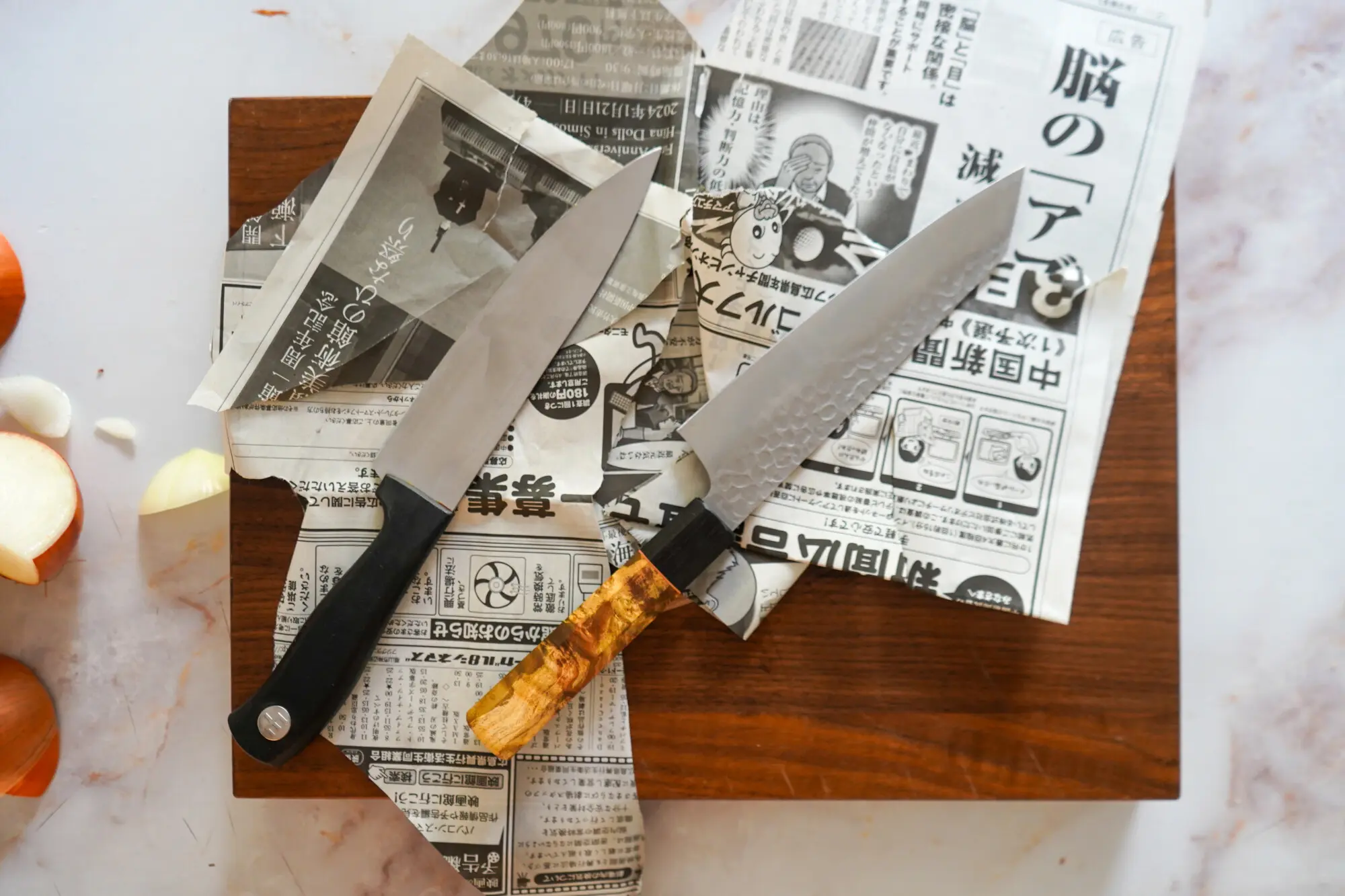
The most popular Japanese-style knife right now is the santoku, which is relatively all-purpose and thus measures up against a Western chef’s knife. Japanese knives have a finer-angled blade (around 15-17º compared with around 20º). They often have a single bevel, which means they are only angled on one side of the blade, enabling very fine slicing – ideal for extremely thin potatoes or onions, for example. This means they tend to be right- or left-handed, whereas Western knives are ambidextrous. Japanese knives tend to be harder to sharpen (not helped by the hardness and brittleness).
While they can be a thing of beauty, and incredibly nice to cook with, Timpson warns against going Japanese for the sake of it, as “Japanese isn’t necessarily a synonym for quality. A huge number of them are banged out in a factory in Osaka, which is the Japanese equivalent of Reading. They’ll have 1,000 years of Samurai tradition written on the box, but it can be a bag of sh*te.” Many of the Japanese knives Timpson receives to sharpen are chipped or have a tip missing, mostly because they’re used for Western-style cooking, which they’re not necessarily geared towards.
Harris, though a big fan of Japanese knives, agrees they’re more high maintenance: “the blades are thinner, they require more care, and you can’t sharpen them on a steel, unless you want to mess them up.”
How to look after your knife
There are several important aspects to knife maintenance: storage, washing, honing and sharpening, as well as using the right chopping boards. Caring for your knife, according to Timpson, is “absolutely vital”. The following advice is for stainless steel knives.
Using a wooden or richlite chopping board is preferable to plastic. Never put in a dishwasher, which amounts to “attacking” the knife, as the salt, hot air and water will ruin the edge, if not the side of the blade; it won’t come out as sharp as it went in. Hand wash as soon as you’ve finished using it (Timpson says, if cutting acidic foods like onions, you’d be ill-advised to even pick up the phone and leave your dirty knife behind, as the acid will begin to corrode the blade). After washing, wipe it dry.
Honing and sharpening are crucial to maintaining efficacy – and they’re not the same thing. When chopping through produce onto the board, you’re not necessarily blunting the blade but, because you won’t cut up and down at a perfect angle, it will misalign slightly. Honing brings it back to shape. You should hone regularly – a professional chef will do so every time they cook. “You’re not removing any metal, or damaging the knife, just conditioning it,” Timpson explains.
Eventually you’ll have to sharpen. Timpson reckons a well looked after knife requires sharpening a couple of times a year, with the best method being a whetstone. There are several good instructional videos online, but “not Gordon Ramsay slashing up and down like an idiot.” After sharpening, which removes steel, a leather strop will get rid of the burr (the rough leftover edges).
Storing a knife is very easy – don’t keep them in a draw. “That’s the biggest mistake people make, even some chefs. It’s just criminal, you’re going to damage the edge or blunt the knives,” Harris laments. Rather than expose your knife to a severe bashing in a draw, keep it in a knife block, a bristle block or – my favourite method – on a knife magnet.
Avoid gimmicks
“Knife making isn’t rocket science,” Timpson says. “If you can’t see the point of something, or a manufacturer is trying to explain it to you using things you don’t understand, it’s probably bulls***. When they bang on about sharpness – I can sharpen a banana to cut a tomato. It’s not about how sharp you can get it initially, it’s about how sharp is stays.”
Timpson points to other things to be wary of, including steel described using various numbers and letters, or magic knives with holes in them. Dimpled knives (scalloped) however, do tend to stick less to the food than non-dimpled, in my experience.
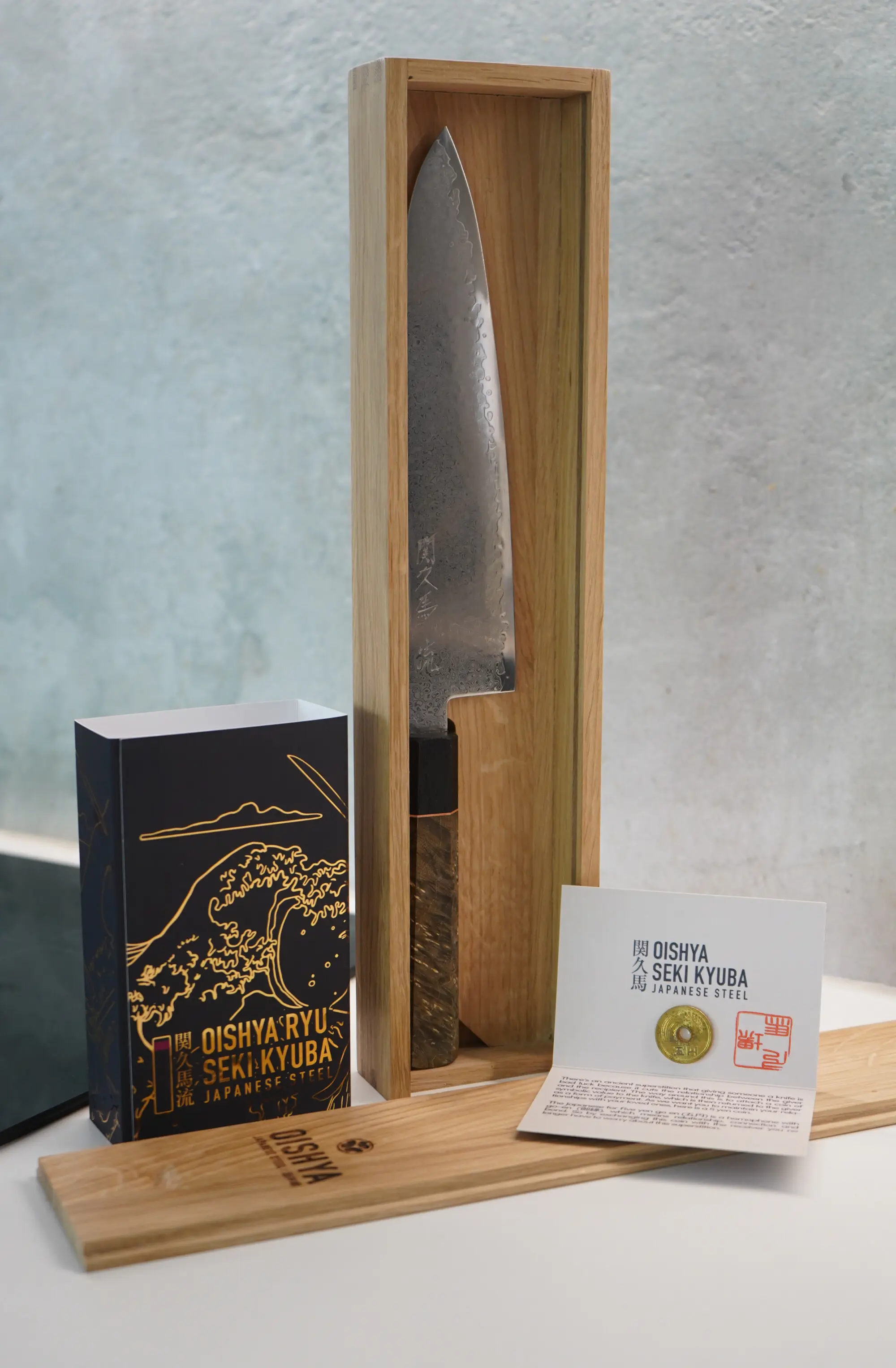
First thing to say is that, upon opening the box, you’ll be met with a stunning product. The dark maple handle, etched with traditional patterns, is a sight to behold. It’s comfortable to grip, and very well balanced in the hand.
But, most importantly, the knife cuts well. It’s got a razor-sharp, all-purpose blade that is equally as useful with meat as with fruit and veg. Chiffonading herbs is easy as can be.
There’s no doubt it’s a wonderful knife, one that’ll last you a long time if treated well. Its superb balance inspired confidence in the user. I found it a little light to my liking, but I know many people who find chef’s knives intimidating, so this could be the one for them. It’s also rather expensive, but there’s no doubting the quality.
Handcrafted Japanese Knives by Oishya
Forged by master craftsmen in Seki and Sakai, Japan. Free worldwide shipping over £270 • 100-day money-back guarantee • Lifetime warranty