
Gyuto: the chef's knife that does almost everything.
A long, gently curved edge for slicing, chopping and the daily work of a kitchen.
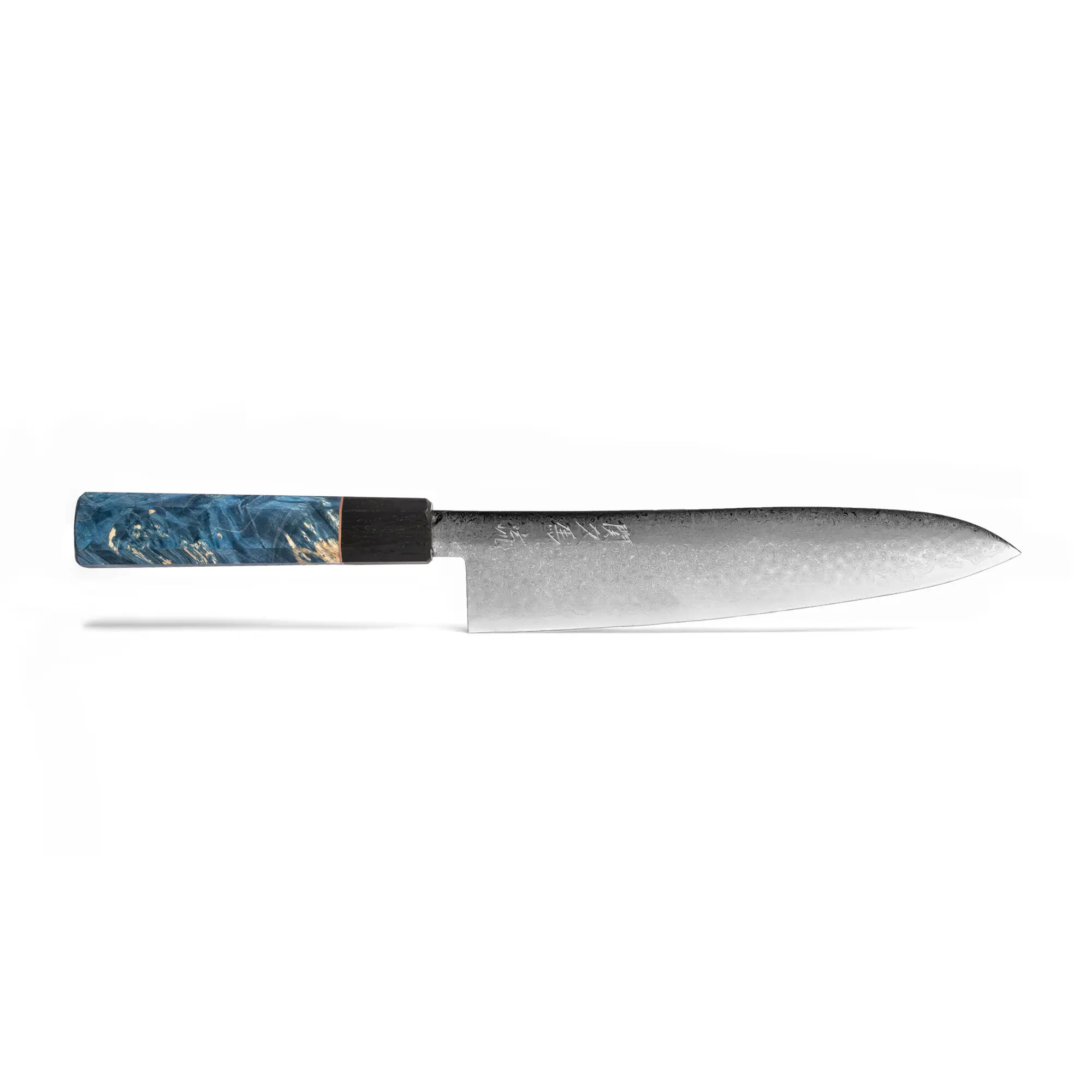
Gyuto literally means “cow knife”, but Japanese cooks long ago adopted it as the general-purpose chef’s blade. Its length and gentle curve let it rock through a stack of herbs, slice a chicken breast clean in one pass, and break down most of what a home kitchen throws at it.
If you can have only one Japanese knife, this is the one we’d put in your hand. Common sizes are 18–24cm. A 21cm Gyuto is the standard. If your hands or your counter run smaller, the 18cm Santoku (the Gyuto’s flatter cousin) is the easier place to start.
Available across our lines
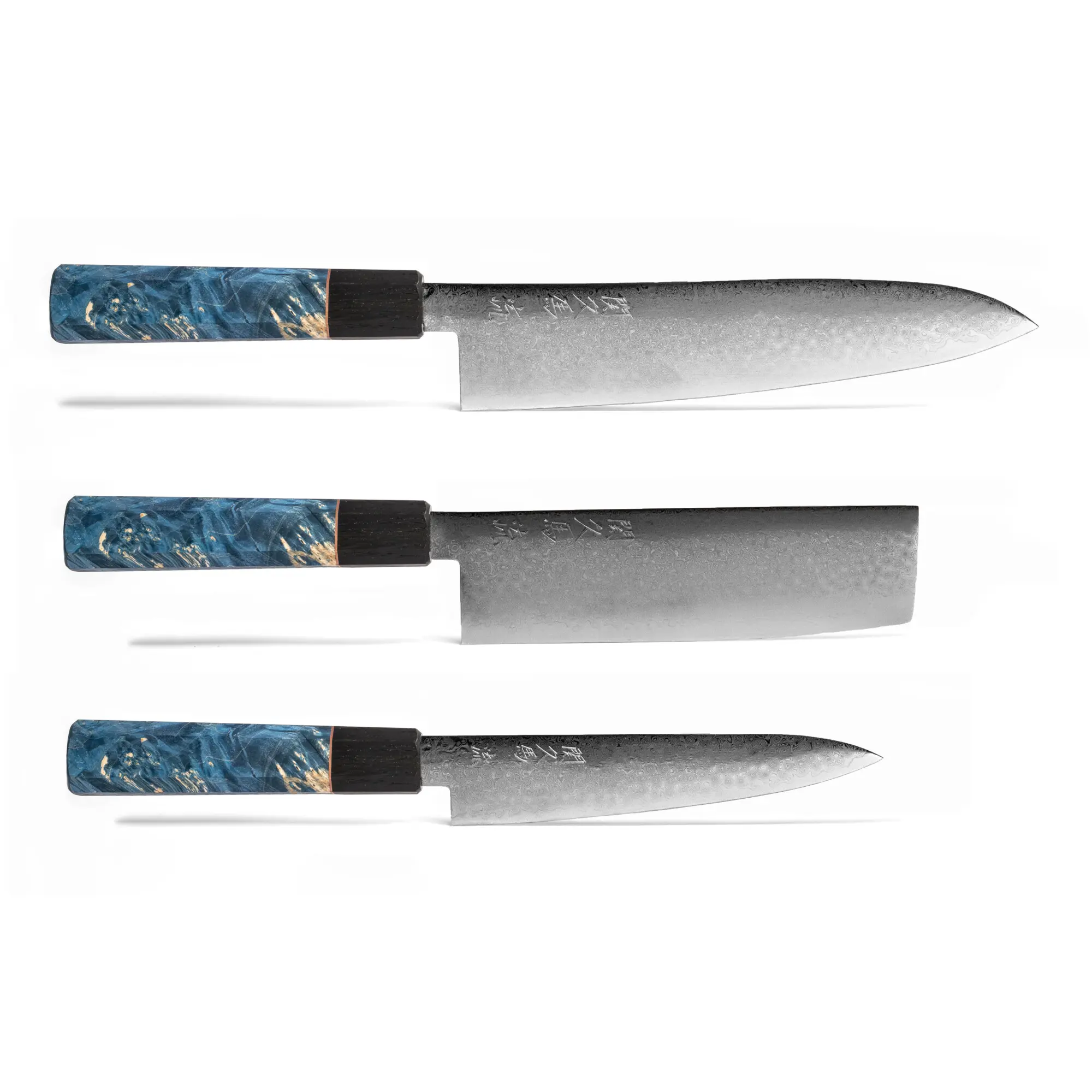
The same shape, made four ways.
We forge a Gyuto in four of our six lines. Choose the steel, the pattern and the feel.



Choosing your gyuto
21cm or 24cm? A 21cm gyuto suits most home kitchens and most hands. Go for 24cm if you have a deep counter and a big board, and often break down large cuts, squash or whole cabbages. Our 24cm is in the SHIN line.
Which steel? Every gyuto we make is hardened to HRC 60–62, a harder edge than most European chef’s knives, so it stays sharp for longer. KYU uses AUS10 under 46 layers of Damascus, RYU uses VG10, NIJI uses 12Cr18MoV in a 37-layer Damascus with copper and brass, and SHIN uses SG2 powder steel, which holds its edge longest of the four.
Gyuto or santoku? The gyuto’s curve lets you rock through herbs and slice in long strokes. A santoku knife is shorter and flatter, made for straight up-and-down chopping. We put the two side by side in santoku vs gyuto.
Left-handed? All our gyutos are sharpened on both sides, so they work the same in either hand.
A note on care
Hand wash and dry immediately. Wooden cutting boards only. Sharpen on a 1000/6000 whetstone three or four times a year. The full method lives in Knife School.
Not sure which line?
A couple of questions, one knife. The quiz reads how you cook and points you to the line that fits.